Pot-bellies require a bath from time to time, although excessive
bathing can dry out their skin. Most piggies just love the water, and enjoy
being scrubbed and brushed, but the whole bathing ritual may be pretty
scary to them at first. Be very careful not to frighten your little 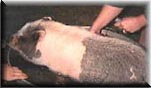 piggy during bath time, and do not get water in your piggy's ears. The
first couple of baths will probably tax your patience, but just think about
how your little piggy feels. They don't know what to expect, so all they
have to go on is their trust in you.
piggy during bath time, and do not get water in your piggy's ears. The
first couple of baths will probably tax your patience, but just think about
how your little piggy feels. They don't know what to expect, so all they
have to go on is their trust in you.
When the weather is warm and sunny, we bathe Piggy outside in a galvenized
tub filled with lukewarm water. On cold days, we'll wash her in a shower
stall inside. We installed a shower head and expandable hose that was long
enough to reach her. We use Johnson's Baby Shampoo, (tearless), because
its mild, and if a little soap does get in her eyes, it won't burn. After
the bath, we dry her off with a towel, and rub a little baby oil all over
her. It is important to oil your piggy every so often so the skin stays
soft and supple, and free of the scalies.
Our piggy was relatively easy to housebreak, as most of them are.
I strongly believe in crate training, repetition, and keeping house pets
on a regular schedule. It took less than 2 days of "accident free" training
for piggy to learn to go to the door when she needed out, or wanted to
come in. I'm sure you've heard the old adage, "an ounce of prevention is
worth a pound of cure". Well, it definitely has merit. I developed a routine
that was designed to avoid accidents, rather than encourage them. In a
nut shell, house training requires constant monitoring for at least 2 to
3 days, and adhering to a regular schedule, even if it means waking piggy
up from a nap.
Piggies have cloven, or "split" hooves similar to a cow. Their little
hooves should be trimmed every 4 to 6 months, so the sooner you get your
little piglet started, the easier it will be for both of you. You'll need
a small rasp, and a special nipping tool, like the beak trimmer used on
parrots, or a set of small horse clippers. I suggest starting out by gently
rasping the hooves, and getting your piggy used to it. Handle your piggy's
feet and hooves as often as you can. When it comes time to clip the hooves,
be careful not to cut into the quick. You will probably have to add a little
belly-scratching before and during the trimming ritual to maintain piggy's
confidence. The main thing is to get your piggy used to the whole ordeal,
otherwise you'll end up spending $70 to $80 for a vet to do it, and they
customarily tranquilize the little porkers to get it done with the least
amount of effort.
|