Computers and the Writing Class
by Dorian Love
St Enda's Secondary School, Johannesburg
One of the very real brakes on effective student writing is its artificiality and lack of urgency. Most adults, when they write, do it with a deadline hanging over their heads like a sword of Damocles. Thank you letters need to be dispatched before family ructions develop, reports and proposals have to be completed by "Monday morning first thing", or CV's polished up ahead of an interview. I'm sure much homework is done with a similar sense of haste, but with far less urgency, and with little pressure to achieve any degree of polish.
A typical school essay, no matter how ingenious the attempt to make it relevant and real, is a set piece and everybody knows it. It will never be read by anyone outside of the classroom, and very few inside it for that matter. Of course, being the wonderfully inventive creatures that we are, English teachers have tried to make writing more real and relevant by publishing class newspapers or magazines, and these are pretty standard, I would guess in most teachers� repertoires. But if your class newspapers look anything like the ones I receive annually, then your disappointment probably matches my own. Tatty pieces of ruled A4 pages, or even nice crisp ones, are covered with carefully written articles on the latest gossip, false lonely hearts advertisements alongside interviews with the new Mathematics teacher and a bunch of teenagers who appear to have their own garage band called ThreePac, or something similar!
No matter how carefully presented, they lack something, and the content suffers as a result. Essays, on ruled paper, for filing away, or neatly transcribed in exercise books can never escape the look and feel of a first draft. It is my contention that nothing looks like the printed word except for the printed word, and unless students can see their work in print, they will never be motivated to finish their work with any degree of precision.
The In Print Project
Background
How many students ever get to see their work in print? Writing letters to a real newspaper, even contributing to a school magazine are the preserves of the class Wordsworth or Dickinson, the same names dominating the creative writing section.
With these thoughts in mind, and as the computer laboratory in my school began to blossom, I decided last year to initiate a writing project this year which would motivate students by giving them a chance to produce professional-looking publications. I have no idea how successful or otherwise the project will be, so this paper is very much "work in progress".
In the last term of last year I took student writing given to me in the course of the year and did the project myself as a trial-run. Reasonably satisfied that with the technology available I could run the project, I prepared some cue sheets and worksheets to use as spurs to action.
The rise of the personal computer, and relatively cheap desktop publishing programs has ensured that many schools have, or could have access to the tools with which meaningful attempts to publish class newspapers and magazines could be made. If your school is lucky enough to have an adequately equipped computer lab, then your task is made that much easier as the students will have access to lengthy computer time. But even if your school does not have a single computer, here are a few tips on emulating professional layout.
Each of my English classes is organized in writing circles, groups of about 5 or 6 students who are jointly responsible for reading each others� drafts, editing, discussing and encouraging each other. I tend to set formal writing exercises every other week, leaving a period every fortnight for free writing, a catchall term for journal and student-initiated writing.
I decided to introduce a new regime for my writing circles. Every student was now obliged to produce one piece of writing in print every term, and I started allocating time during free writing periods for this. Each writing circle was given a folder with ideas and writing assignments for free writing periods, of which the In Print assignment was one component. The file also contained cards (example here) on which I had printed ideas, layout conventions and suggestions on how to proceed with particular projects.
Technical issues
I let each writing circle decide what kind of periodical they wished to produce in the belief that it was best to encourage as wide a brief as possible. Students were then allowed to work on their own contributions, with time allocated in the computer lab as the deadline approached. The plan was for the typed files to be imported into the layout program I use, Quark Xpress and for a group of students who are both in my English and Computer Studies class to help do the layout, and learn some DTP at the same time.
I am priviledged in that I am both an English teacher and the Computer Studies teacher, so I have a great deal of control over who goes into the lab and when. You might have to book computer time. A suggestion might be to institute a policy in your school which will allow language students computer time on a regular basis. This can be justified either as "language across the curriculum", or as "computers across the curriculum"! Try and butter up the computer teacher at any rate.
If you do not have professional layout programs, don�t despair because word processors have improved to meet the challenge, and programs like Microsoft Word, Corel WordPerfect and Lotus WordPro allow precise positioning and re-sizing of graphics and the placing of text in columns for the authentic look of a magazine or newspaper. Recently Sun Microsystems have released their Office suite StarOffice for free!!! This can be downloaded from the internet, or a CD purchased for a small consideration. Watch the computer magazines which have CD's attached, as I'm sure the suite will be released on one of these soon!
You can usually import photos and line drawings in the format in which they are scanned, so you don�t even need sophisticated graphics programs like Photoshop. If you do not have a scanner, then you can photocopy and place the graphics in boxes created to accommodate them. If not, you can photocopy pictures and glue them into the copy before photocopying the final publication.
It is imperative that you avoid all temptation to say to students, "Give me your work and I�ll type it out for you!" I made this mistake several years ago when I attempted a once-off publication at a school which had no computer equippment. Not only will your family life be consigned to the dustbin, the students will learn nothing to boot. Always remember that they must do all the work. Your job as a teacher is to advise and orchestrate. All technical difficulties can be overcome, even if it means putting an old type-writer in your classroom and letting students type up their articles in column widths during breaks and after school.
You should, I believe, put some of your own writing in the odd class periodical because it is important for students to see you writing original material. Just as I think it is important for teachers to read during reading periods, I think teachers need to write during writing periods, tempting as it is to mark scripts. I normally spend about half a period writing, and the rest circulating to give advice.
"What if I'm not a very good writer?" I hear a strangled cry. This is no bar to providing a model for students, and it is no excuse to hide behind. At the very least one should try out the exercises one sets, and show students that we all struggle to write and polish our writing. Nevertheless one's own writing is likely to provide some inspiration to students, if only in that writing is seen as important enough for adults to engage in, and that it is not just something inflicted on teenagers!
Assessment
The idea is, and to date this has not yet been reached, that once the pieces have been entered on a computer, and the layout done, the periodicals will be printed and collated, and then distributed or even sold to other students. Students are required to give five copies to the library and one to me.
When thinking about what form of assessment to use, I have settled on self-assessment. I toyed with the idea of not formally assessing the project so that the point that it is intrinsically worthwhile would be most graphically made, but decided against this in the end. For so major a project not to earn marks seems criminal. There should be some reward for hard work!
I have adapted the following self-assessment form to use. I have used this basic form for project-work many times before and found it very effective. A week after the projects are handed in a report-back period is used. Each group has to justify the mark they gave themselves in front of the often harsh criticisms of other groups, and me, having had a chance to view the project.
Feedback and Results
So, with the deadline now come and gone, how did the writing circles do? In fact the first deadline was missed by all but one group, due in part to computer failure - the lab was out of commission for two weeks - an excuse I pounced on to allow extra time. Most groups are currently entering text and scanning pictures frantically, with the first Quark documents being played out, the revised deadline is two days away! Results to date look fairly similar in content to previous class magazines, but look much more impressive because they are being produced with professional software. I have been particularly impressed by the amount of work that has gone into the creation of original artworks (in MSPaint).
Examples of work done
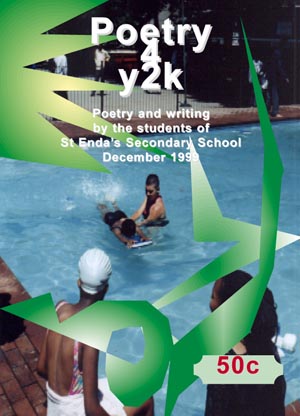
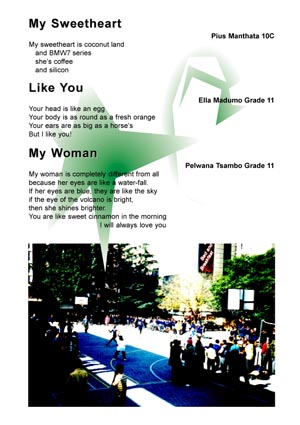
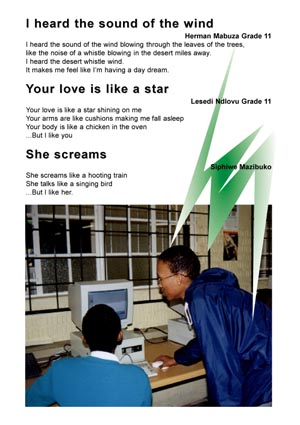
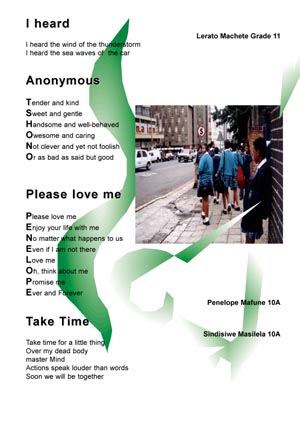
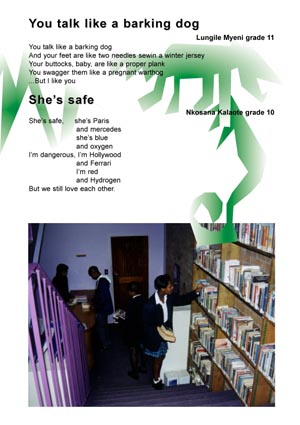
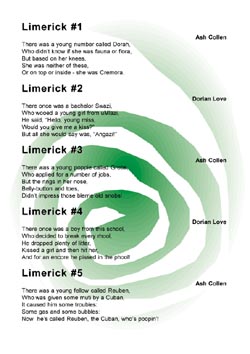
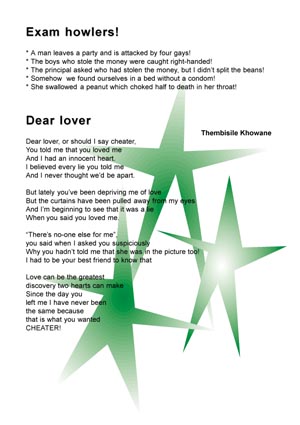
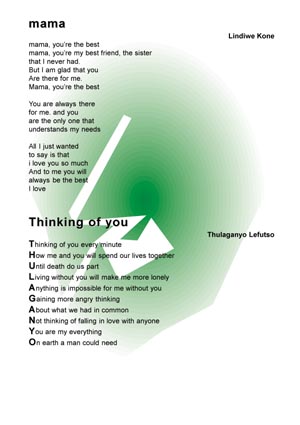
Examples of the results of the above projects are not yet available. A link will be placed here as soon as they are available. Below is the poetry journal I did at the end of the year, from student poetry given to me. Notice that I put a few of my own poems in, including a Limmerick duel between myself and the HOD English, Mr Ash Collen. We have an annual game in which we try to come up with the best Limmericks while invigilating exams - don't tell the G.D.E!