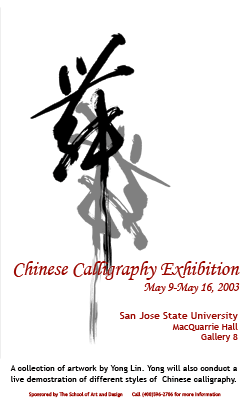
This is a poster that I created in Photoshop.
I used the traditional Chinese calligraphy style for this poster.
The Chinese word is "dance." If you look carefully, you can see a person dancing.
However, not all artists write this word like this.
You will find other ways of writing this word.
It depends on the style of the artist.
Here is a little history of Chinese calligraphy from
Art of Chinese Calligraphy.
Over the thousands of years, the style of Chinese calligraphy has evolved continually.
About 213 B.C., under the famous Chin Shih Huang Ti, who perpetrated the 'burning of the books',
the Prime Minister Li Szu drew up an official index of characters and unified the written
form for the use of scholars. This is chuan-shu and contained more than 3,000 characters.
From that time to the present, there are five major styles of calligraphy: seal script, clerical script,
standard script, semi-cursive script, and cursive script."
|
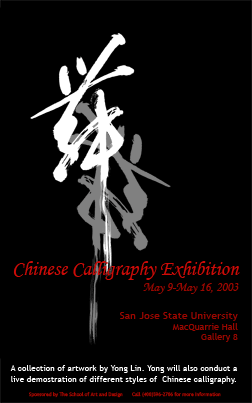
This is another design of the previous poster.
Using black background and white for the calligraphy gives this poster a western taste.
Here is an introduction to Chinese calligraphy from
Asiawind Art Gallery.
"During the imperial era, calligraphy was used as an important criterion for selection of
executives to the Imperial court. Unlike other visual art techniques,
all calligraphy strokes are permanent and incorrigible,
demanding careful planning and confident execution.
Such are the skills required for an administrator / executive.
While one has to conform to the defined structure of words,
the expression can be extremely creative.
To exercise humanistic imagination and touch under the faceless laws and
regulations is also a virtue well appreciated.
By controlling the concentration of ink,
the thickness and adsorptivity of the paper,
and the flexibility of the brush,
the artist is free to produce an infinite variety of styles and forms.
In contrast to western calligraphy,
diffusing ink blots and dry brush strokes are viewed as a natural
impromptu expression rather than a fault.
While western calligraphy often pursue font-like uniformity,
homogeneity of characters in one size is only a craft. To the artist,
calligraphy is a mental exercise that coordinates the mind and the body
to choose the best styling in expressing the content of the passage.
It is a most relaxing yet highly disciplined exercise indeed for one's
physical and spiritual well being. "
|