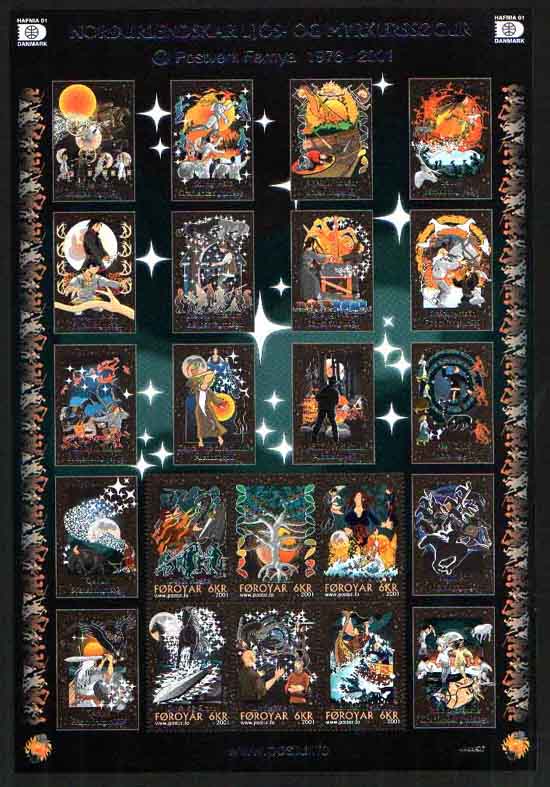
Date of
issue.- 01/04/2001
Values.- 6 x 6,00 DKK
Numbers.- FR 388 - FR 393
Sheet size.- 171 x 250 mm
Perforation.- 14 per 2 cm
Printing.- Offset
Desing.- Anker Eli Petersen
Printer.- Cartor Security
Printing, France
More information about this
issue:
Sun and Moon - Inuit myth from
Greenland
The motifs are based on two myths from eastern Greenland,
"Sun and Moon" and "The First Humans".
Sun and Moon were originally two siblings, who, having
committed incest, ended up in an eternal pursuit in the sky.
The myths also tell of the mighty fire people who live
beyond the horizon, and have it that the Northern Lights are the spirits
of the dead playing football with death's skulls (the stars).
The orphan - Inuit myth from Greenland
A fascinating tale about two orphaned siblings who, even
after the mighty shamans had given up trying to save the settlement from
starvation, made a spiritual journey to the Mother of the Sea. There they
cleaned the Sea Mother from all the filth that sticks to her when humans
don't follow their ancestors' conventions. They also combed her hair so
she would release her prey again.
The second half of the tale is about how the boy, who
is probably a symbol of the moon, humiliates a great shaman with his magical
powers.
Sun and Moon, Bil and Hjuki - Icelandic myth
As a punishment for his blasphemy, the gods took the
children of Mundilfari (he who walks in circles), Sun and Moon, and set
them to steer the sun and moon chariots.
Moon is also followed by two children, the girl Bil (brief
moment) and Hjuki (bent, bowed), who represent the phases of the moon.
The sword in the tree - Icelandic myth
During a celebration hosted by King Volsung, a one-eyed
man appeared in the hall and drove a sword deep into the oak tree growing
in the middle of the room. All the guests tried to draw the sword from
the tree, but no one managed it except Sigmund Volsungson (the father of
Sigurd the Dragonslayer). His brother-in-law King Siggeir of Gautland offers
to buy the sword, but Sigmund is not interested and gives him a contemptuous
reply. This is the introduction to the violent incidents related in the
Volsunge saga.
The death of Hogne - From the Faroese "Hognes ballad"
The Hognes ballad is about how Gudrun Jukedaughter avenges
the death of Sigurd the Dragonslayer by killing her own brothers. Finally
only Hogne is left alive, and then Gudrun calls for the terrible Tidrik
Tattneson. While they are duelling, Tidrik transforms himself into a flying
dragon and belches his venom on Hogne. When Hogne, doomed to die, asks
King Artala that evening to provide him with an earl's daughter for the
night, he says that he carry no wounds on his body. But what was it that
killed him?
The tree of the year - Faroese riddle
The riddle about the tree of the year is a good example
of our ancestors' sense of symbols. Here the year is compared to a tree,
with the months being represented by thirteen branches. The weeks are symbolized
by birds' nests, four on each branch. The days of the week are symbolized
by six birds in each nest, and the seventh, Sunday, has golden feathers.
The Harp - Faroese ballad
The song about the harp is a Faroese variant of a common
Norse ballad, which also exists in an English version. The story is about
two sisters, the younger is pale and beautiful, the elder dark and ugly.
The elder sister lures the younger down onto the beach and drowns her.
Later the dead body drifts back onto the shore and is found by two wanderers,
who make a harp from one of the arms and use the hair as strings. The wanderers
then go to the elder sister's wedding and ask if they may play the harp
for the guests. When they start to play, the strings start to accuse the
bride of her sister's murder. Blood begins to flow from the bride's chest
and she dies of anger. The ballad probably has its origin in ancient beliefs
that the moon is the corpse of the sun. In its waxing or waning phase the
moon bears as a certain resemblance to a harp. The elder sister is probably
a symbol of the darkness of the night.
Gram and Grane - From Faroese ballads
Just as well known as cultural hero Sigurd the Dragonslayer
are his horse Grane (the grey one) and his mighty sword Gram (the voracious
one). When Sigurd has to choose a horse for himself, he walks down to the
riverbank, where the horses are grazing, and throws a stone into the water.
All the horses flee except Grani, and so he becomes the chosen one. Later,
when Sigurd named his sword, it was lying on the smith's floor between
two rivers. Grane may be the Pegasus constellation, while Gram may be the
Swan, which actually looks like a sword. The river in question may be the
Milky Way, which divides into two strings just below the Swan.
The Ballad of Nornagest - Faroese ballad fragment
The Ballad of Nornagest is one of the old Faroese lays.
In this ballad, which unfortunately only exists in fragments, the elderly
Nornagest relates the heroic deeds of Sigurd the Dragonslayer to an unnamed
king. Among other things, the old man tells a strange story about Grane,
who by an accident happens to get stuck in mud and has to be pulled out
again. Nornagest, who was a young lad at the time, led the mighty horse
down to a river and washed the mud from him. From that day Nornagest was
one of Sigurd's men. Grane, stuck in the mud, may be a symbol of the Pegasus
constellation, which looks like the front half of a horse.
Gudrun's evil magic - From the Faroese "Hognes ballad"
When Hogne Jukeson and his brothers are on their way
to the fatal meeting with Gudrun, their sister, their ship is almost wrecked.
This is because Gudrun is sending her evil magic in the shape of wild sea
horses and storm-eagles. The weather becomes so furious that the brothers
only
survive by using the runic stick their mother gave them to resist Gudrun's
magic.
This incident may be inspired by the constellations of
Pegasus and the Eagle, which both lie close to the Milky Way, the great
river of the heavens. Horses and eagles occur surprising often in connection
with rivers in Norse and Finnish sources.
Peer Gynt - Norwegian legend
In the diverse world of Norwegian sagas and fairytales
there is a short legend about the mysterious mountain trapper Peer Gynt.
Peer Gynt is said to be a historical person, who had a tendency to include
himself in the action of ancient legends and sagas. In this case, Peer
Gynt and his dogs meet the mighty troll "Boigen", who has encircled them
in the dead of night. Boigen means something like: a circle, something
bent. The story may originally have been about Orion, the hunter of the
sky, who wanders in circles, followed by his two hunting dogs, Canis Major
and Canis Minor. The trolls, whom Peer meets later in the tale, are said
to be place names in the Norwegian mountain world.
Oskoreia - Norwegian superstition
In Norway's diverse cultural history you can find a very
strange phenomenon called "Oskoreia". Oskoreia is a troop of wild ghost
riders, galloping through the darkness, followed by barking and yelping
dogs. The phenomenon is known all over the Germanic world, in English culture
as the "Wild Hunt" or "Wild Huntsman".
King Skjold - Danish myth
Some of the oldest pre-English writings tell of a strange
event at the beginning of time. They say that a ship once came drifting
from the great sea and landed on the Danish coast. The only living creature
on board was a little boy, sleeping on a golden shield. Otherwise the ship
was loaded with tools and weapons. The Danes called the boy Skjold and
made him King of Denmark. During his reign Denmark flourished. When King
Skjold eventually died of old age, the Danes placed him on board the same
ship as he had arrived on and sent him back to the gods.
This legend probably originates from ancient conceptions
of the king of the sun, who sailed the arch of heaven in his ship.
Fenja and Menja - Danish myth
The Danish King Frode (grandson of Skjold) owned a mighty
grinding mill, which he kept going with the help of two giantesses called
Fenja and Menja. But Frode became too greedy and wouldn't let the sisters
rest, which resulted in them grinding destruction upon him. After the destruction
of Frode, Fenja and Menja were kidnapped by the sea king. But the sisters
ground so much salt from the mill that the sea king's ships sank and the
mill went down with them. Like the Finnish mill Sampo, the mighty grinding
mill was probably a symbol of the grinding heaven (the upper millstone),
which rotates above the Earth (the lower millstone).
The Ramsund rock - Rock engravings from Sweden
In Sodermanland in Sweden lie the well-known Ramsund
rock engravings. The motifs are from the myths about Sigurd the Dragonslayer.
Sigurd is frying the heart of the dragon when he burns himself and so puts
his finger in his mouth. From the blood of the dragon heart, wisdom and
insight come to Sigurd, and he becomes omniscient. In front of Sigurd lies
the beheaded smith Regin, and behind him stands Grani, tethered to a tree.
The rock engraving may be a star map in which the beheaded
Regin is Orion, the dog Canis major or minor, Grani Pegasus, the bird the
Eagle, etc., etc.
Gefion - Swedish myth
The stories tell how Odin once sent Gefion, one of the
Asynjas, to King Gylfi of Sweden. The king promised her as much land as
she could plough in one day and one night. Gefion then ploughed a huge
piece of land from Gylfi's kingdom and moved it westwards into the sea.
Where Gefion had ploughed, a great lake called Logur appeared (Mälaren
in Sweden). The land she took from Gylfi was called Selund, the Danish
island of Zealand. But there are things that indicate that Selund was originally
a symbol of the Milky Way.
Beivve - Sami goddess of the sun
On the upper part on the Scandinavian peninsula, from
Norway, across Sweden and Finland, into the Kola peninsula of Russia lies
Sápmi, the land of the Sami people. Just like the Inuit of Greenland
and the Finns, the Sami have their own language and culture, which are
not related to Norse culture.
In the ancient religions of the Sami people there are
many fascinating creatures of nature, including Beivve, the goddess of
the sun and messenger of the spring.
The fratricide - Sami myth
Among the Sami sagas you will find the tale of how evil
came into the world. Attjis, who married the moon daughter, takes his brother
Njavvis's home and place from him. When Njavvis hunted a wild reindeer
and didn't wait for his brother, Attjis killed him with the reindeer's
antlers. As a punishment for his crime, Attjis was carried away from the
earth, up to the moon, where he now stands with his reindeer's antlers.
This story is probably a "light to darkness" saga.
The ghost horse in the wood - Saga from Aland
In the Bay of Bothnia, between Sweden and Finland, lie
the Aland islands. Aland is a Swedish cultural area within the state of
Finland and is self-governing, just like Greenland and the Faroe Islands.
The motif for the first Aland picture comes from ghost
tales from the Marby Forest on the island of Eckero. Among several similar
stories you may find the tale of a man who, on a dark night, sees a gaudy
horse galloping through the forest, dragging a huge fireball.
The story is reminiscent of the Norwegian Oskoreia stories
and was probably once a "light to darkness" myth.
The girl with the apples - Riddle from Aland
In order to understand our sagas and myths, we should
maybe take a closer look at the riddles that can be found in every cultural
area around the world. Old tales, which often seem complicated and incomprehensible,
may sometimes make sense, if we interpret them as riddles. In this riddle
from Aland, the firmament is explained as the mother's sheet, the stars
as the father's money, and sun and moon as the sister's apples.
The singing match - Mythical lays from Finland
The motif is based on two Finnish lays called "The Singing
Match". When the young and aggressive Joukamoin's horse collides with old
Väinamöin's horse, these two cultural heroes get involved in
a singing match with each other. Old Väinamöin conjures young
Joukamoin down into the ground. To save his own skin, young Joukamoin promises
the old shaman his young and beautiful little sister.
The confrontation probably symbolises the struggle between
daylight (Väinamöin) and darkness (Joukamoin) at daybreak.
Sampo - Mythical lays from Finland
This too is based on two mythical lays from the Finnish
cultural area.
Together with Ilmarinen the Smith and young Joukahainen,
old Väinamöinen sails out to sea. They are heading north, bound
for Pohjola, the land of darkness. When they arrive, old Väinamöinen
steals Sampo, a mighty grinding mill. But Louhi, the scary mistress of
Pohjola, notices the theft and starts to chase Väinamöinen in
the shape of an eagle, which carries a thousand warriors on its wings.
In the struggle between Väinamöinen and Louhi, Sampo tumbles
overboard and is scattered into a thousand pieces.
Sampo, also called "The Bright Cover", is probably a
symbol of the starry sky (the upper millstone) rotating above the earth
(the lower millstone). When Väinamöinen, who is a symbol of daylight,
steals Sampo, he is engaged by Louhi, who represents the half light of
dawn. The daylight wins out over the darkness and the starry sky (Sampo)
is lost in the process.
Owing to the huge amount of source material used to make
this picture sheet, we have opened a special homepage on the Internet,
where the texts of the various ballads, sagas and myths are presented together
with interpretations of the sources. The homepage will be accessible from
12 February at the following Internet address: www.tjatsi.fo |