Date of
issue.- 01/04/2001
Values.- 3 x 4,50 DKK
Numbers.- FR 385 - FR 387
Sheet size.- 139.0 x 44 mm
Perforation.- 12 per 2 cm
Printing.- Steel plate printing
and photogravure.
Desing.- Czeslaw Slania
Printer.- Sweden Post.
More information about the
issue:
25 years of the Faroese Postal Service
The last 25 years only represent
part of the history of the Post Office on the Faroe Islands – it is actually
much older. The first branch post office was opened in Tórshavn
as long ago as 1870. At that time the Post Office was Danish and the Postmaster-General's
Office appointed the then Member of Parliament and Sheriff H. C. Müller
to look after the interests of the Post Office on the Faroe Islands.
Being a sub-postmaster was far
from easy during the first year. There were all sorts of acts, statutory
instruments and executive orders to comply with, the oldest of which dated
back to 1694. A new Post Office Act came into force on 1st April 1871,
repealing in the process 28 acts, statutory instruments, charges and statutes
from 1694 to 1868.
The postage on 18th February 1970
was 8 skilling for letters weighing up to 15 g and 16 skilling for 15-250
g. As early as 1st April 1871, however, the Faroe Islands were included
in the domestic, i.e. the Danish, tariff zone, where the postage was 4
skilling for letters weighing 0-250 g.
Before regular boat services were
established between the islands, a special transport system was required
to enable people from the different islands to exchange messages. This
system was called "Skjúts".
It involved a "Skjútsskaffari",
or agent, being appointed in every village with the duty of organising
a crew to transport people, letters or parcels from one village to another.
The Skjúts system was actually
introduced in around the mid-1860s, with the first Skjúts Act coming
into force in 1865.
Skjúts charges were laid
down by the Lagting, the Faroese Representative Council, for 5 years at
a time. There were three types of Skjúts: Official, Clerical and
Private. The charges for Skjúts varied, with Official being the
cheapest and Private the most expensive. There was no charge for Skjúts
prior to 1865.
All healthy males of between 15
and 50 years of age were liable for Skjúts, i.e. they could not
refuse without incurring a fine.
It was never an easy task to transport
mail from one island to another across perilous waters where there were
often powerful currents.
Peter S. Johannesen, who was one
of the first post carriers, tells of a letter delivery from the days of
Skjúts. The letter, which had to go from Tórshavn to Hvalba
on Suðuroy, was marked "K.T.", i.e. Kongelig Tjeneste (On His Majesty's
Service), and bore the endorsement "Uopholdelig Befordring" (For Immediate
Delivery), i.e. it had to be dispatched as soon as the weather permitted.
The letter was first given to the
Skjúts agent in Tórshavn, who immediately got hold of a man
liable for Skjúts. The man walked from Tórshavn to Kirkjubøur,
where he handed the letter over to the Skjúts agent in the village.
The agent got a boat with eight men to carry the letter to Sandoy – to
where the village of Skopun lies today. One of the men in the boat then
had to walk to the village of Sandur with the letter and hand it over to
the village's Skjúts agent, after which he returned to the boat,
which was still waiting for him. The Skjúts agent in Sandur then
got a man to walk to Dalur with the letter, after which it was carried
by boat from Dalur to Hvalba on Suðuroy. Here the letter was handed
over to the priest.
Owing to strong currents and bad
weather the Skjúts crew were unable to row back to Dalur that evening.
The weather worsened during the night and the men had to stay on the island
for two weeks.
The Skjúts system existed
right up until around World War I, but was not used as much by then, as
the Post Office's rates were relatively low and so represented a reasonable
alternative.
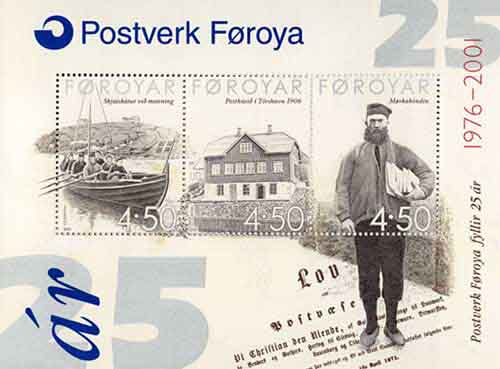
The block shows three motifs from
the history of the Post Office: a boat providing Skjúts, a postman
and the first post office in Tórshavn.It was the then sub-postmaster,
C. C. Danielsen, who started to build a new post office in the centre of
Tórshavn in 1905. The post office was finished a year later, with
the new building being occupied on 1st December. It was a historic event,
as this was the first time that a building had been erected specifically
as a post office.
The postman on the block is Simon
Pauli Poulsen, who was known as Mørkabóndin. He carried mail
from the village of Fuglafjørður.
Being a postman could be a dangerous
and risky job, and the history of the Post Office on the Faroe Island also
includes reports of fatal accidents. The first struck the 52-year-old Jacob
Eliassen, known as Jakki i Vági. In 1887 Jakki was on his way over
the mountain between Klaksvík and the village of Árnafjørður.
It was winter and the weather was bad, but the mail had to go out all the
same. On this particular winter day Jakki failed to reach his destination.
His body was later found lying on a ledge below the mountain crest from
which he had plunged.
The Post Office on the Faroe Islands
remained in Danish hands until 1976. After the Lagting elections of November
1974 the government decided that the Faroese Post Office should be taken
over by the Faroese Home Rule Government. The Danish and Faroese governments
entered into negotiations on this matter in 1975. The outcome of the negotiations
was that the Faroese Home Rule Government took over the Post Office on
the Faroe Islands with effect from 1st April 1976. This new institution
was called Postverk Føroya (the Faroese Postal Service). A ram's
horn was chosen as its logo. |