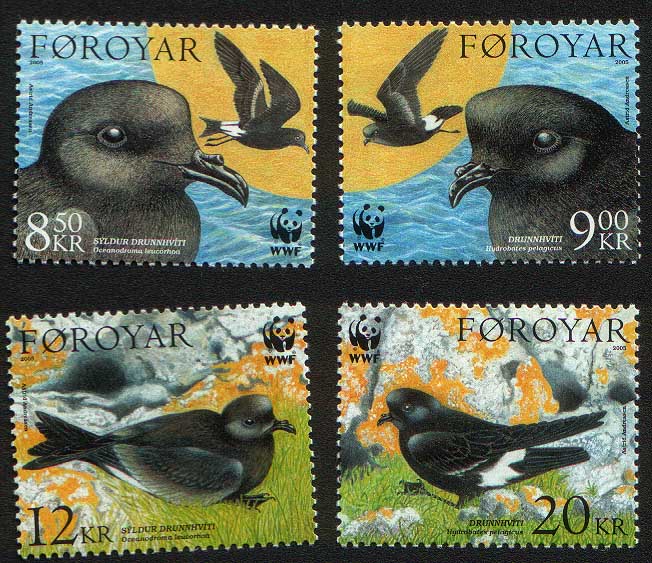
Date of issue.- 06/06/05
Values.- 8,50, 9,00, 12.00 and 20.00 DKK
Numbers.- FO 522 to FO 525
Size of stamp. 38.00 x 30.60 mm
Perforation.- 13 per 2 cm
Printing.- OffsetDesing.- Astrid
Andreasen.
Printer.- Cartor
Security Printing. France.
Birds of the order
Procellariiformes are seabirds that spend nearly their entire life out on the
open seas and only come ashore to breed. The petrels all have an extremely well-developed
sense of smell, which they use to find food and to return to their nesting site
at night. On land they are only seen flying in their colonies at breeding time.
The petrel’s worst enemy is the rat. Arctic skuas and gulls also take some of
the old birds, but the petrel tries to protect itself against them by coming
ashore in the dark. In some places domestic cats are also a great threat to old
petrels.
If the petrel is disturbed, it defends itself by spitting oil up from its
stomach. Like most other birds in this order of seabirds, the petrel has a very
distinctive smell.
The word “storm” is found in the common names of the petrels in several
languages. This is because “storm” petrels were often seen after a storm. The
Danish name translates literally as “storm swallow”, with the bird’s narrow,
pointed wings making it resemble a swallow at first glance. Its special beak and
webbed feet mean that it cannot be confused with ordinary swallows, however.
The petrel’s diet includes plankton (krill), small fish and squid, which it
catches by “walking” on the surface of the sea.
Storm-petrel
Weighing in at around 27 g, just 16 cm long and with a wingspan of 37 cm, the
storm-petrel is one of the smallest seabirds there is.
The world’s largest colony of storm-petrels is probably at Urðini on the island
of Nólsoy. The storm-petrol also breeds at other sites on the Faroe Islands, but
nowhere in the same numbers as on Nólsoy. The main range of the storm-petrel is
in an area between Island, Lofoten and Scotland. Around 30,000 storm-petrels
have been ringed on the Faroe Islands and it seems from ring sightings that the
birds overwinter in South Africa.
Life cycle: The first birds arrive on the Faroe Islands from South Africa at the
end of May. They usually nest under rocks. In July-August they lay a large,
white egg weighing approximately 7 g, which they then incubate for around 40
days. The chick is fed every night for about 50 days, by which time it is
overfed and the parents leave it. After 8-12 days it has lost so much weight
that it can take off and start its long journey to South Africa. The young
return home when they are 2 years old and start to breed when they are 3-4.
Leach’s petrel
With a weight of approximately 45 g, length of 21 cm and wingspan of 46 cm,
Leach’s petrel is slightly larger than the storm-petrel.
A couple of thousand pairs breed on the island of Mykines and Mykineshólm. The
main range of Leach’s petrel is on the coast of Newfoundland on the other side
of the Atlantic. In Europe they breed sparsely in the triangle formed by Norway,
Iceland and Scotland. It is thought that most of the birds overwinter off
tropical Africa.
Life cycle: The first birds return to their nesting burrow, which they have
often dug themselves, at the end of April. In May they lay a large, white egg
weighing approximately 11 g. The incubation period is 41 days. The chick is fed
every night for around 60 days, by which time it is so overfed that it is unable
to fly. The parent birds then leave the chick, which loses so much weight in
8-10 days that it can take off and start its long journey south towards West
Africa. The young return home when they are 2-3 years old and start to breed
when they are 4-5.
Their sense of smell is known to be of great importance to them when it comes to
finding their way “home” partly because an experiment was once conducted in
which their nostrils were blocked. It turned out that none of the birds with
blocked nostrils could find its nest.
Two birds were also once taken from their nest in New Brunswick, Canada, and
released in Sussex, England. Thirteen days later they were back in their burrow,
4,800 km from Sussex
|