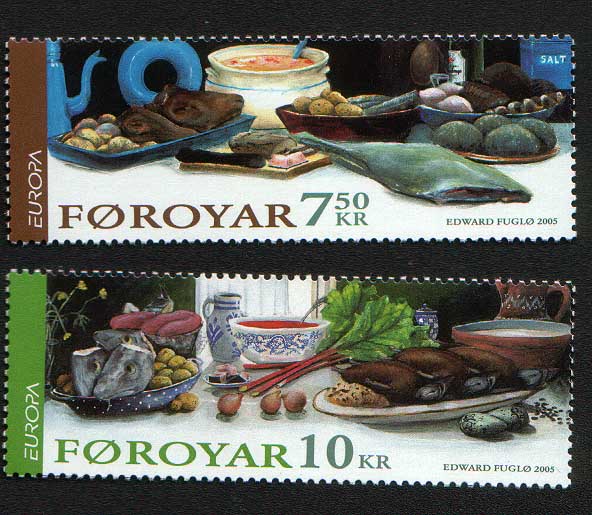
Date of issue.- 18/04/05
Values.- 7,50 and 10.00 DKK
Numbers.- FO 520 and FO 521
Size of stamp. 72.00 x 25.95 mm
Perforation.- 13 per 2 cm
Printing.- OffsetDesing.- Edward
Fuglo
Printer.- Cartor
Security Printing. France.
All over the world the
provision and preparation of food have always been an important part of national
culture, with countless variations being shaped by the possibilities to hand.
Climate has been crucial in terms of the type of food it was possible to
produce. Living in tropical countries and having to survive in the polar regions
will always be different, of course.
The original food on the Faroes came for the most part from the animal
population on the island, mainly sheep in the upland pastures, birds on the bird
cliffs and fish in the sea. The climate is not the best for cultivating cereals,
vegetables, etc., so they were not of great importance.
Potatoes did not become a regular ingredient in the daily diet until the late
19th century, although people had long been familiar with them. Instead they
used to boil Faroese swedes (Brassica) for dinner, for example.
The seasons set their stamp on eating habits. Fish was more or less available
all year round, but mostly in the spring, when it provided roe in addition to
liver. The opportunity to eat other fresh food arrived at the same time as
spring fishing (March – April). Cows usually calved in spring, so there was most
milk in summer. Birding and egg collecting (nest plundering on the bird cliffs)
were also part of the summer, while the chances of catching pilot whales are
greatest in August, when people could also go out into the potato fields and
pick new potatoes. In autumn the men went up into the mountains to bring the
sheep in for slaughtering. Nearly every bit of a slaughtered sheep was put to
good use. As well as the meat, people used the head, trotters, liver, lungs,
heart, stomach and blood (the collective Faroese word for which is avroð).
Since ancient times the only way to keep most foodstuffs was to salt or dry them.
Salt was in short supply for a long time, so drying was the commonest method for
preserving food. There were two salting methods, pickling in brine and dry-curing,
with barrels being used for both.
Meat, whale, fowl and fish were all dried. Once gutted, sheep were hung up to
dry in the wind in a single piece. Before birds were hung up, they were split
along the back and tied together in pairs. Fish too were hung up to dry in pairs,
while whale meat was cut into loops before hanging.
The autumn weather had a major impact on whether what had been hung up to dry
tasted right. The drying process itself can be divided into three stages: visnað
(lightly dried), ræst (semi-dried/seasoned) and dried. These terms refer to
flavour, appearance and smell. What we can call “lightly dried” is achieved in
just a few days and is much faster for fish than for whale meat. The word visnað
is not generally used about meat.
The change to ræst is slow, but if the air suddenly turns cold, whatever has
been hung up to dry can jump this stage and never gets the real semi-dried/seasoned
flavour. If, on the other hand, the air is too warm, the dried meat can become
too ræst and so end up with a harsh or rank flavour. Meat is normally dried
until Christmas.
Mutton, fish, fowl and whale meat are eaten at all three stages of the process
(and fresh too, of course). Visnað and ræst have to be cooked. Dried meat is
eaten as it is. For food to have the best possible flavour, it has to be treated
correctly, of course. In particular you have to make sure that flies are kept
away, especially in mild autumn weather, or there is a risk of the food being
spoiled by maggots.
Mealtimes vary from country to country. In days gone by there were three main
mealtimes on the Faroe Islands: morgunmatur (lunch) at around 9 – 10 am, døgurði
(dinner) at around 2 – 3 pm and nátturði (supper) at 9 pm or later. Normally
there were also two smaller mealtimes: ábit (breakfast), which people ate when
they got up early in the morning, and millummáli (tea), which came between
dinner and supper.
For lunch people used to eat drýlur (cylindrical, unleavened bread, originally
baked in the embers of the fire). Later, rye bread made from rye and wheat flour
became more common. An accompaniment would be served with the unleavened bread.
These days it is sliced meats and the like, but back then it was most likely to
be a piece of mutton.
Dinner usually consisted of boiled fish, whale meat and blubber or fowl. In the
late 19th century it became common for people to eat potatoes for dinner. On
Sundays and festivals those who could (i.e. farmers) would have ræst meat and
súpan – soup, specifically meat soup (made from preserved meat with flour or
grains, etc., added). Cooked fish was also considered to be a good Sunday meal.
Supper nearly always took the form of spoon food, i.e. milk products of various
sorts in summer and soup in winter. When the cow had calved there would be
ketilost, a cold dish of heat-thickened colostrum served with cinnamon and sugar.
Drýlur and bread were not eaten with supper, but it was common to eat wind-dried
fish before the soup. People generally drank water, milk, milk mixed with water,
tea or coffee.
No one started the day’s work on an empty stomach. Breakfast was therefore a
slice of drýlur and a drink of milk, a little soup or leftovers from the
previous day’s supper.
For tea people drank milk, tea or coffee accompanied by a slice of bread or,
occasionally, pancakes. White bread or cake has gradually become more common.
Food was generally boiled. Every household had at least two pots: one for oily
or greasy food such as blubber, liver, etc., and one for everything else. There
were three types of food bowl: a meat bowl, a fish bowl and a snyktrog (for
greasy or oily food). As well as their pots, people also kept large ladles (sleiv),
slotted spoons (soðspón) and various “sticks” for stirring porridge (greytarsneis)
and whipping milk or cream (a milk beater or tyril) in their one-roomed hut,
which served as kitchen, workshop, living room and bedroom.
Times have changed, with the result that we now eat a lot of food bought in
shopping centres – most of it foreign. The Faroe islanders have acquired an
international cuisine, with vegetables, fruit and spices being a normal part of
everyday life. But old Faroese food is still eaten with great relish and is
regarded as a real delicacy.
|