|
BY
ALEJANDRO ACEVEDO

SKA
FOR THE UNINITIATED
Tracing Ska Music's History
'Ska
is an odd looking word: short punchy, almost funny.
So is the music at
times, a light, bouncy, horn infused grandfather of reggae.'
- Niel Strauss, The
Sound Of New York: Ska. Ska' Yes, Ska. (The New York Times. 1995)
The
history of ska music is interesting as since its birth ska has continued
to develop into many different styles. In forty years ska has enjoyed
three waves of popularity around the world. This essay attempts to trace
ska music's history, the roots, the birth, the styles and, hopefully
will offer you some interesting facts.
EARLY
JAMAICAN CULTURE
To
fully understand the origins of ska and trace its unique musical
elements we must understand some important parts of Jamaican history.
The island of Jamaica was first visited by Europeans in 1494 by
Columbus. The British won the right to colonize and began shipping
slaves from the west coast of Africa to work on newly set up
plantations. By 1807 there were over two million Africans in Jamaica
working on English plantations in the most brutal systems of slavery in
the world.
 The
slaves tried hard to hold on to their African philosophy and established
their own system of beliefs and values in their slave communities. Some
forms of African music, such as the Burru were allowed by the white
masters who believed it would help the slaves to work faster. At times
the slave musicians were also called upon to entertain the white
masters. The type of entertainment provided by the slave musicians
followed a carnival tradition and allowed the oppressed performers to
dress and act like kings, queens, lords and ladies for the amusement of
the white masters. In the 1960's this tradition was continued by
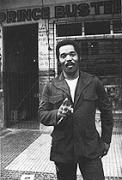
performers who adopted royal titles such as 'Prince' Buster, 'Lord'
Tanamo, 'Duke' Reid to name a few. The
slaves tried hard to hold on to their African philosophy and established
their own system of beliefs and values in their slave communities. Some
forms of African music, such as the Burru were allowed by the white
masters who believed it would help the slaves to work faster. At times
the slave musicians were also called upon to entertain the white
masters. The type of entertainment provided by the slave musicians
followed a carnival tradition and allowed the oppressed performers to
dress and act like kings, queens, lords and ladies for the amusement of
the white masters. In the 1960's this tradition was continued by
performers who adopted royal titles such as 'Prince' Buster, 'Lord'
Tanamo, 'Duke' Reid to name a few.
Often
this carnival type of entertainment was combined with the Quadrille
which was a dance set popular in Europe in the late 18th century and was
taken to the slave colonies by plantation owners.The dance was
transformed by the black population where it exhibited a more
distinctive African bounce quality as well as an expressive tone of
derision. Critical social commentary has been important aspect of ska
lyrics since its earliest inceptions.
After
the emancipation of slaves in 1834, Jamaica experienced a revival that
gave birth to two religious sects that had an influence on the birth of
ska. Pukkumina maintained African derived elements in its rituals and
used body sounds such as clapping and stamping for rhythmic support.
Over breathing was also used as both a two beat vocal percussion rhythm
and to induce a trance like state in the performers.
 The characteristic 'hup, hup, hup...' and 'Ch-Ka-Ch-Ch' vocal percussion
is still a feature in ska music. Examples can be heard in The Skatelites
'Guns of Navarone', Madness' version of 'One Step Beyond' and more
recently Pete Porker in 'Chemical Imbalance'. The other religion was
called Zion Revival and was popular in areas of Jamaica with a
concentration of Europeans. Revival music is characterised by improvised
vocal harmonies and changing patterns of rhythm in clapping and stamping
and drumming that accompany the songs. European elements such as brass
band music, brought by British troops; and sea shantys, brought in by
British sailors also influenced the sound of revival choruses. There are
literally hundreds of choruses used to accompany all occasions such as
'Let us Break Bread Together', a thanksgiving song and 'Dip Dem,
Bedward' a baptismal chorus.
The characteristic 'hup, hup, hup...' and 'Ch-Ka-Ch-Ch' vocal percussion
is still a feature in ska music. Examples can be heard in The Skatelites
'Guns of Navarone', Madness' version of 'One Step Beyond' and more
recently Pete Porker in 'Chemical Imbalance'. The other religion was
called Zion Revival and was popular in areas of Jamaica with a
concentration of Europeans. Revival music is characterised by improvised
vocal harmonies and changing patterns of rhythm in clapping and stamping
and drumming that accompany the songs. European elements such as brass
band music, brought by British troops; and sea shantys, brought in by
British sailors also influenced the sound of revival choruses. There are
literally hundreds of choruses used to accompany all occasions such as
'Let us Break Bread Together', a thanksgiving song and 'Dip Dem,
Bedward' a baptismal chorus.
MENTO
Mento
is generally considered to be a fusion of African rhythm and European
tunes and was most popular in the 1940's and 50's. It is an acoustic
music that was often performed in streets. It is performed on portable
instruments such as guitar, banjo, African thumb piano (kalimba) and
bongos. Musically, mento is similar to the Caribbean Rhumba style. The
basic rhythm follows the 3+2+2 pattern and there are strong accents on
the last beat of each bar. 'Dis Long Time Gal', 'Water Come a Me Eye'
and 'Banyan Tree' are example of traditional mento songs. Mento tunes
are used over and over again with new lyrics commenting on topical
situations and sometimes innuendo such as the Jolly Boys' 'Touch Me
Tomato'.
THE
JAZZ INFLUENCE
The
brass band tradition originally brought to Jamaica by British Troops
gradually became incorporated into some areas of Kingston. Most
importantly was the music program at Alpha Boys Catholic School, in West
Kingston. Alpha Boys was a catholic reform school where morals and
strict order ruled, but more importantly it had a great brass band.
Although mento was popular amongst the lower classes, Kingston's small
middle class population had been familiar with American and English Jazz
since the 1930's. The teachers at Alpha Boys included Jazz in their
music education program. Many well known Jamaican musicians were
educated at Alpha Boys including Tommy McCook, Don Drummond (The
Skatelites) and Rico Rodriguez (The Specials).
After
leaving school some Alpha Boys began performing in Jazz Big Bands that
drew on the influence of American stars like Duke Ellington and Count
Basie. But it was the smaller American Rhythm and Blues (R&B) bands
that became the most important influence to Jamaican musicians. American
R&B radio programs broadcast from Memphis, Maimi and New Orleans
were able to be picked up on AM radios in Jamaica. These programs were
refreshing and relevant to Jamaican audiences who had grown tired of BBC
radio replays favoured by the National broadcasting company 'Radio
Jamaica'.
SOUND
SYSTEMS & THE JAMAICAN RECORDING INDUSTRY
Growing
radio audiences led to the birth of the Jamaican recording industry. At
the same time portable dance music operators running 'Sound Systems'
competed for public popularity. Sound System operators were an enormous
influence on Jamaican youth as they controlled what people listened to
and the import of R&B recordings. The two most important were Duke
Reid and Clement Dodd. Reid was known as 'the Trojan' after the Trojan
flat bed truck he used to transport equipment. It is believed the Dodd's
nickname Coxsone was taken from his favorite Yorkshire cricket player.
Throughout the 1950's these two conducted a musical war. This war
escalated to the point that rough nuts known as 'Dance Hall Crashers'
were employed to attend the competitors sound system parties, trash the
joint and fight with the club goers. These club goers were called 'Rude
Boys' and they were the primary listeners and fashion setters in the
dance hall scene. More about 'rude boys' later.
THE
BIRTH OF SKA
Like
mento before it, ska was born out of a combining musical elements. Both
mento and jazz were combined to produce a new style that was initially
called 'Shuffle' Popular shuffle hits were recorded by Neville Esson,
Owen Grey and the Overtakers. The newly set up recording studios were
always on the look out for the next new sound. With the popularity of
American R&B artists like Fats Domino and Louis Jordan many Jamaican
performers incorporated the 12 bar blues chord progressions and boogie
bass lines with mento guitar rhythms. Increasing emphasis was placed on
the offbeat rhythms of mento.
 The
offbeats became shorter and more detached. These distinct syncopated
rhythms were sounded on guitar and piano. The new style of music became
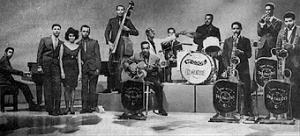
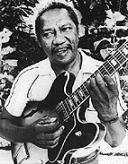
known as ska. The first person to record this 'ska' rhythm was Ernest
Ranglin when performing with Cluet Johnson (Clue J.) and the Blues
Busters The
offbeats became shorter and more detached. These distinct syncopated
rhythms were sounded on guitar and piano. The new style of music became
known as ska. The first person to record this 'ska' rhythm was Ernest
Ranglin when performing with Cluet Johnson (Clue J.) and the Blues
Busters
One
day he was trying to get the guitars to play
something, and him say 'make the guitars go Ska!,
Ska!, Ska!' And that's the way the ska name was born.
(Bunny Lee in Johnson and Pines. 1982 .49)
Clue
J was well known for greeting his friends with a call of 'Love
Skavoovie'. Many believe the name of ska is a shortened form of this
greeting.
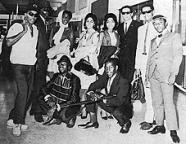 Ska
quickly became the most dominant form of music in Jamaica. Its success
coincided with the independence and the departure of the English in
1962. There was a new attitude towards indigenous music. Ska was already
enormously popular in Jamaica and music producers attempted to export it
to the rest of the world, a move that was supported by the government.
It was the national music of Jamaica and was demonstrated to the the
world at the 1964 Worlds Fair in New York. The Jamaican delegates
included Byron Lee and the Dragonaires, Jimmy Cliff , Prince Buster and
dancers Ronnie Nasralla and Jannette Phillips who taught the world the
moves for the 'Backy Skank', the 'Rootsman Skank' and the 'Ska'. Ska
quickly became the most dominant form of music in Jamaica. Its success
coincided with the independence and the departure of the English in
1962. There was a new attitude towards indigenous music. Ska was already
enormously popular in Jamaica and music producers attempted to export it
to the rest of the world, a move that was supported by the government.
It was the national music of Jamaica and was demonstrated to the the
world at the 1964 Worlds Fair in New York. The Jamaican delegates
included Byron Lee and the Dragonaires, Jimmy Cliff , Prince Buster and
dancers Ronnie Nasralla and Jannette Phillips who taught the world the
moves for the 'Backy Skank', the 'Rootsman Skank' and the 'Ska'.
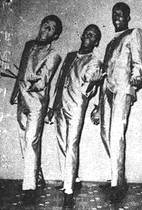 Early
ska dance movements and some lyrics were influenced by the religious
revival era. Songs such as 'Wings of a Dove' performed by both The Blues
Busters and The Wailers, 'Oil in My Lamp' by Eric Morris and 'King of
Kings' by Jimmy Cliff are revival tunes with lyrics that are sped up.
'Israelites' by Desmond Dekker also features revival characteristics in
the lyrics. Other ska lyrics were pop orientated and feature very little
Jamaican patois. These songs were either nonsense lyrics such as Eric
Morris' 'Humpty Dumpty' and 'Solomon Gundie' or romantic such as Delroy
Wilsons' 'Dancing Mood', which was one of the first songs to bridge the
gap between ska and it's slower successor Rocksteady (more later). In
stark contrast are the political ska lyrics that reflected the social
concerns of rude boys. Early
ska dance movements and some lyrics were influenced by the religious
revival era. Songs such as 'Wings of a Dove' performed by both The Blues
Busters and The Wailers, 'Oil in My Lamp' by Eric Morris and 'King of
Kings' by Jimmy Cliff are revival tunes with lyrics that are sped up.
'Israelites' by Desmond Dekker also features revival characteristics in
the lyrics. Other ska lyrics were pop orientated and feature very little
Jamaican patois. These songs were either nonsense lyrics such as Eric
Morris' 'Humpty Dumpty' and 'Solomon Gundie' or romantic such as Delroy
Wilsons' 'Dancing Mood', which was one of the first songs to bridge the
gap between ska and it's slower successor Rocksteady (more later). In
stark contrast are the political ska lyrics that reflected the social
concerns of rude boys.
RUDE
BOYS
As
mentioned earlier these youths were the primary listeners to ska in
Jamaica. They were rebellious out of work and reacted against economic
tensions. They emulated Hollywood gangster fashions by wearing black
suits, thin ties and pork pie hats, the type of look that is still seen
today in Taritinos movies 'Reservoir Dogs' and 'Pulp Fiction'. Rude Boys
often lived outside of the law and were also sometimes called
'Scofflaws' (people who belittle the law). Ska lyrics at the time
reflected the life and times of Rude Boys. Some examples include The
Soul Brothers' 'Lawless Street', The Heptones' 'Gunmen Comin to Town',
Desmond Dekkers' '007 Shanty Town', Dandy Livingstones' 'A Message to
You Rudi' and Prince Busters' 'Judge Dread' who handed out 400 year
sentences to Rude Boys.
Clement
Dodd backed a young group who envisioned themselves as rudies - The
Wailers Bob Marley, Bunny Livingstone (Wailer) and Peter Macintosh
(later shortened toTosh). It was a picture of Peter Tosh from an early
Wailing Wailers album that inspired the Jerry Dammers Two Tone artwork,
more later.
The
way rude boys danced to the music also influenced the ska sound. They
rhythmically pumped their arms back and forward and adopted a more
menacing posture than the traditional style demonstrated by Ronnie and
Jannette. As a result the music became more menacing. Bass lines became
more syncopated rejecting the easy going walking boogie style. More
evidence of the continual evolution of this musical style.
ROCKSTEADY
TO REGGAE
By
1966 in Jamaica many audiences had grown tired of the insistent ska beat
and tempo. Around 1966 the beat of ska was slowed and rocksteady was
born. Some say that it was a particularly hot Jamaican summer that led
to this more relaxed style but the real reason for this change can be
traced once again to the continuing influence of American R&B. By
the mid 60's R&B was developing into the smoother soul styles of
Motown, Memphis and Philadelphia soul. Jamaican musicians responded to
this with their own slower smoother styles. The most notable hit of the
rocksteady era was 'The Tide is High' by The Paragons. In the 80's this
was covered by Blondie and was one of their biggest hits. The influence
of another religious revival, Rastafarianism led to further musical
developments of ska and rocksteady and reggae was born. As we know
Reggae has dominated the Jamaican music scene since.
The
BIRTH OF BRITISH SKA
Ska
went to England with the immigrants of the early 1960's and was
initially known as 'Bluebeat'. The first international ska hit was 'My
Boy Lollipop' by Millie Small. It was recorded in England in 1964 for
Island Records and featured a young English Mod Rod Stewart, just
beginning his own music career on Harmonica. Ska gained popularity
amongst the Mod scene and several hits followed including 'Guns of
Navarone' by the Skatalites, 'Carry Go Bring Come' by Justin and The
Dominoes, and 'Rudy, A Message to You' by Dandy Livingstone. In 1969,
'The Israelites' by Desmond Dekker became the first Jamaican produced
recording to become a number one hit in Britain. Other big ska chart
hits in 1969 included 'Monkey Man' by Toots and the Maytals, 'Long Shot
Kick De Bucket' by The Pioneers and 'Liquidator' by The Harry J
Allstars. It is interesting to note that these hits had all been
recorded several years earlier in Jamaica and gradually crept into the
UK charts over a long period of time.
TWO
TONE
 In
1979 ska enjoyed a revival of popularity. Initially the ska revival was
an English phenomenon, but gradually spread to the rest of the world,
including Australia. The most notable bands associated with the second
wave of ska popularity were The Specials, Madness, The Beat, and The
Selecter. All these bands recorded their first albums for 'Two Tone
Records', a label established by The Specials keyboard player Jerry
Dammers. The label was named after the two tone tonic suits worn by the
original ska stars of the 1960's and also reflected the multi racial
membership of the bands signed to the label. The trade mark of the
company was based on a negative photo of Peter Tosh from an early
Wailing Wailers album cover. This 'Rude Boy' logo became affectionately
known as Walt Jabsco. In
1979 ska enjoyed a revival of popularity. Initially the ska revival was
an English phenomenon, but gradually spread to the rest of the world,
including Australia. The most notable bands associated with the second
wave of ska popularity were The Specials, Madness, The Beat, and The
Selecter. All these bands recorded their first albums for 'Two Tone
Records', a label established by The Specials keyboard player Jerry
Dammers. The label was named after the two tone tonic suits worn by the
original ska stars of the 1960's and also reflected the multi racial
membership of the bands signed to the label. The trade mark of the
company was based on a negative photo of Peter Tosh from an early
Wailing Wailers album cover. This 'Rude Boy' logo became affectionately
known as Walt Jabsco.
The
Two Tone artists relied heavily on the first wave ska stars attitudes
and philosophy. The Specials took their name from the 'special' one off
recordings made for the early sound system operators in Jamaica and
'Madness' are named after a Prince Buster song. The bands did not
attempt to conceal their musical dependence either. They quite rightly
believed that if it was a good song you might as well play it. At the
time, some fans believed that the cover versions were actually
originals. Listed below are some of the classic cover versions by Two
Tone bands.
TITLE
OF SONG ORIGINAL PERFORMER COVER BY
Rudi, A Message to You Dandy Livingstone The Specials
Too Hot Prince Buster The Specials
Monkey Man Toots & The Maytals The Specials
Guns of Navarone The Skatalites The Specials
One Step Beyond Prince Buster Madness
Madness Prince Buster Madness
Can't Get Used to Losing You Alton Ellis The Beat
Whine & Grine Prince Buster The Beat
Carry Go Bring Come Justin Hinds & the Dominoes The Selecter
The
popularity of these cover versions led to a demand for the original
recordings and suddenly Symarip's 'Skin head Moonstomp' was in the
charts exactly ten years after its first release. Also interesting is
the fact that Prince Buster has made more money from royalties paid by
cover artists than he ever made from his own album sales.
The
two bands also paid tribute to the original ska performers by using
musical material from the original recordings. This music was adapted,
rearranged and used as the basis of a new original tune. Sometimes, just
the lyrics of songs were used to inspire a new song. Listed below are
some examples.
ORIGINAL
SONG ARTIST ADAPTION ARTIST
Al Capone Prince Buster Gangsters The Specials
Judge Dread Prince Buster Stupid Marriage The Specials
Earthquake/Freezing Up/ Prince Buster The Prince Madness
Orange Street/Ghost Dance
Longshot Kick De Bucket/ Pioneers Skinhead Symphony The Specials
Liquidator/Skinhead Moonstomp.
Despite
the fact that it relied on pre-existing ska songs, the sound of the Two
Tone era was fresh and new. The punk rock era had set new musical rules
and second wave ska incorporated this energy. Two Tone recordings are
characterised by faster tempos, fuller instrumentation and a harder edge
than original 60's ska. All the Two Tone bands were young and from
working class backgrounds and so the lyrics reflect their concerns:
school, work, politics, crime, racism and having fun.
THE
THIRD WAVE
Although
enjoying a massive revival in Britain, Europe and, too a lesser extent,
Australia, Two Tone ska did not make an impact in America. Bands such as
Madness and The Specials were considered 'too English' probably due to
their lyrics reflecting their own political and social concerns and the
English dance hall type antics of the live shows that was far removed
from the demur American stadium rock popular at the same time. Recently
ska has enjoyed another wave of popularity. The third wave exists in
many forms and combines many different
styles of rock with ska rhythms and instrumentation. Bands such as
Hepcat, New York Ska Jazz Ensemble, Jazz Jamaica and The Stubborn All
Stars play traditional first wave styled ska. In contrast is the sound
of Operation Ivy, Rancid, Voodoo Glow Skulls and Reel Big Fish who
favour a harder 'ska-core' sound that is heavily influenced by punk. And
there are thousands of bands playing every style in between. Although
the sound of these bands is varied, the musical characteristics of the
original ska can still be heard although sometimes it is not as obvious.
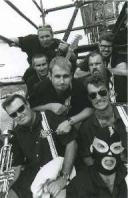 As
in the other ska eras, the third wave ska revival has created an
interest in two tone bands. Many of these bands are re-releasing
original vinyl albums on CD and performing again to enthusiastic
audiences. Some of the original ska hits are still enormously popular
today. Imagine the delight of Lord Tanamo when 'I'm in the Mood for Ska'
eventually made the UK charts in 1990, twenty five years after its first
release. In 1995, members of The Specials recorded an album of old ska
covers with Desmond Dekker and this in turn led to the release of
'Todays Specials' (1996) and more recently the excellent 'Guilty 'til
Proved Innocent' album (1998). Today ska bands like The Skatalites,
Toots and the Maytals,The Specials, Mighty Mighty Bosstones and many
others enjoy popularity all around the world. In Australia, The
Allniters most popular in the mid 80's with their cover of 'Montego Bay'
are enjoying popularity once again with a new younger crowd and The
Porkers enjoy a large following as a regular performer on the Australian
festival circuit and have recently performed on the US Vans Warped Tour. As
in the other ska eras, the third wave ska revival has created an
interest in two tone bands. Many of these bands are re-releasing
original vinyl albums on CD and performing again to enthusiastic
audiences. Some of the original ska hits are still enormously popular
today. Imagine the delight of Lord Tanamo when 'I'm in the Mood for Ska'
eventually made the UK charts in 1990, twenty five years after its first
release. In 1995, members of The Specials recorded an album of old ska
covers with Desmond Dekker and this in turn led to the release of
'Todays Specials' (1996) and more recently the excellent 'Guilty 'til
Proved Innocent' album (1998). Today ska bands like The Skatalites,
Toots and the Maytals,The Specials, Mighty Mighty Bosstones and many
others enjoy popularity all around the world. In Australia, The
Allniters most popular in the mid 80's with their cover of 'Montego Bay'
are enjoying popularity once again with a new younger crowd and The
Porkers enjoy a large following as a regular performer on the Australian
festival circuit and have recently performed on the US Vans Warped Tour.
|