
 Reviews
 FAQ
FAQ Guestbook
 RSS Feed
 |
Reviews |
FAQ |
Guestbook |
RSS Feed |
Painkiller HD
|
 |
Title |
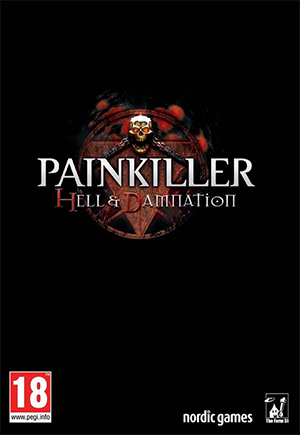
Painkiller Hell & Damnation |
Developer |
The Farm 51 | |
Publisher |
Nordic Games | |
Relase Year |
2012 | |
Platforms |
Playstaion 3, Xbox 360, Windows PC | |
Review Platform |
Windows PC |
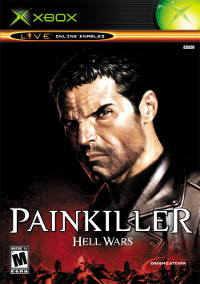 Painkiller Hell & Damnation, or Painkiller HD, as I will be referring to it as for the remainder of this article, is a first person shooter developed by The Farm 51, and released in 2012. It
has a strangely complicated relationship with the other games in the Painkiller series, in that it's both a sequel to, and a remake of the original game released back in 2004. I'll get more into that weirdness later
though. I had Painkiller HD on my list of games I've been meaning to play for some time prior to picking it up as part of the Painkiller bundle during the Steam summer sale earlier this year, mostly because I have fond
memories of playing the original Painkiller on Xbox back when I was in high school. When I finally got around to playing it recently I was excited to re-play Painkiller with a fresh coat of paint on a modern PC, and was
surprised to find how different it was from the game I remembered. Needless to say, I'll be making plenty of comparisons to the original game throughout this review, which, it's worth noting, was developed by a
completely different studio.
Painkiller Hell & Damnation, or Painkiller HD, as I will be referring to it as for the remainder of this article, is a first person shooter developed by The Farm 51, and released in 2012. It
has a strangely complicated relationship with the other games in the Painkiller series, in that it's both a sequel to, and a remake of the original game released back in 2004. I'll get more into that weirdness later
though. I had Painkiller HD on my list of games I've been meaning to play for some time prior to picking it up as part of the Painkiller bundle during the Steam summer sale earlier this year, mostly because I have fond
memories of playing the original Painkiller on Xbox back when I was in high school. When I finally got around to playing it recently I was excited to re-play Painkiller with a fresh coat of paint on a modern PC, and was
surprised to find how different it was from the game I remembered. Needless to say, I'll be making plenty of comparisons to the original game throughout this review, which, it's worth noting, was developed by a
completely different studio.
Story has never really been a major focus, or particular strong point of the Painkiller games, so I'm going to mostly gloss over it here. In the first game the player character, named Daniel
Garner (I had to look up his name, that's how irrelevant and forgettable the plot is) dies in a car crash with his wife. She goes to Heaven, he gets stuck in Purgatory, and gets caught up in a war between Heaven and Hell
where he has to fight through the armies of Hell and kill Lucifer, yada yada yada, I'm sure you can all figure out where that goes.
Painkiller HD has basically the exact same plot, except now, because it's technically a sequel, there's some contrived reason why he has to do the same thing all over again. This time
Death is running the show instead of Lucifer, which results in worse final boss fight, and just enough wiggle room to explain away all the other pointless gameplay changes. But I'll get to those in a bit. Ultimately the
only reason for the existence of the plot in either game is to provide some context for the nonsensical level progression, and over-the-top demon murder spree that characterizes the bulk of the experience. It also doesn't
help that the cutscene animation and voice acting are both awful.
The gameplay department is where Painkiller HD shines the most. It more-or-less follows in the footsteps of old school 90s shooters, like Doom, Quake, and Duke Nukem 3D, but with a few
modern tweaks. The biggest difference is that there's a much stronger emphasis on combat. The maze-like levels and keycard puzzles that characterize Doom and it's ilk are all but gone, replaced instead by a linear
string of combat arenas, where enemies spawn in massive waves and assault the player, one after the other.
The combat itself is classic circle-strafing shooter goodness, with the addition of a modern physics engine, and
all the benefits that come with it. The main benefit in this case being that when an enemy is killed, instead of just dropping dead in a pool of blood, they break apart into giblets that fly across the room in a
spectacular, gory mess. Almost all the enemies stick to the "shoot it until it dies" formula, with the only exceptions being the last couple of bosses, and one variety of grunt that can only be killed for about 10
frames of animation and are otherwise immune to damage. The weapons palyers collect throughout the campaign are all distinct and fun to use, my personal favorite being the Stakethrower gun that can pin enemies to walls.
There are a couple weapons that feel a bit redundant, but they don't come in until the very last stretch of the campaign. Overall the core combat is pretty well balanced.
There's also a good amount of strategy for a game that mostly amounts to 'shoot anything that moves'. There are no standard health pickups in the game, instead health pickups come in the form
of souls that are dropped by every enemy that's defeated. The souls take a few seconds to apper after killing though, and they disappear shortly thereafter. This can lead to an interesting tension, when the player is low on
health the only way to get more is to collect as may souls as possible from fallen enemies. I ended up having to do a sort of dance, where I backpedaled around the room trying to fight the horde of monsters chasing me
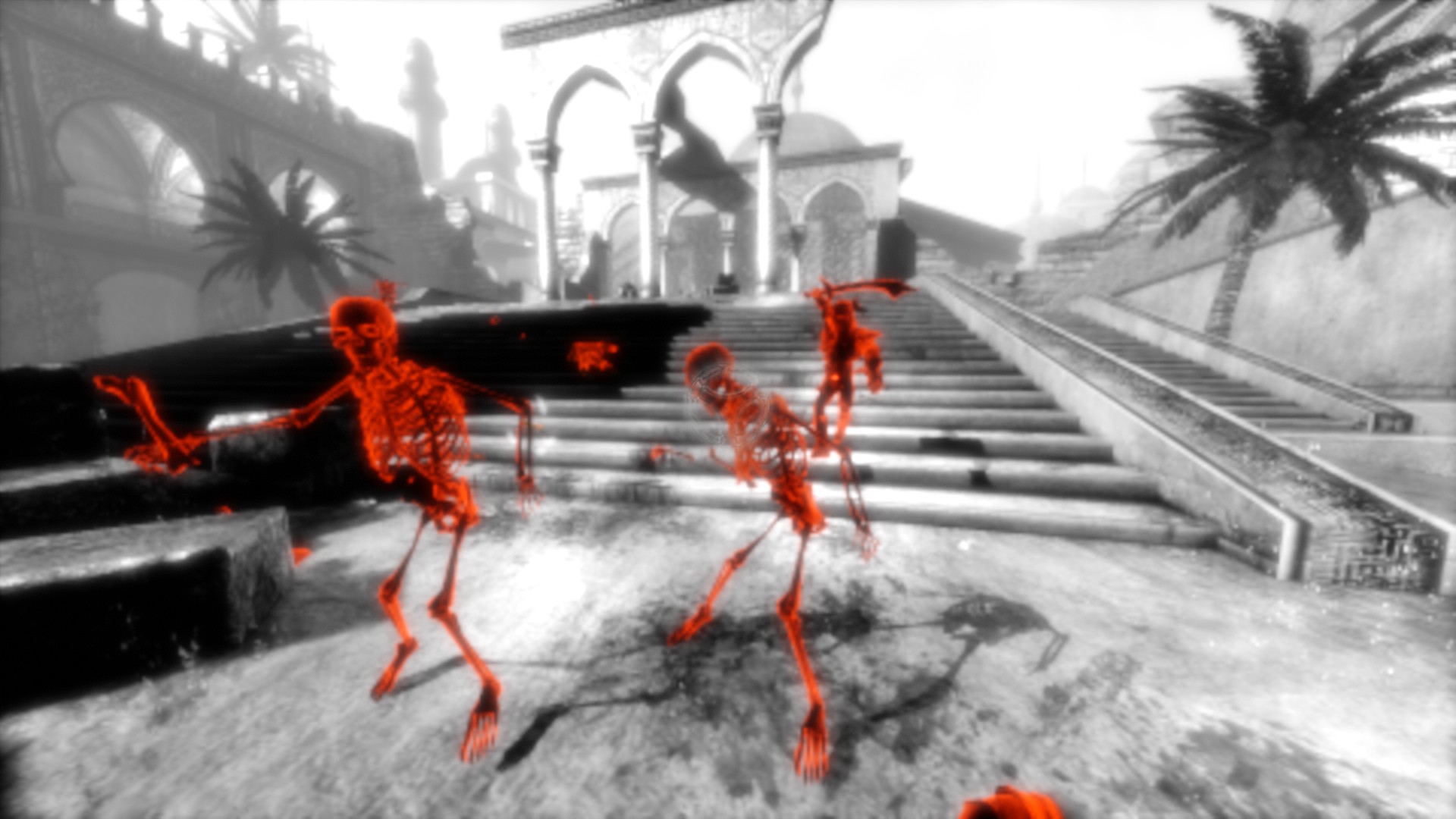
while at the same time doubling back over where I was 20 seconds ago, in order to pick up the dropped souls, all while trying not to get cornered and mauled to death. Dropped souls also act as the game's power-ups,
where, upon collecting 66 souls, a trippy filter get's applied to everything, and you gain invincibility, and one hit kills on most enemies for a limited time.
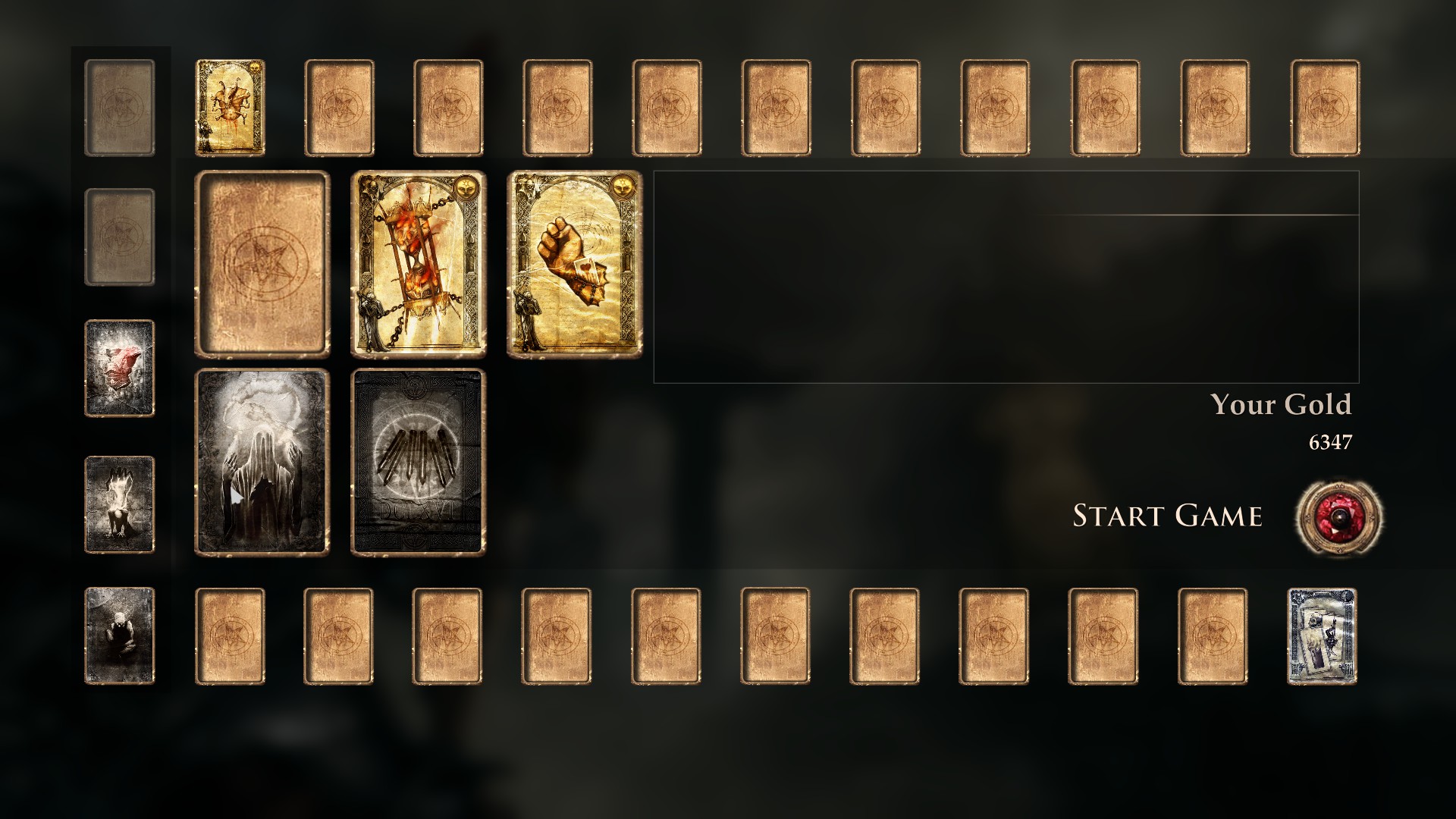
On top of that, there's a card collecting system that can affect gameplay pretty significantly. Each stage has a set of optional objectives, each of which unlock a card at the end of the
level if completed. The cards can then be equipped on the menu between stages for various perks and extra abilities, but they have a casting cost, so in order to use the cards players have to both complete the bonus
objectives and explore the levels to find additional gold in order to cast them. My personal favorite perk has to be the one that lets you slow down time to a crawl, so you can really appreciate the bloody
mess that the enemies burst into upon death. The only downside to all this is that the card bonuses tend to make the game a bit too easy, the 666 health and ammo bonuses in particular turn it into a bit of a joke.
As touched on earlier, the levels in Painkiller HD are mostly linear strings of combat arenas designed around predetermined combat encounters. That description undersells it a bit though, as
the levels manage to be distinct and hugely varied, while still sticking to the established formula. For one thing the aesthetics of the levels change drastically throughout the campaign. The first chapter takes place in
generic horror-fantasy settings, like a graveyard, a dungeon, and a Gothic cathedral, but form there moves on to include a military base, a Arabian palace, and a hunted theme park, among other exotic
locales. The layout of the levels is also intricate and varied enough that most of the time I didn't really notice that all the action was confined to a walled-off combat arena. After the first chapter the arenas get
bigger and are filled with obstacles and varied terrain that allow for multiple vectors of attack, as well as narrow passages and choke points, where palyers can become easily overwhelmed if their not careful. In some
later levels, the progression path even leads back to the same arena multiple times which really helps to make the environments feel more like real places.
My biggest recurring issue with the level design is that it's not always easy to find your way to the next objective after clearing out a combat arena. The game has a compass at the top of
the screen pointing toward the next objective to try to compensate for this, but it's not always that helpful, particularly in areas that have multiple levels. That's not to mention the fact that the compass is there in
the first place means the designers knew there levels were unintuitive to navigate. Where this all really comes to a head though, is in the larger, more complex levels, when the enemies in a wave are dead, but it's not
obvious where to go for the next wave spawn in. The problem is the compass only points to the nearest enemy currently in the level, or the next checkpoint, so I often found myself wandering around a huge level for minutes on
end, trying to find the invisible checkpoint that makes the next wave of enemies appear, all while the same generic heavy metal riff looped endlessly in the background.
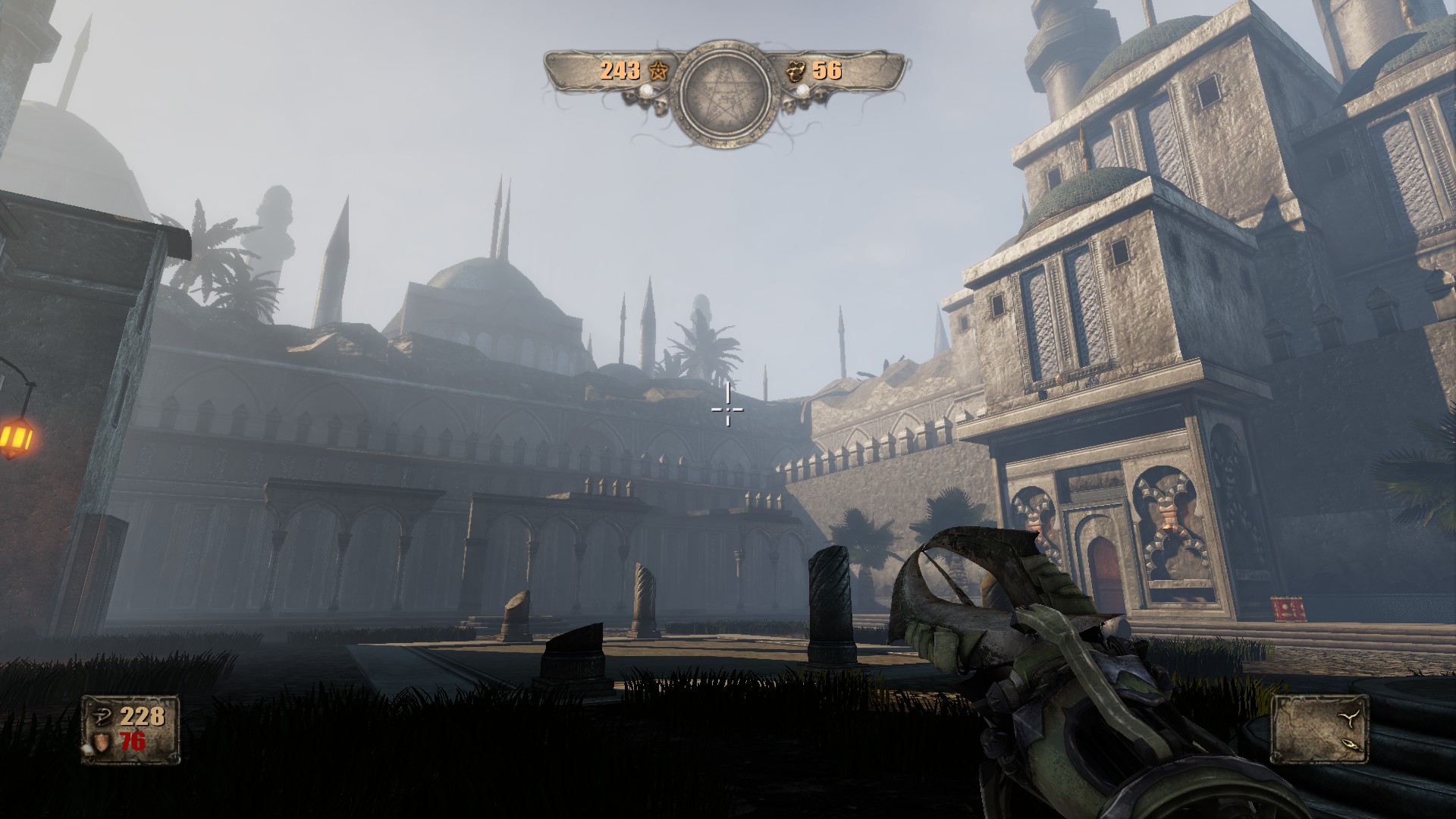 Up until this point, pretty much everything I've written in regards to gameplay and level design applies to both the original Painkiller and Painkiller HD, but now it's time to dig into what
makes the two games notably different. The biggest and most noticeable change is obviously the improved graphics. The Farm 51 dev team did a good job re-creating the look and feel of Painkiller in the Unreal engine and
the added detail looks fantastic.
Up until this point, pretty much everything I've written in regards to gameplay and level design applies to both the original Painkiller and Painkiller HD, but now it's time to dig into what
makes the two games notably different. The biggest and most noticeable change is obviously the improved graphics. The Farm 51 dev team did a good job re-creating the look and feel of Painkiller in the Unreal engine and
the added detail looks fantastic.
Unfortunately, the improvements Painkiller HD makes over the original pretty much begin and end at the visuals, in fact, the first problematic change is noticeable right form the
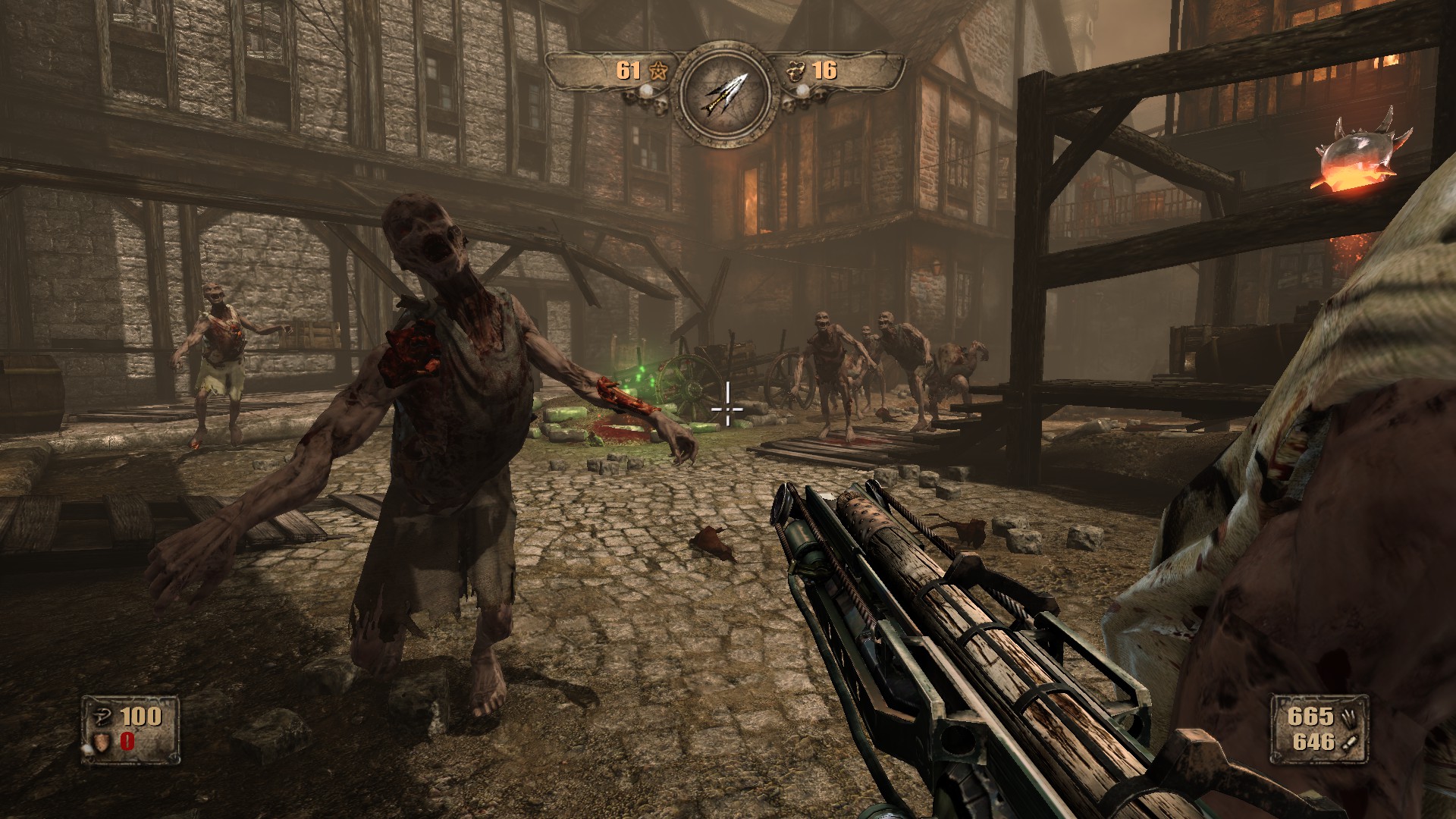
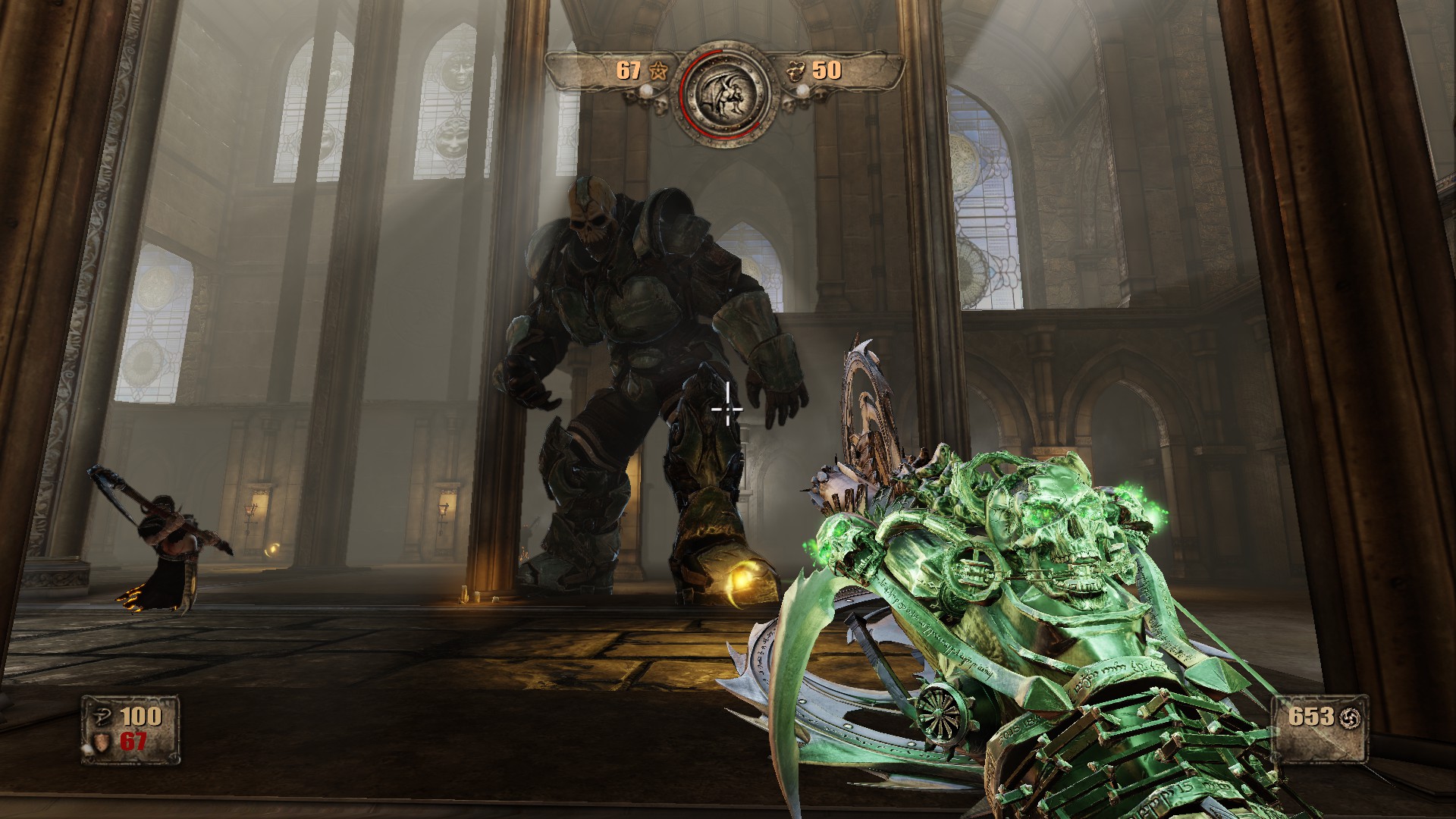
beginning of the campaign. In Painkiller, the two weapons that are given to the player right at the beginning of the game are a pseudo-mele weapon called the Painkiller (pictured alongside this paragraph) and the
Shotgun. The reason this is important to note, is because the entire first level of the game is made up of a series of encounters designed to subtlely teach the player how to handle a variety of situations they'll
encounter throughout the rest of game, with only these two weapons. So what does Painkiller HD do? It replaces the Painkiller with a never-before-seen gun called the Soulcatcher (pictured second screenshot), as one of the
starting weapons without changing the design of the first level at all, the end result of this is a player who's ill-equipped to tackle the challenge they've been presented.
The point when this problem becomes most apparent is an encounter that happens toward the end of the first level. The player is locked into a very small walled-in area of the map, where several
large waves of enemies spawn in one, after the other, and include the most powerful enemies the they've encountered at this point it the game. This setup pretty much ensures that the player will get overwhelmed and, presumably,
backed into a corner where they will have figure out how to use the Painkiller to deal with groups of close-range enemies if they haven't already. In the original game this setup is barely noticeable, and blends right in with
the rest of the level. In Painkiller HD on the other hand, the player doesn't have the Painkiller at this point, and this one little area becomes exponentially more difficult than it was ever designed to be. I died more times
attempting to get through this one little corner of the first level, than I did throughout the entire rest of my time playing Painkiller HD, I even played through the same level of the original game to compare,and it gave me no
trouble at all. Thankfully you get the Painkiller at the beginning of the next level, so this issue never comes up again, but it was a poorly thought-out change regardless.
The biggest and, most damning change Painkiller HD makes, first started to show itself during my second play session when I found myself playing
through a level that I remembered being in last stretch of the original Painkiller. I distinctly remembered that it had taken me about a week's worth of play sessions to reach this same level when I was in high school, yet here
it was in Painkiller HD, no more than a few hours into the game. I shrugged it off, and kept playing, only to have the same thing happen again a little while later, then again, and again, and before I knew it I was at the final
boss. The biggest problem with Painkiller HD is that it claims to be both a remake and a sequel to the original game, yet has a fraction of the content. I managed to finish the entire campaign in a little over five hours, and
that's with a fair bit of exploration to find gold and hidden items. Just for comparison, I pulled up my original save file on my old Xbox, the total play time was around thirteen-and-a-half hours, and that was just one run
through the campaign.
I did some digging, and found that of the 35 levels present in Painkiller's campaign, only 27 of them were ever remade for Painkiller HD, and of those, only 11 are present in Painkiller HD's
pitifully short 13 level campaign. As for the other 16 levels that got remade, they were broken up and sold in various DLC packs, alongside a selection of levels remade form Painkiller Recurring Evil. I find this type of carving
up of content to be totally unacceptable, doubally so for a game whose sales pitch is that it's an enhanced remake of an established title. When I hear the term "enhanced remake" I imagine a game that has most, if not all,
the content from the orignal, plus some extras, such as new levels, characters, or game modes. Painkiller HD completely fails in this regard, by offering no real improvements to the source material, outside of the visuals,
and including so little content in the base game that it feels more like an expansion pack than a full game
If I had bought Painkiller HD for full price at launch, I would be livid. I was lucky enough to get it in a bundle that
I only paid around six dollars, with all the DLC and I still feel a bit cheated. All the DLC packs combined just barley bring the length of Painkiller HD up to that of the original game, and that's ignoring the
fact that a number of the extra levels are duplicates of levels already in the base game, either as holiday themed re-skins, or shifted to a top-down perspective. And the worst part about this? I wouldn't have even noticed any
of this if the DLC had been tacked on to the main campaign, instead of being sectioned off in their own part of the menu.
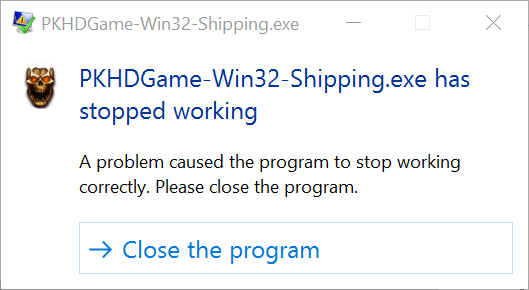 Painkiller HD's most glaring technical issue first made itself known to me the second time I sat down to play it. I booted up the game and picked up where I left only to have the game crash
to desktop, and display the cryptically vague error message shown to the right. I launched the game again, figuring it was the result of a one-off bug, and another two minutes later it crashed again with the same error message.
My next thought was "Okay, this game's a few years old, and I'm running Windows 10, maybe it'll work in compatibility mode." Tried it, same result. Fast forward several frustrating minutes of troubleshooting and error log
checking, and I finally decide to look up the error, only to find that Painkiller HD on PC crashes if, after two minutes the game doesn't detect and active Internet connection, and gives no indication as to what the problem is.
At that point I realsied a problem I'd been having with one of my network switches had prevented my gaming PC form connecting on boot. I fixed it, and was finally able to sit down and enjoy the game, while being left to ponder
whaton earth had caused this issue in the first place. Even now I'm still not sure if the crashing was due to a deliberate attempt at always-online DRM, or if it was just a bug. If it's some from of DRM, then it's one of the
shoddiest and most cryptic DRM schemes I've ever seen, and the publisher should be absolutely ashamed of using it. If it's a bug on the other hand, the fact that there hasn't been an update to address it almost five years after
the game's release is downright embarrassing.
Painkiller HD's most glaring technical issue first made itself known to me the second time I sat down to play it. I booted up the game and picked up where I left only to have the game crash
to desktop, and display the cryptically vague error message shown to the right. I launched the game again, figuring it was the result of a one-off bug, and another two minutes later it crashed again with the same error message.
My next thought was "Okay, this game's a few years old, and I'm running Windows 10, maybe it'll work in compatibility mode." Tried it, same result. Fast forward several frustrating minutes of troubleshooting and error log
checking, and I finally decide to look up the error, only to find that Painkiller HD on PC crashes if, after two minutes the game doesn't detect and active Internet connection, and gives no indication as to what the problem is.
At that point I realsied a problem I'd been having with one of my network switches had prevented my gaming PC form connecting on boot. I fixed it, and was finally able to sit down and enjoy the game, while being left to ponder
whaton earth had caused this issue in the first place. Even now I'm still not sure if the crashing was due to a deliberate attempt at always-online DRM, or if it was just a bug. If it's some from of DRM, then it's one of the
shoddiest and most cryptic DRM schemes I've ever seen, and the publisher should be absolutely ashamed of using it. If it's a bug on the other hand, the fact that there hasn't been an update to address it almost five years after
the game's release is downright embarrassing.
I'm happy to report that, other than the error message from Hell, Painkiller HD has no real technical issues to speak of. It's an FPS built on the Unreal engine, so it goes without saying that
it's well opitmized. I initially tried running it on max settings, only to have the game hitch slightly every time I killed an enemy, but after dropping the post-processing down a notch, it ran at a buttery-smooth 60 FPS for the
remainder of my play time. (For reference, I'm using an i5 6600K with a GTX 1060).
Painkiller HD, while by no means a bad game in it's own right, falls short when compared to it's predecessor. It attempts to be at once, both a sequel and a remake to the original game, and fails to fully deliver on either promise. It's design is too rooted in the original to realize the potential of anything new it brings to the table, and is too distracted trying to distinguish itself to remain a faithful remake, and the carving up of content, excessive DLC, and always-online DRM, or glitch, or whatever it is don't improve anything. Ultimately I'd only recommend it to hardcore Painkiller fans who want to play it for completion's sake, or people who already have a copy of it somehow and want to try out Painkiller. The only people I could see enjoying this more than the original are those who think that graphics trump gameplay, and are therefore willing to trade improved visuals for a compromised experience. If anything I've said about Painkiller HD has sparked your interest and your thinking of picking it up, I can almost garentee you'll have a better time if you get Painkiller Black instead.
| Score | Recommendation |
|||||||||||||||||||||||||||||||||||||||||||||||----|---------|---------|--------|--------|---------|
46/100
|
Mabey |

Any copyrighted material on this site is used solely for purposes of commentary and/or criticism, and is property of it's respectful owner.
All other material and
it's source code, is made freely available under the terms of the Creative Commons Attribution-ShareAlike 4.0 license.