 |
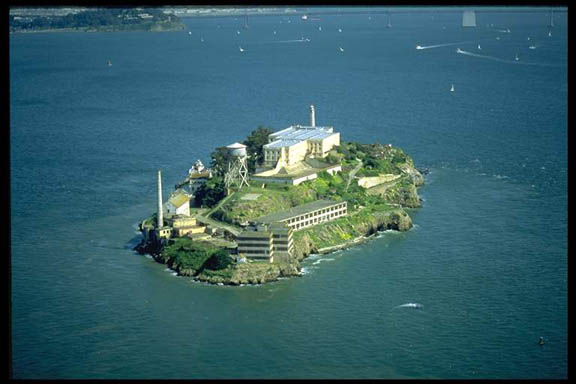
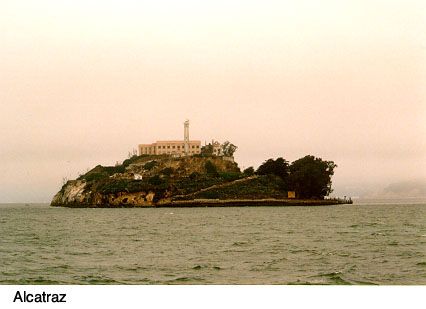
Before the Prison The name Alcatraz is derived from the Spanish "Alcatraces." In 1775, the Spanish explorer Juan Manuel de Ayala was the first to sail into what is now known as San Francisco Bay - his expedition mapped the bay and named one of the three islands Alcatraces. Over time, the name was Anglicized to Alcatraz. While the exact meaning is still debated, Alcatraz is usually defined as meaning "pelican" or "strange bird." In 1850, a presidential order set aside the island for possible use as a United States military reservation. The California Gold Rush, the resulting boom in the growth of San Francisco, and the need to protect San Francisco Bay led the U.S. Army to build a Citadel, or fortress, at the top of the island in the early 1850s. The Army also made plans to install more than 100 cannons on the island, making Alcatraz the most heavily fortified military site on the West Coast. Together with Fort Point and Lime Point, Alcatraz formed a "triangle of defense" designed to protect the entrance to the bay. The island was also the site of the first operational lighthouse on the West Coast of the United States. By the late 1850s, the first military prisoners were being housed on the island. While the defensive necessity of Alcatraz diminished over time (the island never fired its guns in battle), its role as a prison would continue for more than 100 years. In 1909, the Army tore down the Citadel, leaving its basement level to serve as the foundation for a new military prison. From 1909 through 1911, the military prisoners on Alcatraz built the new prison, which was designated the Pacific Branch, U.S. Disciplinary Barracks for the U.S. Army. It was this prison building that later became famous as "The Rock."
|
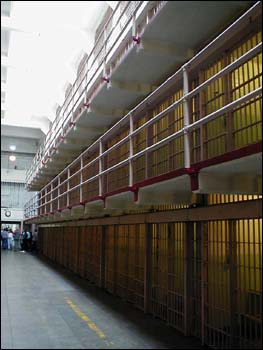
Prison Life While several well-known criminals, such as Al Capone, George "Machine-Gun" Kelly, Alvin Karpis (the first "Public Enemy #1"), and Arthur "Doc" Barker, did time on Alcatraz, most of the 1,576 prisoners incarcerated there were not well-known gangsters, but prisoners who refused to conform to the rules and regulations at other Federal institutions, who were considered violent and dangerous, or who were considered escape risks. Alcatraz served as the prison system's prison - if a man did not behave at another institution, he could be sent to Alcatraz, where the highly structured, monotonous daily routine was designed to teach an inmate to follow rules and regulations. At Alcatraz, a prisoner had four rights: food, clothing, shelter, and medical care. Everything else was a privilege that had to be earned. Some privileges a prisoner could earn included working, corresponding with and having visits from family members, access to the prison library, and recreational activities such as painting and music. Once prison officials felt a man no longer posed a threat and could follow the rules (usually after an average of five years on Alcatraz), he could then be transferred back to another Federal prison to finish his sentence and be released. |
 |
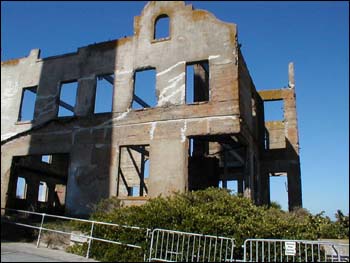
Alcatraz Closes On March 21, 1963, USP Alcatraz closed after 29 years of operation. It did not close because of the disappearance of Morris and the Anglins (the decision to close the prison was made long before the three disappeared), but because the institution was too expensive to continue operating. An estimated $3-5 million was needed just for restoration and maintenance work to keep the prison open. That figure did not include daily operating costs - Alcatraz was nearly three times more expensive to operate than any other Federal prison (in 1959 the daily per capita cost at Alcatraz was $10.10 compared with $3.00 at USP Atlanta). The major expense was caused by the physical isolation of the island - the exact reason islands have been used as prisons throughout history. This isolation meant that everything (food, supplies, water, fuel...) had to be brought to Alcatraz by boat. For example, the island had no source of fresh water, so nearly one million gallons of water had to be barged to the island each week. The Federal Government found that it was more cost-effective to build a new institution than to keep Alcatraz open. |
 |
Escape Attempts
There were, however, prisoners who decided not to wait for a transfer to another prison. Over the 29 years (1934-1963) that the Federal prison operated, 36 men (including two who tried to escape twice) were involved in 14 separate escape attempts. Of these, 23 were caught, 6 were shot and killed during their escape, and 2 drowned. Two of the men who were caught were later executed in the gas chamber at the California State Prison at San Quentin for their role in the death of a correctional officer during the famous May 2-4, 1946, "Battle of Alcatraz" escape attempt.
Whether or not anyone succeeded in escaping from Alcatraz depends on the definition of "successful escape." Is it getting out of the cellhouse, reaching the water, making it to land, or reaching land and not getting caught? Officially, no one ever succeeded in escaping from Alcatraz, although to this day there are five prisoners listed as "missing and presumed drowned."