Making Tracks Through Cyberspace

Village Crosstown Trolley Coalition
Making Tracks through the Village.Greenwich Village, New York City
Become a Member
Contact VCTC
The 8th St. Corridor
GV Transit
Newsletter
Questionnaire
Board of Directors
Volunteers Wanted
Calendar of Events
Transit Links
MAKING TRACKS - Vol. 6, No. 4 - Fall 2000
Entire contents of MAKING TRACKS is copyright © 2001 by Village Crosstown Trolley Coalition,
but may be reproduced either in whole or in part with a clear acknowledgment of the source.
Please report any errors to us at VCTC. Thanks.
Inside this Issue
Portland Streetcar: New West Coast Pioneer
42nd Street Light Rail Project Gains New Momentum
The Tracks of New York - No. 1, Metropolitan Street Railway - 1907
Trolley Slide Show Available
Letter from the Editor
By William K. Guild
Portland, Oregon, a leader in the light rail revolution of the 1980s, and the first city in North America to introduce low floor LRVs, is out front again with Portland Streetcar, an all-urban trolley system due to begin operation in July 2001. Planned to complement MAX, the expanding 35-mile light rail system now linking eastern and western suburbs with downtown, the new trolleys will operate almost entirely in city streets. Thus the line will resemble the proposed Village Crosstown Trolley more closely, in some ways, than the more "traditional" light rail systems which have become increasingly popular in and around cities across the country, from San Jose to Jersey City.
MAX opened in 1986, the second "new" LRT system on the west coast-San Francisco had never completely abandoned trolleys or cable cars. The original line, street-running through business and historic districts on both sides of the Willamette River, operates over dedicated right-of-way, including two high-speed segments, for most of the 15 miles to Gresham, east of Portland. In 1998, Westside MAX extended the route 18 miles in the other direction to Hillsboro, more than doubling total mileage. A 5.5 mile branch to Portland International Airport is nearing completion and another northern extension, about the same length, is planned.
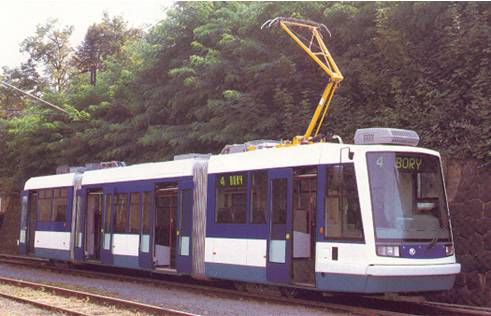
Low floor transit vehicles developed specifically for urban routes will soon be rolling on Portland Streetcar system. Shorter and lighter than high-speed LRVs used on most new U.S. systems, including Hudson-Bergen Light Rail now running in Jersey City and Bayonne, these cars would be ideal for crosstown operation proposed by VCTC. (Photo courtesy Skada)
The initial 2.4 mile segment of Portland Streetcar will run from the Northwest 23rd Street shopping area to Portland State University, south of the city center, passing through several residential districts now undergoing upscale redevelopment. Like MAX, which it will cross at right angles in the heart of downtown Portland, the new trolley will operate in parallel one-way streets, north on 10th and south on 11th. Fares will be the same as those charged on buses and light rail. As on MAX, trips within the downtown area will be free. The systems will operate independently, but compatible power supplies and a downtown track connection will permit Portland Streetcar light rail vehicles to use the MAX shops for repairs, avoiding a major capital expenditure. A future extension beyond Portland State University may also be shared if another proposed north-south light rail line is approved.
While it includes some street running sections, mostly in downtown Portland, MAX was intended mainly to carry people to and from the central business district, much like the interurban lines of an earlier day, or even the subways and commuter rail lines of New York. Portland Streetcar will occupy a different niche. Like the Village Crosstown Trolley, and other proposals supported by VCTC for New York, it will provide an important means of transportation and an amenity for burgeoning residential areas close to a major business center.
The stated goals of Portland Streetcar are to:
- Link neighborhoods together and provide transportation alternatives;
- Fit the scale and traffic patterns of existing neighborhoods;
- Provide quality service that will inspire new transit ridership;
- Attract more housing to parts of the city, like the River District, that have room for new development.
VCTC believes these goals are both visionary and achievable, and we wish Portland Streetcar well in bringing them to fruition. Indeed, they track closely with our own goals for the 8th Street corridor. The most obvious difference here is that housing is already in place in the East Village, including "Alphabet City" and the East River waterfront, lacking only reliable transit, while Portland Streetcar is already attracting new residential development to its service area.
Critics of urban light rail frequently argue that, during construction, neighborhoods will be disrupted, seriously damaging business and inconveniencing residents for extended periods. Such objections have been raised here, to the Village Crosstown Trolley and to other improvements along the 8th Street corridor, but Portland Streetcar shows these concerns to be greatly exaggerated. Any disruption has been brief and minimal. A shallow 12-inch deep track slab design has reduced both construction time and utility relocations, allowing the entire line to be completed in well under two years. The 8-foot wide track slabs are fitted to existing grades, limiting the scope of street and sidewalk reconstruction. While the April 5, 1999 groundbreaking followed nearly a decade of planning, revenue service will begin in July 2001-after six months of testing and training over the completed trackway.
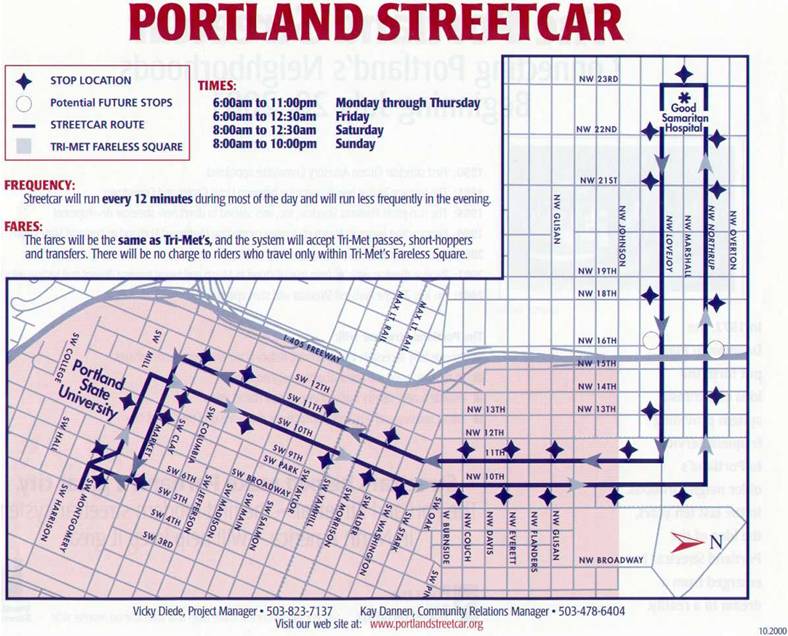
Portland Streetcar Phase 1 will link a busy shopping area northwest of the city center with Portland State University, to the south, providing mobility to residential areas now undergoing upscale renewal and crossing the established MAX light rail line in the heart of downtown Portland. (Map courtesy Portland Streetcar)
With Portland Streetcar up and running, the city and surrounding area will be a showcase of nearly every type of modern light rail operation: street running in both mixed traffic and exclusive lanes, including boulevard medians, and exclusive rights of way, both new and recycled interurban or mainline rail lines. This variety demonstrates the versatility of light rail transit, which can be adapted to balance transit needs with requirements for other transportation modes and public amenities. One light rail mode not present in Portland will be a line running for any significant length in a pedestrianized street. To see this, Portlanders will have to travel to the K Street Mall in Sacramento, California, (MAKING TRACKS, Fall 1997), or to Europe, where such corridors have proven very successful and popular, especially in older sections of historic cites. We hope that, one day, they will be able to observe this phenomenon "back east" in New York, as well.
We are aware of no precise model for the Village Crosstown Trolley, at least in this country. Old photos show that, early in the 20th Century, trolleys dominated urban transport, even in crowded New York where they provided frequent and convenient service, especially on crosstown routes. As many as 46 streetcars per hour-one every 78 seconds-operated along 8th Street in each direction, compared to a maximum of six buses per hour now. Of course, all this was swept aside in the name of "progress," with tracks torn up or paved over to accommodate ever more automobiles. Portland Streetcar should establish the viability of modern streetcars designed strictly for urban transit in a 21st Century American city. We too must look to Europe for large-scale examples of streetcars operating successfully in pedestrianized corridors of mature cities.
VCTC does not advocate replacement of the subway system with light rail transit, nor even the construction of trolley lines at the expense of long-overdue rapid transit projects such as the Second Avenue subway. Rather, we propose the re-conversion of important bus routes into far more attractive and efficient trolley routes, complementing our indispensable subway system just as, on a smaller scale, Portland Streetcar will complement MAX.
The route length of Portland Streetcar's initial segment is nearly identical to the Village Crosstown route and the projection of 4,200 to 4,700 rides per day is just slightly higher than current M-8 bus ridership. VCTC believes that modern, low-floor streetcars, running in a substantially auto-free environment along the 8th Street corridor, would attract much larger numbers of new transit riders. This currently untapped market would quickly justify-indeed, require-far more frequent service than the 12-minute headways planned for Portland Streetcar and currently operated by NYC Transit on the M-8 route.
During the heyday of streetcars in New York, when some 20,000 passengers per day were riding the two lines operating across 8th Street, the subways were carrying more passengers than they do today. Four active elevated lines intersected the corridor, at First Avenue, Third Avenue, Sixth Avenue and Greenwich Street. The conversion of surface lines to bus operation 65 years ago was misguided, as was the demolition of the els with mere promises of new subways yet to be built. We believe the time has come to reverse these mistakes, but streetcar infrastructure can be restored faster and at a fraction of the cost of new subway lines.
By George Haikalis
Restoration of surface light rail transit in the Village-our Village Crosstown Trolley plan-was always thought to be NYC's second light rail project, gaining momentum and credibility from the completion of the long-planned 42nd Street line. But the 42nd Street plan, approved by the City Council in 1994 by a vote of 49 to 2, has yet to move.
Though initially embraced by the Giuliani Administration, the project was stalled by car-friendly NYC Department of Transportation engineers, who cautioned that utility relocation costs would be substantially higher than those projected by the sponsor. After what seemed like an endless round of consultant studies, the cost issue remains unresolved. Now, NYC Department of City Planning head and real estate scion Joe Rose is advancing a far more costly proposal-extension of the #7 Flushing subway line to a new Olympic sports complex on Manhattan's Far West Side. Rose argues that the 42nd Street light rail line lacks the capacity to serve the stadium. This comment ignores the possibility of building both.
Surprisingly, the new proposal is gaining momentum. An advisory committee of 13 prominent urban experts has been recruited, including real estate developer Douglas Durst. Over thirty presentations of a slide show describing the proposal have been made to civic groups and public officials. The transportation committees of each of the three community boards along the route have scheduled presentations.
A number of important issues have been raised that must be addressed before the revised project can go forward. These include a full analysis of the traffic consequences of the proposal, provision for the delivery of goods, access for important business travelers and the disabled, implementation cost and the management of public open space.
The logical entity for exploring these concerns is the MTA, as it begins a detailed study of the #7 extension. But, MTA is reluctant to seriously consider light rail options without an expression of support from the City. Light rail advocates argue that the two projects complement each other. Light rail serves local travel along the 42nd Street corridor and reaches new developments at the eastern and western ends of the street that cannot be reached from the #7 subway. The auto-free feature of the light rail proposal enhances the walking environment above the three existing #7 line stations on 42nd Street.
Perhaps the real reason for the antipathy toward the light rail proposal is the loss of space for motor vehicular travel. Although nearly 80% of the households in Manhattan do not own cars, elected officials seem to cater to the powerful minority that overwhelm the borough's streets and make life more difficult for all of us, including themselves. Don Doctoroff, wealthy securities trader that is leading the Olympics 2012 initiative, stated as much at a recent forum on the West Side sponsored by the Regional Planning Association. He solidly opposed the light rail proposals because they would take away street space from motor vehicles.
The political climate may be changing, however. Three of the four Democratic candidates for Mayor have endorsed the idea of a three-month demonstration of carfree Central Park and Prospect Park. For years, groups like Auto-Free NY and Transportation Alternatives have been calling for this measure. A well-monitored demonstration could show what many of us at VCTC suspect-just as when new roads are added in crowded places traffic expands, traffic shrinks if roadway capacity is removed. If this principle is demonstrated with the park closings, an auto-free 42nd Street light rail boulevard and our dream, an auto-free Christopher Street-8th Street-St. Marks Place crosstown corridor with light rail transit, may not be far behind.
The Tracks of New York - No. 1, Metropolitan Street Railway - 1907
Trolley Slide Show Available
Letter From the Editor
Portland, Oregon continues to be at the forefront of modern light rail developments, as our cover story illustrates, and will introduce a new streetcar line in July, 2001 that will compliment the exiting MAX light rail system. The new streetcar line has many similarities to what we are proposing for 8th street and will have taken just over 2 years to complete. If only the 42nd street light rail project could move as quickly. Although approved by the City Council in 1994, this project has suffered from a lack of political will and interest but the tide may be turning. Read all about it in this issue’s other cover story.
Michael Goodman, Editor
NY Today
TimeOut New York
CitySearch New York
