Making Tracks Through Cyberspace

Village Crosstown Trolley Coalition
Making Tracks through the Village.Greenwich Village, New York City
Become a Member
Contact VCTC
The 8th St. Corridor
GV Transit
Newsletter
Questionnaire
Board of Directors
Volunteers Wanted
Calendar of Events
Transit Links
MAKING TRACKS - Vol. 6, No. 1 - Winter 2000
Entire contents of MAKING TRACKS is copyright © 2000 by Village Crosstown Trolley Coalition,
but may be reproduced either in whole or in part with a clear acknowledgment of the source.
Please report any errors to us at VCTC. Thanks.
Inside this Issue
Trolleys Return to Jersey City Streets
NJ Light Rail Fares--Not Quite There Yet
Trolley Slide Show Available
Trolley Topics
Letter from the Editor
By George Haikalis
After an absence of nearly half a century, trolleys returned to city streets in Downtown Jersey City on Saturday, April 15, 2000. In a gala ribbon-cutting ceremony near the Liberty Science Center, New Jersey Governor Christy Whitman marked the initiation of streetcar service on the first 7.5 mile segment of New Jersey's 22-mile long Hudson Bergen Light Rail Transit (HBLRT) line. At the ceremony were both U.S. Senators from New Jersey, the Mayors of Bayonne and Jersey City, and other elected officials and civic activists who had pressed hard for the construction of this new transit line-one of the Garden State's largest public works investments. Concurrent ceremonies were held at each of the 12 stations on the route. VCTC officers and other rail advocates were present in full force at the HBLRT Exchange Place station, less than two miles from the Christopher and West St. terminus of VCTC's proposed Village Crosstown Trolley line.
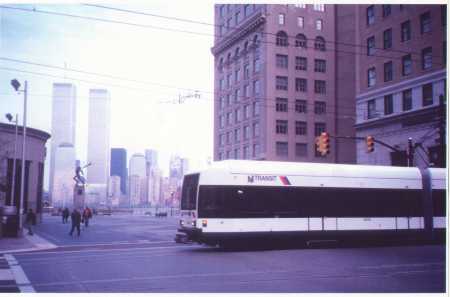
NJ Transit's Hudson-Bergen light rail line train glides in front of the World Trade Center towers as it leaves the Exchange Place station, the temporary northern terminus of the line (see below). Construction continues to the north, eventually to Hoboken and northern Bergen county.
VCTC expects interest in light rail transit to grow in NYC, with a real-life installation just across the river, only a short PATH ride away from Greenwich Village. Until now New Yorkers had to travel to Philadelphia or Boston to see surface light transit operating in city streets. New Jersey selected light rail technology because it is far less costly to build, and can be placed in service far more quickly, than subways. With frequent street-level stations, LRT becomes an attractive competitor to the auto for access to the dense residential and commercial development growing along NJ's Hudson River waterfront. Operating in its own reserved right of way on surface streets LRT provides a distinct advantage over buses delayed in mixed traffic. Modern light rail vehicles like those used on the waterfront line have curb-height low floors for easier boarding, an especially important feature for seniors and the disabled. Dwell time is also substantially less than for buses because passengers can use multiple doors on these 90 foot long rail cars instead of passing single file by the fare box on a bus. To accomplish this, passengers must purchase tickets or passes in advance and be able to display them when asked by random fare inspectors. This "proof of purchase" fare collection system, a first in the New York area, is the norm on most European rail systems and is used on all new LRT systems in the U.S. VCTC proposes both low floor trolleys and proof of purchase fare collection on a restored 8th Street Crosstown Trolley.
While the impetus for constructing the HBLRT was primarily to serve the growing "gold coast" development along New Jersey's waterfront, the initial segment functions as a feeder to PATH for travel to the Manhattan Central Business District-the region's most concentrated workplace. The starter line begins at 34th Street in Bayonne and makes three intermediate stops to serve older residential communities along what was once the busy mainline of the Jersey Central railroad. At the newly completed Liberty Science Center, a branch from southern Jersey City joins the mainline. Signs of renewal and new construction are in evidence near each of the stations on both lines.
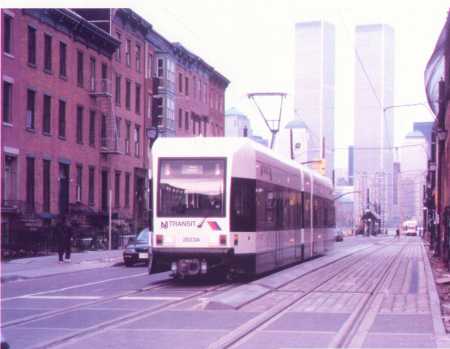
On Essex street, the streetcar shares space with one lane of traffic in the southbound direction. Northbound streetcars have their own right-of-way. A second streetcar, moving north, can be seen in the distance on far right moving away from the Essex Street station.
North of the Science Center, the route follows a new surface alignment through abandoned industrial areas that are soon to be redeveloped for housing and a new medical center. In the Paulus Hook Historic District the LRT operates on Essex Street. Many of the row houses along Essex Street resemble those in the Greenwich Village Historic District, both developed in the same era (see picture above). The trolley turns north on a newly rebuilt Hudson Street, just behind the famous Colgate clock, and reaches its temporary terminus at Exchange Place adjacent to the PATH station.
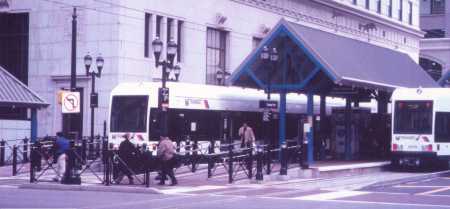
Exchange Place station in Jersey City, New Jersey. Using state-of-the-art low floor vehicles, boarding is easy at platform level, requiring no stairs to enter the train.
Exchange Place was once the hub of a very extensive trolley system serving Hudson County and the terminus of the Pennsylvania Railroad, where passengers transferred to ferries for the trip across the Hudson. After the railroad built its own tunnels and a new station in midtown Manhattan in 1910, downtown Jersey City lost its transfer function and related commercial activity. It became a manufacturing and distribution center, including among its many factories Colgate, once the largest soap producing facility in the world. By the 1980s, global competition had caused these activities to decline and Colgate, like most of the other nearby factories, ceased operation. Colgate flattened all of the buildings in its complex and began a campaign to attract financial services from higher priced office space in Manhattan. Now massive office developments flank the light rail line at this location. A new ferry service also relieves some of the PATH overload to Lower Manhattan.
Construction continues on the light rail line north of Exchange Place, to the Newport Center at the Pavonia PATH station. This street-level segment, when completed this fall, will allow passengers to transfer to the Uptown PATH line for direct service to the Village and to Midtown Manhattan. Completion of the line to the Hoboken, NJ Transit commuter rail terminal is scheduled for next year. Later phases will extend the line north to Bergen County. The Pavonia-Hoboken segment includes the most ambitious construction element of this project, a half-mile long elevated structure and a bridge over a canal.
The two mile stretch from Liberty Science Center to Pavonia most closely resembles an urban street railway similar to VCTC's proposed Village Crosstown Trolley line. Traffic signals govern train movements and signal preemption is installed to give light rail transit an edge over motor vehicular traffic. Some start-up problems have been encountered with the control system but city officials are committed to making this feature fully functional. While most of this route segment is in a separate reservation, the light rail line shares street space with local traffic on several blocks of Essex Street. This proved to be the most controversial segment of the new line, with local residents pressing for an alternate route. They were joined by merchants in the Grove Street area, near the PATH station, who wanted the light rail line to revitalize their business district. The Grove Street route would have permitted light rail passengers to reach the Uptown PATH line more quickly, generating higher ridership. (The author of this article assisted these residents and merchants, as a transportation consultant.) With solid support from Jersey City Mayor Bret Shundler, who believed that the Essex Street alignment would permit the Colgate site to be developed more quickly and yield greater economic benefits to his city, that route was selected.
With the exception of this routing controversy, the Hudson-Bergen light rail transit line is about the triumph of grass-roots rail transit activists over government bureaucracy. New Jersey Governor Kean originally suggested a waterfront transit route as part of his "Circle of Mobility" plan to link new commercial developments on the waterfront with inland transportation hubs. But as the plan began to take shape, highway-oriented transport officials argued for an "interim busway" instead of a light rail line. Local residents and environmental leaders discovered plans for a "stealth highway" pieced together from individual roadway proposals. Under the auspices of the NJ Association of Rail Passengers, the Hudson County Chapter of the Sierra Club and other civic organizations, a light rail plan was developed over the objections of state "public transit" officials. Thanks to the untiring efforts of local elected leaders, including Assemblywoman Rose Marie Heck and Bayonne Mayor Joseph Doria, the stealth highway was halted in its tracks and the pioneering light rail line gained approval. Once the decision to build was made construction proceeded very quickly using a new technique-design, build, operate and maintain (DBOM). A single contractor, 21st Century Rail, was selected after a competitive procurement process to handle all aspects of this project.
A concerted effort by a dedicated group of community advocates is needed to press public agencies to advance a visionary project. Rarely in New York City or elsewhere do political "leaders" lead. Instead they react to grass roots pressure. A much-needed project can gain its greatest momentum in reaction to a perceived threat-in the case of the Hudson-Bergen LRT, the stealth highway. Greenwich Village's Washington Square Park became auto-free only when Robert Moses proposed widening an existing roadway through the park. Problems along the Village Crosstown Corridor, Christopher Street, 8th Street, St. Marks Place and East 10th Street have been around for a long time. Only when younger motorists made 8th Street a drag strip did the police react and close the street to traffic in late night hours. The untiring effort of the Village Alliance BID to widen the heavily trod, but far too narrow, sidewalks on 8th Street is a commendable exception.
Recognizing the long term challenge to advance its crosstown trolley proposal through education, rather than in reaction to a specific crisis, VCTC enthusiastically publishes this newsletter and meets with community organizations to explain the advantages of a pedestrian-only light rail transit corridor through the Village. The opening of the Hudson-Bergen light rail line, only a short PATH ride away, gives a great opportunity to show how our plan can greatly enhance the livability of our community.
Trolleys once again rolling down the streets of Jersey City is welcome news for all transit advocates in the New York Region. Yet the Hudson Bergen Light Rail Transit Line lags far behind all other new light rail installations in the U.S. in fare integration. While a monthly pass costs $53, less than the $63 MTA requires for New York City transit service, and permits unlimited rides on feeder buses as well as on the light rail line, single trip fares are another matter. The single trip fare, good for an hour and a half of riding on the light rail line, is not honored on local buses-another dollar is required. And for light rail riders transferring to the PATH system, yet another dollar is charged. It is hard to imagine a more effective way of discouraging potential new light rail riders.
While NYC Mayor Guiliani rails against the heavy subsidy the Port Authority gives to New Jersey residents with its low one-dollar PATH fare, transit riders have a different perception. Most PATH riders require at least one other mode of transportation to complete their trips: either by bus or subway in NYC or by train or bus in New Jersey. For a traveler going from the center of Bayonne, NJ to Rockefeller Center or Grand Central, a single trip costs $5.00 each way ($1 for a local bus, $1.50 for the LRT, $1 for PATH and $1.50 for NYC Transit). A trip of similar length from Bay Ridge in Brooklyn to midtown Manhattan costs only $1.50 using a MetroCard.
Many transit advocates favor extending the MetroCard to PATH as a first step to regional fare integration. NJ Transit local buses and the light rail system feeding PATH could also use the MetroCard. While raising the PATH fare to $1.50 would increase the price for those travelers who can walk to or from PATH, offering a free transfer for local transit service on either side of the Hudson would be a bargain for most PATH riders. Local buses in Jersey City could still retain their $1 fare for non-transferring passengers, similar to off-peak riders on New York City-subsidized buses in Queens. Another boost for HBLRT ridership would be extension of local bus routes in Staten Island to the Bayonne terminal, coupled with integrated fares.
The New York Region has long suffered from separate transit systems requiring costly and inconvenient transfers between jurisdictions. The result is half hour motor vehicle queues at the Holland and Lincoln Tunnels each weekday and some of the worst air quality in the nation. It is time to put parochial differences aside and work for a comprehensive regional transit system. The HBLRT is an important part of a new vision for public transit in the Region. Its fare structure should be an example to follow, not a weak point.
VCTC would be happy to present a slide show to any organization about trolleys in general as well as our proposal for a crosstown light rail transit line through the Village. Call George Haikalis at 212-475-3394 for more info.
Trolleys offer attractive way to Reach San Francisco's Fisherman's Wharf
Saturday, May 4, 2000 saw the completion of an extension of San Francisco's popular Market Street trolley--the "F" line--to Fisherman's Wharf, the city's most popular tourist attraction. The $80 million extension has doubled ridership on the F line, now over 20,000 per day. The extension follows a rebuilt Embacardero surface highway that replaced the much-despised elevated freeway along San Francisco's spectacular waterfront. Ten 1928-vintage streetcars from Milan, Italy have been added to the F line's fleet of PCC streamliner trolleys. Painted in the liveries of a dozen former U.S. trolley companies, the PCCs have been running on Market Street for several years. The F line supplements two cable car routes that have been the traditional link from downtown to the Wharf area.
Letter From the Editor
Dear Reader,
Light rail transit is inching closer to NYC--so close in fact that you can see it from the shore of the Hudson River. Across the river in Jersey City, NJ, the Hudson-Bergen light rail transit line began operating in mid-April. This issue of MAKING TRACKS is dedicated to this transit line. It is our hope that by reading the stories and viewing the pictures in this issue, all will be educated about the facts regarding light rail transit--including non-polluting, easy on/off boarding, low noise. Help us in our cause to bring this method of transportation across the river to NYC, where it once existed throughout the five boroughs.
Michael Goodman, Editor
NY Today
TimeOut New York
CitySearch New York
