Making Tracks Through Cyberspace

Village Crosstown Trolley Coalition
Making Tracks through the Village.Greenwich Village, New York City
Become a Member
Contact VCTC
The 8th St. Corridor
GV Transit
Newsletter
Questionnaire
Board of Directors
Volunteers Wanted
Calendar of Events
Transit Links
MAKING TRACKS - Vol. 5, No. 4 - Fall 1999
Entire contents of MAKING TRACKS is copyright © 2000 by Village Crosstown Trolley Coalition,
but may be reproduced either in whole or in part with a clear acknowledgment of the source.
Please report any errors to us at VCTC. Thanks.
Inside this Issue
Greenwich Village Historic District: A Trolley Ran Through It
A Trolley Rolls in Brooklyn
Modern low-floor trolley in Historic Vienna
The Tracks of New York - No. 1, Metropolitan Street Railway - 1907
Letter to the Editor
Letter from the Editor
By George Haikalis
Greenwich Village residents are justifiably proud of their historic district. The designation made on April 29, 1969 by the Landmarks Preservation Commission was the culmination of a two decade long struggle to preserve the charm and character of one of America's most famous urban neighborhoods. By far the city's largest when it was designated, the 65-block district encompasses some 2,000 buildings. NYC's pioneering landmarks preservation law came into being in 1965, two years after wreckers began demolishing the monumental and notable Pennsylvania Station, one of city's two massive train stations. This act of architectural vandalism, accompanied by the threat of a similar destructive act against Grand Central Terminal, ignited civic leaders to move quickly to enact legislation.
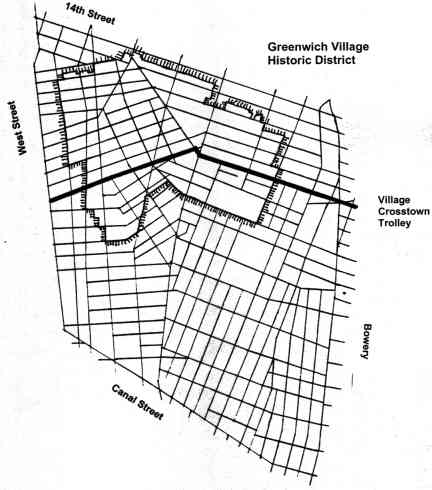
Greenwich Village Historic District. Help advance preservation efforts in the Village. Contact the Greenwich Village Society for Historic Preservation at 212-475-9585.
The 1965 landmarks law came too late to save another NYC transportation treasure-the extensive network of street railways that was the largest and busiest in the world. In 1936 nearly half of Manhattan's street car lines, including the 8th St. Crosstown Line, were converted to diesel bus operation. By 1948 the remaining lines in Manhattan suffered the same fate. The LaGuardia Administration was eager to "modernize" mobility in the city. But removing streetcars not only greatly reduced the utility and attractiveness of surface public transportation-it opened the floodgates for massive intrusion of motor vehicles into dense urban areas, like Greenwich Village. Noise, air pollution, congestion and deaths and injuries were the unanticipated ill effects of this "modernization."
The Village's historic preservation movement began in earnest in reaction to city transportation czar Robert Moses' plan to widen the roadways through Washington Square Park and extend Fifth Avenue south into his planned urban renewal areas in what is now Soho. Villagers organized to stop this roadway in 1953, and won a surprising victory-a completely auto-free park. The potential loss of hundreds of Civil War era cast iron structures in the area from Houston south to Canal St., and the displacement of thousands of manufacturing jobs, created an effort to halt Moses' destructive urban renewal programs and set the stage for the historic preservation movement that followed.
The Village, with its unusual street grid and equally non-conforming residents, was long a cradle of free speech and determined action. Revolutionary war hero Thomas Paine was one of the Village's earliest residents. Famous for its artists and playwrights, the Village seemed frozen in time by the end of the Second World War. While a few high rise buildings were built in the 1920s, the bulk of the Village's housing stock was low rise, some of it dating to the 1830s but most built during the hey-day of the streetcars-the 1870s through the 1920s. After the Great Depression and the Second World War, when very little construction took place in the city, developers were eyeing the Village for sites for new high rises. By the 1950s a number of new "luxury" apartment houses had been constructed, displacing older buildings and their tenants. As much a social movement about tenant rights as a historic preservation effort the "Save the Village" committee was established. In her oral history transcribed and preserved by the Greenwich Village Society for Historic Preservation, Ms Doris Diether, one of the committee's founders and hardest working members, describes efforts to halt demolition of the Village's historic housing stock. To call attention to the "avaricious landlords" who were moving ahead with new building plans, the committee rented a pig to lead a demonstration. While the "pig squealed indignantly" and "stood haughtily", according to the NY Times, the gimmick worked helping to build support for preservation legislation which passed five years later.
The 50-block Brooklyn Heights Historic District was the first designated under the city's new landmarks preservation law in 1965. There was little controversy about that district where almost all the structures were built at about the same time, and of relatively homogeneous architectural style. The Village district was a different story. Real estate interests argued that it was inappropriate to create a district with such a variety of building styles and construction dates. Instead they proposed that a checkerboard of 18 separate mini-districts be designated, with many development sites spared. The Real Estate Board of New York, the Sixth Avenue Association and the Greenwich Village Chamber of Commerce were concerned that economic development would be stifled. But in the end community leaders prevailed and the district survived intact.
Now after thirty years it is clear that by preserving an entire community, one with such a rich legacy of art and culture, the economic value of all the parcels is greater, and the value to the city is even more important. The Village remains one the city's most vital tourist attractions, generating millions of dollars of tax revenues and providing jobs for thousands of workers in the tourist industry. Recognizing this the Village Alliance Business Improvement District, which looks after a key segment of the 8th St. retail strip in the core of the historic district, has been especially creative in encouraging merchants to upgrade their storefronts to conform to district standards. Under the able direction of its Executive Director Ms Honi Klein, the Village Alliance has pressed for improvements that would enhance the attractiveness of the street for visitors and residents alike.
Still missing from the historic district is the surface transportation mode that grew up along with the district, and was very much a part of its ambience for nearly 60 years-the 8th St. Crosstown Streetcar. We at the Village Crosstown Trolley Coalition continue to remind our friends and neighbors that the traffic mess on Christopher St., 8th St. and St, Marks Place is not the appropriate historical context for transportation in the Village. Restoring the streetcar line in this corridor is both practical and an economic necessity. Since the overwhelming majority of travelers on this crosstown street already walk or use public transport, creating a pedestrian-only street along with the streetcar line would greatly improve the livability of the Village. Motorists are an intrusion in any historic district and especially in the Village, where more than 80% of households do not own cars even today.
The redesign of the crosstown street and the restoration of streetcar service would require careful planning to enhance the historic district. VCTC believes that modern, low floor streetcars would best serve the needs of the traveler and that sensitively placed overhead wires would be preferable to restoring the subsurface conduit for electric power. Streetcars can complete the historic preservation effort championed by so many civic activists in the Village some three decades ago.
By Carter Craft
The civil-war era storehouses along the Brooklyn waterfront provided a scenic backdrop as the Number 3 car rolled out of the car barn and made a quarter-mile trip from Van Brunt to Conover Streets in Red Hook. In a century that saw the development of intricate trolley networks throughout the United States, and then their rapid demise, New York history was made on October 31, 1999 when the Brooklyn Historic Railway made its inaugural run.
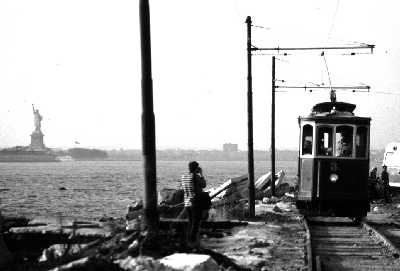
Brooklyn Historic Railway car #3. Built in 1897 by the Schuckert Company of Nurnburg, Germany, the Brooklyn Historic Railway car #3 was first used on the Hollmenollen Line in Oslo, Norway. Rumor has it that it was used by King Oscar II of Norway.
With a gathering of nearly one hundred supporters, friends, and neighborhood residents, Railway president Bob Diamond donned an engineer's cap and pulled the lever to set the historic Number 3 car in motion. On this warm autumn afternoon, the steel wheels squealed and the waters of the Upper Bay slapped at the bulkhead, throwing a fine mist across the side of the historic car as the crowd cheered.
"This is the culmination of nearly two decades of backbreaking work" said Bob Diamond, founder of the trolley and President of the Brooklyn Historic Railway Association (BHRA).
"When I started this project back in 1981, I never imagined we'd end up on the most prominent stretch of the Brooklyn waterfront. Now I can only think of one place I'd rather be," he said, with a quick pause and a wry smile, "downtown Brooklyn."
The gradual progress of the Red Hook trolley over the 1990s provides a sharp contrast to the rapid set of accomplishments in the last few months of 1999. For a project whose progress was long marked in linear feet of track laid per year, the beginning of the City's land use review process (known as the Uniform Land Use Review Procedure or "ULURP") in Summer 1999 suddenly put the project in high gear.
The process began at the Independence Savings Bank just across from the Red Hook Houses in late August. That night, at a hearing of Community Board 6's Land Use Committee, Trolley engineers Diamond and Greg Castillo made a presentation on the proposed route of the Trolley, focusing on the relationship with city streets and adjacent businesses.
In the audience were supporters and skeptics. For the Committee members, issues such as impacts on parking, deliveries, and pedestrian safety seemed most important. To allay these concerns, Diamond explained the system of dedicated trolley signals that would be used, as well as the emergency braking system and numerous electrical controls.
As for traffic impacts, Diamond emphasized that the current project would only provide service on Sundays, thus minimizing the effect on commercial traffic. Yet he also did not discourage any speculation by the audience that trolley service could be expanded in the future.
"There's simply not much transit here," said Diamond, "all Red Hook has is a single bus line, and we believe this project is a real improvement to the transit system of the whole community."
After a brief caucus the committee approved the project on two conditions. First, that the trolley's current landlord agree to a 20 year lease to Diamond. "What good will those tracks be," said one committee member, "if the Trolley loses its lease on the storage barn?"
The second condition was that the Trolley demonstrate operation within 60 days. Based on the recommendations of the Committee, the full board approved the project in September, and then all eyes turned to the October 31 deadline.
The Red Hook Trolley project has experienced-some might say been "plagued" with administrative oversights, errors, and guffaws. At least some of the stumbling blocks, says Diamond, may not have been just unfortunate occurrences.
"First the whole project file disappeared just after a project manager left the department," said Diamond, shaking his head with both laughter and frustration, and we had to resubmit the whole drawing and design package. Then," he continued, "the day we show up for our ULURP hearing before the City Planning Commission we're told that the hearing has been postponed because someone forgot to do the photocopying of the information packets for the commissioners."
Two weeks later the mistake was corrected. In early December the New York City Planning Commission voted unanimously to allow the Trolley to expand onto the city street network. "Who could vote against the trolley?" asked Planning Commissioner and Yale Professor Alex Garvin.
Coincidence and conspiracy aside, it's worth remembering that trolleys vanished from city streets or city life in almost 50 years. The Agency that administers the federal grant funding for the Red Hook Trolley, the New York City Department of Transportation, did not even exist until the early 1970s. Perhaps the projects' greatest challenge is to instill a sense of necessity and public benefit in how this project can help to serve a transit-poor neighborhood and act as a lever in the waterfront revitalization of this historic neighborhood.
The most interesting chapter of the Brooklyn Waterfront Trolley is yet to be written. Just a half mile north of the currently mapped route, the future Brooklyn Bridge Park is taking shape. With $2 million dollars in planning funds from the New York State Department of State, this $80 million park project may act as a magnet for the Trolley, whose supporters foresee a waterfront route that extends north to the Navy Yard and perhaps beyond to Williamsburg and Greenpoint.
Asked about his plans for 2000 and beyond, Diamond is most concerned with the immediate next steps.
"Right now we're waiting to get the go ahead from City Department of Transportation to begin work in the street. ULURP is over, and more money was approved, but we're still waiting for it to become available."
Carter Craft is the Editor of Waterwire
Ed. note: This Spring, BHRA plans to resume the regularly scheduled Sunday hours beginning again in April, weather permitting. If you would like to assist BHRA call 718-941-3160.
Modern low-floor trolley in Historic Vienna
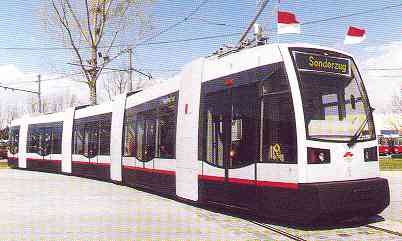
In modernizing its extensive tramway system, Vienna selected the Elin ULF 197 ultra low floor tram. The trolley floor is only 7.8 inches above the rail, by far the lowest in operation anywhere in the world, making trams easy to board for travel in this historic European city.
The Tracks of New York - No. 1, Metropolitan Street Railway - 1907
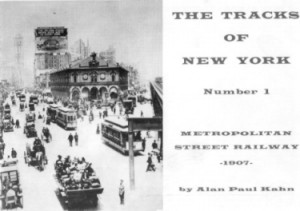
Originally published by the Electric Railroaders' Association in 1973, this splendid volume includes six full pages of track plans showing Manhattan's streetcar network in 1907, carhouse and yard plans, a description of each of the forty-seven routes then in operation, a brief history of the system and numerous photographs. A must for anyone interested in the history of the city or in light rail, past or future. A bargain at $7.50, copies are available to our readers for a limited time only at $6.50, postpaid. Send check or money order payable to VCTC, PO Box 409, New York, NY 10014.
Letter To the Editor
Support for VCTC Proposals
I picked up a copy of Making Tracks, found it interesting, and checked your Website. Very interesting. Here are a few thoughts.
The several proposals for crosstown LRT lines in Manhattan all appear to have merit because of the very large volumes of passengers likely to ride. However, as proposed, they do not make a system. I believe there would be synergy of a system if one or more main north-south avenues were also converted to LRT, especially on avenues that have no subway and are relatively remote from a subway.
The proposed crosstown subway lines would be so costly that they would never be built. This leaves LRT as the only viable improvement, other than "improved bus service." The latter shows up in nearly all studies, and it has been my opinion that, if the transit operator were doing his job, no additional improvements would be justified.
I have reservations about preserving conduit trackage even though I am very interested in transit history and transit technology. George Krambles and I surveyed a proposed restoration in the DC area that would have made use of the existing exposed conduit trackage in Georgetown. We found that the slot was closed throughout the route, indicating that in all probability the yokes were broken. Modern motor trucks are far heavier than the designers of those cast iron yokes ever envisaged, so it is not surprising that nearly all were broken.
Therefore I suspect that it will probably be necessary to completely replace the track structure for any new LRT lines in Manhattan. The use of Professor Leslie (Univ. of Liverpool, UK) low profile rails might keep costs within reason (given that no construction in Manhattan is reasonable).
And yes, I agree that overhead contact is the only reasonable power source. Best wishes for your several LRT proposals.
Bill Vigrass
The writer, Assistant General Manager/Superintendent of Equipment of PATCO prior to his retirement and former Chairman of the Transportation Research Board's Committee on Rail Transit Systems, is a well-known writer and authority on transportation issues.
Letter From the Editor
Dear Reader,
This issue of MAKING TRACKS is "historic" in nature. The landmarking of Greenwich Village in April 1969 came too late to save the streetcar network that stretched throughout the city. Read about how the landmark status came about and how the return of streetcars to Greenwich Village could enhance its historic nature. Across the river in Brooklyn, history was made recently when the Brooklyn Historic Railway made its inaugural run. President Bob Diamond describes the process that led to this historic occasion and how the return of streetcars to Brooklyn streets will help the neighborhood. Bob Diamond's "grass roots" effort to build a waterfront trolley in Brooklyn encourages us at VCTC to continue to press for our crosstown trolley line.
Michael Goodman, Editor
NY Today
TimeOut New York
CitySearch New York
