.jpg)
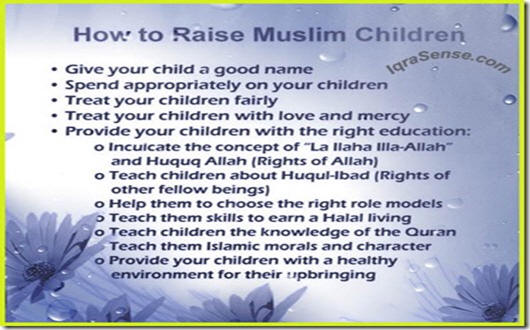 Give the child a good name
Parents have the responsibility to provide the child with a good name which is in accordance with Islamic traditions. One of the hadith in this context is the one narrated by Naafi’ that Ibn ‘Umar said: The Messenger of Allah (sallallahu alaihi wa sallam) said: “The most beloved of your names to Allah are ‘Abd-Allah and ‘Abd al-Rahmaan” (Narrated by Muslim, 2132).
Parents, and especially fathers, have the responsibility to spend on their children in ways that can help their proper upbringing. It was narrated that ‘Abd-Allah ibn ‘Amr said: The Messenger of Allah said: “It is sufficient sin for a man if he neglects those on whom he is obliged to spend” (Narrated by Abu Dawood, 1692; classed as sahan by Shaykh al-Albaani in Saheeh al-Jaami’, 4481). Another hadith in this context states that ‘Aa’ishah, the wife of the Prophet , said: A woman came to me with two daughters and asked me for food, and I could not find anything except one date which I gave to her. She shared it between her two daughters, then she got up and went out. The Prophet came in and I told him what had happened. He said: “Whoever is in charge of any of these girls and treats them well, they will be a shield for him against the Fire” (Narrated by al-Bukhaari, 5649; Muslim, 2629).
 Treat your children fairly
All children within a family have their own rights to be treated fairly. This right was referred to by the Prophet in the saheeh hadeeth:“Fear Allah and treat your children fairly” (Narrated by al-Bukhaari, 2447; Muslim, 1623).
Parents should not show undue preference to their children based on their gender or other criteria. Unfair treatment can arouse a feeling of jealousy and hatred in children that can continue for life and can also lead to bitterness in the child’s heart toward the parents as well. The Prophet referred to this in the hadeeth narrated by Muslim (1623) when he said to the father of al-Nu’maan, “Would you like them to honor you equally?” He said, “Yes.” In other words, if you want them all to honor you equally, then be equally fair to all of them.
Even about the inheritance that children are bound to receive from parents, Allah ( has made it clear that it does not depend on the parents’ wishes but has to be given according to the laws laid down in the Quran:
“Allah commands you as regards your children’s (inheritance)…” (An-Nisa 4:11).
Treat your children with love and mercyParents have the obligation to show love and mercy to their children. This will help children to develop normal and stable personalities and will also make it easier for children to love and respect their parents and elders when they grow up. Seeing the Prophet kissing his grandson, a person named Alaqr’a Ibn Habis found this behavior strange and said, “I have ten children, but I have never kissed any of them.” The Prophet replied, “The one who has no compassion will not be treated mercifully” (Bukhari and At-Tirmidhi).
One of the most important facets of raising children is for the parents to provide them with the right training. According to Islamic traditions, the best gift that parents can provide to their children is training that can help them live as responsible Muslim adults fulfilling the rights of Allah and others. This, then, can lead them to succeed in the hereafter as well. The Prophet (sallallahu alaihi va sallam) said, “The best gift to children from parents is their correct training”(Tirmizi).
Educating children in such a way that they can be successful both in this life and the hereafter should be the supreme responsibility of parents. In today’s world, while it is common to see parents focus on the kind of education that can help them toward building the right careers and in making a living, the focus on Islamic education rarely gets its due focus. Depriving children of proper Islamic teachings can prevent children from building a close relationship with their creator Allah, which is the cornerstone of all success in this life and the hereafter. A good religious education grounded in love of their Lord, on the contrary, can help them live a more peaceful life, deal with life’s challenges easily and maturely, and fulfill the rights and obligations of all around them (including the parents themselves), leading the children to grow up as better citizens of their communities and making them an integral part of the overall Muslim Ummah.
The following provide some of the key responsibilities of the parents in terms of raising and training their children:
Parents should inculcate in their children the correct ‘aqeedah of the oneness of Allah followed by all religious acts of worship that are needed for them to get close to Allah. This involves teaching children all rights of Allah, which can come by children fully understanding the concepts of Tawheed. The principles of Tawheed should never be taken lightly because they mark the boundaries of entering Islam. Mu`âdh bin Jabal relates that the Prophet (peace be upon him) said to him: “O Mu`âdh! Do you know what is Allah’s right over His servants and what their right is over Him?” I said: “Allah and His Messenger know best.” He said: “Allah’s right over His servants is that they worship Him without associating any partner with Him in worship, and their right over Him is that He does not punish anyone who worships Him without associating any partner with Him in worship” [Sahîh al-Bukhârî and Sahîh Muslim].
Eeman (belief/faith) in Allah comprises of the following distinct concepts that parents must strive to teach their children:
1. Faith (Eeman) in the Existence of Allah: This refers to believing in Allah – not just any God – but specifically Allah as the supreme being of this universe and all that exists in this universe.
2. Faith (Eeman) in the Rububiyah (Lordship) of Allah – This refers to believing in Allah as the true Lord of this universe and as the controller of all aspects of this universe.
3. Faith (Eeman) in the Uluhiyyah (Worship) of Allah – This refers to singling out only Allah as the one who is worthy of any worship.
4. Faith (Eeman) in al-Asma was-Sifat (the names and attributes) of Allah – This refers to belief in Allah’s names and attributes.
Believing and living life on the concepts of Tawheed not only can lead to ultimate salvation, it can also nurture the love of Allah in the children’s hearts at an early age, which is the essence of our relationship with Allah. The Quran also gives us examples where prophets and the righteous stressed the importance of fulfilling the rights of Allah to their children. As an example, Luqman (alaihis’salam) provided the following instructions to his son as mentioned in the Quran by Allah:
“And (remember) when Luqmaan said to his son when he was advising him: “O my son! Join not in worship others with Allah. Verily, joining others in worship with Allah is a great Zulm (wrong) indeed” [Luqmaan 31:13].
As part of this training, parents should also ensure that they train their children on all the rituals of worship including the five times obligatory prayers, fasting, charity, Hajj, reciting Quran, and so on. A hadith in this context clarifies this concept where Mu’adh ibn Jabal narrated that, “I said to Allah’s Messenger (peace be upon him): Inform me about an act which would entitle me to get into Paradise, and remove me away from Hell-Fire. He (the Prophet) said: You have asked me about a matter (which ostensibly appears to be) difficult but it is easy to those for whom Allah, the Exalted, has made it easy. Worship Allah and do not associate anything with him, establish prayer, pay the Zakat, observe the fast of Ramadan and perform Hajj to the (sacred) House (Ka’bah).”
Teaching children about Huqul-Ibad (Rights of other fellow beings)Huqul-Ibad is about respecting the rights of others and especially understanding others’ rights from an Islamic standpoint. A concise description of fulfilling both Huqooq Allah and Huqooqul Ibaad is found in the following verse:
“Worship Allah and join none with Him in worship, and do good to parents, kinsfolk, orphans, Al-Masakin (the poor), the neighbor who is near of kin, the neighbour who is a stranger, the companion by your side, the wayfarer (you meet), and those (slaves) whom your right hands possess. Verily, Allah does not like such as are proud and boastful (An-Nisa 4:36).”
For example, children raised in certain non-Muslim cultures may not develop the same respect for parents and elders as mandated in Islam. Children should, therefore, be taught to be respectful and dutiful to their parents, maintain good relations with relatives, and neighbors. Children should also be warned against picking up habits that can lead to disrespecting others. These include backbiting, slandering, lying and abusing others.
Helping children to choose their role modelsRole models help people to model their behavior and character after those personalities. Parents should, therefore, help their children choose their role models wisely. When teaching about Islam and its teachings, parents should help their children learn about the lives of the prophets, especially Prophet Muhammad , sahaba (prophet’s companions such as Abu Bakar, Umar, and so on), tabieen (the ones who followed the sahaba), other salaf (the likes of Hassan al-Basri, Muhammad ibn Sirin, Umar Ibn Abdul-Aziz, Ahmad bin Hanbal, etc.), and early Islamic scholars such as Ibne-Taymiyyah, Ibn Al-Qayyim, Ibn Katheer, and so on. Learning about these personalities of Islam who actualized the teachings of Islam can help children learn from their knowledge and appreciate the relationship that those individuals developed with Allah and how they lived exemplary lives. While it may be difficult to teach children about each one of them, parents should at a minimum introduce these personalities to their children and how such personalities achieved high status within Islamic circles. Planting the seeds of respect for such personalities at an early age in your children’s hearts will make it easier for them to seek out more knowledge about these personalities of Islam when they get older.
Parents should spend their time, effort, and resources to help their children make the right choices for earning a living. In doing so, parents should stress the need for their children to pursue career paths that can provide them solely with Halal (legal) living. Islam places enormous emphasis on this subject and these teachings are clearly stated both in the Quran and hadith. In one case, the prophet said:
“…Purify your food, your supplication will be accepted. By the one in whose hand lays the life of Muhammad, verily a servant places a morsel of Haram in his stomach (and as a result) forty days of worship will not be accepted from him.” (Recorded by Imam Tabrani). In another narration, it is narrated that an angel at Bayt al-Maqdis proclaims every day and night: “Whosoever consumes unlawful (haram) food, Allah Most High will not accept his obligatory (fard) and voluntary worship.” (See: al-Kaba’ir of Imam Dhahabi).
Teaching children knowledge of the QuranIn addition to teaching your children recitation of the Quran, knowledge of the Quran will help your children to think beyond the mundane matters of this life and instead develop elevated thinking that can enable them to ponder about critical issues that can help them reconcile the many confusing ideologies that the world will throw at them as they grow up. Getting them to start thinking about the reasons of their existence, their day to day struggles, and where the world is heading to will make them become more prudent in terms of their life’s priorities.
Consider that once when in Madinah, the prophet had to send a group to Yemen for teaching new Muslims there about Islam. The prophet picked Mu’adh bin Jabal as their leader (even though Muadh was very young – perhaps in his early twenties). The prophet said, “The most knowledgeable of my ummah [community] in matters of Halal [permitted, allowed, lawful or legal] and Haram [forbidden] is Mu’adh bin Jabal.” This shows that knowledge of Quran had expanded the horizons of Muadh to such an extent that the prophet himself picked him as a leader for an important expedition.
Teaching children Islamic morals and charactersBesides teaching children the rituals of worship and the rights of individuals, children should be taught Islamic morals, characters, and etiquette from an early age so that it becomes part of their habits. Children should be taught the principles of humility, tolerance, patience, and other such behavioral traits. These personality traits can help any individual tremendously in their lives. For example, teach them about patience and tolerance and dealing with tough situations, and they will be thankful to you for the rest of their lives. Those of us who struggle in life by not having properly learned such conduct may also very well know their value. Children can learn such conduct by learning hadith as well as learning about the lives of the prophet and his companions.
Provide your children a healthy environment for their upbringingTraining children so that they can grow up to become responsible citizens requires that parents actively maintain an atmosphere at home that is conducive to positive learning and upbringing. This, therefore, requires that parents, too, model their lives according to the Islamic way of life. Children can get conflicting messages and thus can get confused when they do not see parents and elders following the instructions that they give to them, or when out of excessive love for them, parents become so indulgent that they turn a blind eye to their sins and fail in checking them.
It is well known that children who are raised in households where argumentation, fighting, and abuse abound, not only learn less but are more prone to develop personality disorders. There is plenty of research that shows that the serious problems of adolescents, including drug abuse, school failure, delinquency and violence, have grown to tragic proportions in part because of the deteriorating environments in which young people are raised.
ConclusionParents should put in their best efforts to ensure that their children become true inheritors of Islam, and to keep Islam alive in their lives and their families’ lives after their death. Parental efforts are, therefore, quite instrumental in inculcating the love of Islam and the desire to worship in the right manner. Parents should also recognize that raising good children can be a source of their salvation in the hereafter. This is because if parents raise good Allah-fearing children, those children can constantly pray to Allah for their parents after their death. The Prophet Muhammad (sallallahu alaihi wa sallam) said:
“Upon death, man’s deeds will stop except for three deeds, namely: a continuous charitable fund, endowment or goodwill; knowledge left for people to benefit from; and a pious righteous and God-fearing child who continuously prays to Allah, for the souls of his parents” (Muslim).
Finally, let’s not forget that fulfilling the rights of the individuals prescribed by Allah is part of the limits set by Allah that should be taken seriously. Allah states thus in the Quran:
And treat not the Verses (Laws) of Allah as a jest, but remember Allah’s favors on you (i.e. Islam), and that which He has sent down to you of the Book (i.e. the Qur’an) and Al-Hikmah (the Prophet’s Sunnah – legal ways – Islamic jurisprudence) whereby He instructs you. And fear Allah, and know that Allah is all-aware of everything Quran (2:231).
How to bring up your child in Islamic way
 WHY
DOES IT SEEM SO DIFFICULT?
WHY
DOES IT SEEM SO DIFFICULT?
In recent years, many communities have been forced to address a lack of Islamically appropriate conduct on the part of their youth. We have typically attempted to remedy the situation through a set of predictable steps that include the following: sending the youth to Islamic lectures and events, immersing them in the culture "back home", or hoping that this is a phase they will tire of eventually. However, our approach to teaching our children about Islam consistently falls short of success because while we know that a child must be taught to read and write beginning at the age of five, we rarely instill in them the need to pray on time at the same age. Very often, the social surroundings of a person are blamed as the reason behind who and what they turn out to be. There is much to disagree with in this regard; however, the blame cannot be placed solely on the parents ever. The reality is far more complicated and to say "it's the parent's fault" would be absurd, considering that historically we have had Prophets and Imams whose children have disobeyed Islam. What is the solution then?
In many Muslim households, Islam is taught to children in isolation of other concepts and values and we rely far too heavily on the four hours of Sunday school to teach our children an ample amount of information. We also begin teaching basic Islamic values to children too late with regard to their age, and often we may not be teaching them what they need to grow into happy and practicing Muslims and human beings. The impetus is on us as a whole community, not just on those who are blessed to be parents already, to work together to make sure children are surrounded with Islamic values and actions rather than just empty rhetoric.
|
|
What Are the Rights of Children in Islam? |
Before practical measures can be taken to teach important Islamic concepts and behaviors to children, we must recognize that all children in our community hold rights against us. We are currently failing as a collective Muslim community in fulfilling our obligations towards the youngest of God's followers and creations. On the Day of Judgment, each and every one of us is accountable for our work done towards helping our young in attaining an understanding of Islam.
What exactly are the rights of children in Islam? The Prophet Muhammad (peace be upon him and his progeny) said to Imam Ali (peace be upon him): "O Ali, there are as many rights of children incumbent upon parents as there are rights of parents incumbent upon children." According to theThe Family Life of Islam by Allama Sayyid Saeed Akhtar Rizvi, children have six basic rights in Islam:
1. The right to life.
2. The right to belong to a family.
3. The right to have a good name.
4. The right to have proper maintenance.
5. The right to have a basic secular and religious education.
6. The right to be brought up according to Islam.
Keeping in mind that the Prophet and His Household have set forth for us guidelines in how to raise children according to Islam, below are suggestions and steps necessary to facilitate a proper Islamic upbringing in our community.
|
|
Modeling Appropriate Behaviour |
Prophet Muhammad divided the life of a child from the age of infancy to 21 into three stages, each lasting seven years. During the first stage from 0-7 years old, it must be a priority to instill in children the values necessary for a proper upbringing and to work on character building. Those familiar with child development will agree that that is not the period to introduce complex concepts in Islam and nor is it appropriate to use fear and shame as a tactic to get children to comply with Islamic laws. Instead, Prophet Muhammad teaches us that at this stage we must model appropriate behavior and treat children with grace and respect: "Respect your children and teach them good behavior and Allah will forgive (your sins)."
We must model Islamically appropriate behavior before young children in our community at the mosque, community events and in day-to-day activities regardless of whether or not we are the parents. Children at this age absorb information quickly and it's up to us to show them what is and is not acceptable. It is important to also model certain behaviors out loud – for example, when beginning a meal we must say "Bismillah," or "in the name of God," and when we finish a meal we should thank God. It is also important to watch our language, keep calm and remain respectful before children because we are teaching them how to act. Children must be in a positive environment and the Prophet stresses upon the need for this too: "It is among the rights of the child on his father to teach him good manners and keep him in good society."
Imam Ja'far as-Sadiq (peace be upon him) also provides us with a sequence of steps to teach children important Islamic concepts during this age by advising: "When the child reaches three years, teach him seven times to recite 'There is no God but Allah' (la ilaha ill'Allah). Then leave him at that 'til he is three years, seven months and twenty days old; then train him to say 'Muhammad is the Messenger of Allah' (Muhammadun Rasul'Allah). Then leave him at that 'til he completes four years. Then teach him seven times to say 'Peace be upon Muhammad and the progeny of Muhammad' (sall'Allahu ala Muhammadin wa aali-Muhammad). Then leave him at that 'til he reaches the age of five years; then ask him which one is his right hand and which one is the left. When he knows it, then make him face the Qibla and tell him to do Sajda (prostration)."
|
|
Teaching Islam to Children |
When children are 8 to 15 years old, they are in the second stage of their Islamic upbringing. Children during the first two stages are taught the steps of prayer and ablution, until eventually at the age of nine they should be able to master prayer. In many texts and traditions, it is mentioned that once a child has learned how to pray, God will forgive the sins of the parents. It is important to remember that teaching prayer in gradual steps is more logical than teaching prayer in a very short amount of time (a week, for example).
During this stage, children must be taught formal Islamic knowledge. Many families have opted to entrust this large task to Sunday Schools. This approach remains problematic because children are immersed in secular education five days a week and in religious education only a few hours a week. There must be a form of collaboration between parents and weekend Islamic schools so that children are getting the time and attention needed to meaningfully learn and implement Islamic laws and values. During this stage, females also begin to wear the headscarf; however, they must understand that the basis of Hijab is modesty, not simply wearing a cloth on their heads, and that modesty manifests itself in our speech, conduct, friendships, and dress. For both genders, it is important during this stage to limit and eliminate their exposure to un-Islamic television shows, books, and movies due to the large element of anti-religious rhetoric that lies within such things. Furthermore, we must work with the youth at this stage to develop fun and fulfilling alternatives to activities that are forbidden in Islam while also providing them with the reasoning as to why certain activities and television shows are not appropriate for a Muslim to watch.
The final stage of Islamic Upbringing takes place during the ages of 15 to 21, and at this point the hard work of the community in working together to raise a child should manifest itself in the child's conduct. Unfortunately, many families begin Islamic upbringing at this age! This is an ineffective method as we have witnessed and instead, during this stage, we should be reinforcing important ideas and behaviors taught in the first two stages. The Prophet has suggested that parents now act as a "friend" to their child rather than continue in the role of a teacher. However, we have seen some parents take this concept too far and are unable to remind their teenagers of Islamic answers to the typical teenage problems and concerns. For one, we see far too many Muslim families allowing their teenagers to mix freely with the other gender and attend events like prom. This lends itself to a lack of Islamic knowledge on the part of both parent and teenager. Prophet Muhammad said, "A virtuous child is a flower from the flowers of Paradise." He also said, "Among the good fortunes of a man is the virtuous child."
Islamic upbringing begins in the early childhood years and should continue throughout the teenage years. It is the responsibility of all members of the community to work together to instill in our children the best social, moral, and religious values – and these values are found only in Islamic behavior and knowledge.