
Helmholtz observes that his system of just intonation affords an approximation to the harmonic seventh. In fact, if we form a seventh by 14 fifths down in positive systems (fifth = 7 + δ), we obtain a note with negative departure (-14δ), which can approximately represent the har�monic seventh: c - \bb represents such an interval.
Mr. Ellis has observed (Roy. Soc. Proc. 1864) that the mean-tone system, which is negative, affords a good approximation to the harmonic seventh. In fact, if we form a seventh by 10 fifths up in negative systems (fifth = 7 - δ), we obtain a note with negative departure (-10δ), which can approximately represent the harmonic seventh.
Concords of Regular and Regular Cyclical Systems.
These considerations permit us to calculate the departures and errors of concords in the various regular and regular cyclical systems. There is, however, one quantity which may be also conveniently taken into consideration in all cases, viz. the departure of 12 fifths of the system. We will call this Δ, putting Δ = 12δ.
We have then the following Table of the characteristic quantities for the more important systems hitherto known.
The value of the ordinary comma (81/80) is .21560. It is comparable with the values of Δ, and if introduced in its place in the Table would give rise to a regular non-cyclical system, lying between the system of 53 and the positive system of perfect thirds, the condition of which would be that the departure of 12 fifths = a comma.
| Name, or n. | Order, r. | Δ = 12δ, or 12r/n. | Error of fifth, δ - .01955. | Error of third, .13686 - 8δ. | Error of har- monic seventh, .31174 - 14δ. |
| 17 | 1 | .70588 | .03927 | -.33373 | -.51178 |
| 29 | 1 | .41379 | .01493 | -.27586 | -.17101 |
| 41 | 1 | .29268 | .00484 | -.19512 | -.02970 |
| Perfect fifths. | ... | .23460 | ... | -.01954 | .03804 |
| 53 | 1 | .22642 | -.00068 | -.01409 | .04758 |
| Positive perfect thirds. | ... | .20529 | -.00244 | ... | .07223 |
| 118 | 2 | .20339 | -.00260 | .00127 | .07445 |
| 65 | 1 | .18462 | -.00417 | .01378 | .09635 |
| (δ = r/n - is here negative.) | .13686 + 4δ. | .31174 + 10δ | |||
| 43 | -1 | -.29707 | -.04431 | .03784 | .06418 |
| 31 | -1 | -.38710 | -.05181 | .00783 | -.01084 |
| Mesotonic. Nega- tive perfect thirds. | ... | -.41058 | -.05376 | ... | -.03041 |
| 50 | -2 | -.48000 | -.05955 | -.02314 | -.08826 |
| 19 | -1 | -.63158 | -.07218 | -.05367 | -.21458 |
A few systems of the higher orders, which possess some interest, will be given separately.
An illustration may be made as follows, which shows on inspection all the data involved in the above Table, and the properties of any other system introduced into it.
Take axes of abscissae and ordinates, and set off on both distances representing tenths of E. T. semitones - for ordinary purposes 10 inches to the E. T. semitone answers best; for Lecture scale, 1 meter to the E. T. semitone.
On the axis of ordinates set, off points representing the values in column Δ of the Table, and corresponding values for any other system required. Through each of these points rule a straight line parallel to the axis of abscissae.
On the axis of abscissae set off points representing the values -.13686 and -.31174. Rule lines through these parallel to the axis of ordinates. These abscissae represent respectively perfect thirds and perfect seventh.
Draw lines inclined to the axis of abscissae at angles tan-1(3/2) and tan-1(6/7). These give, by their intersections with the lines of the different positive systems, the thirds and sevenths respectively.
Draw lines inclined to the axis of abscissae at angles tan-1(-3) and tan-1(-6/5). These give, by their intersections with the lines of the different negative systems, the thirds and sevenths respectively.
The errors of the thirds and sevenths are the perpendicular distances of the intersections which determine them from the ordinates of perfect thirds and sevenths already constructed.
In Regular Cyclical Systems, to find the number of Units in any interval
in the Scale
Let x be the number of units in the seven-fifths semitone, then
x(12/n) = 1 + 7δ = 1 + 7(r/n),
or
x = (n + 7r)/12.
It is easy to see that x will always be integral if the order condition is satisfied (Th. iii.), viz. if 7n + r is a multiple of 12.
For then 7(7n + r) = 49n + 7r; whence, casting out 48n, n + 7r is a multiple of 12. We can now determine the remaining intervals in terms of x and r: -
| No. of units | |||
| Interval. | Positive systems | Negative systems | |
| 5-fifths semitone.............................. | x - r | .......... | x - r |
| Minor tone ..................................... 10-fifths tone .................................. | 2x - 2r | .......... | .......... |
| Major tone .................................... 2-fifths tone.................................... | 2x - r | .......... | 2x - r |
| Minor third .................................... | 3x - r | .......... | 3x - 2r |
| Major third .................................... | 4x - 3r | .......... | 4x - 2r |
| Fourth ........................................... | 5x - 3r | .......... | 5x - 3r |
| Fifth............................................... | 7x - 4r | .......... | 7x - 4r |
| Sixth............................................... | 9x - 6r | .......... | 9x - 5r |
| Harmonic seventh........................... | 10x - 7r | .......... | 10x - 5r |
| Major seventh ................................ | 11x - 7r | .......... | 11x - 6r |
| Octave............................................ | 12x - 7r | .......... | 12x - 7r = n |
The -r's in negative systems are, of course, positive quantities.
Employment of Positive Systems in Music.
Rule for thirds. - If we write down one of the duodenes of the notation,
f# - c# - g# - d# - a# - f - c - g - d - a - e - b,
and remember that positive systems form their thirds by 8 fifths down, we have the rule : -
The four accidentals on the left in any duodene of the notation form major thirds to the four notes on the extreme right in the same duodene. All other notes have their major thirds in the next duodene below. Thus d - f#, c - \e are major thirds.
Use of the Notation with Musical Symbols.
It is an essential point in this notation that it can be used with musical symbols. The following example shows the major and minor chords and the interval used for the harmonic seventh: -
The first chord is the major triad; the second involves g - \f, the har�monic seventh; the fourth crotchet gives the minor common chord; and the first chord of the second bar is the sharp sixth, rendered peculiarly smooth by employment of the approximate harmonic seventh for the interval /ab - f#.
The employment of positive systems is presupposed with this notation, unless the contrary is expressly stated.
Such passages as this can be played on the harmonium hereafter described.
Principle of Symmetrical Arrangement in Regular Systems.
If we place the E. T. notes in the order of the scale, and set off the departures of the notes of any regular system at right angles to the E. T. line, sharp departures up and flat departures down, we obtain the posi�tions of what may be called a symmetrical arrangement.
The distances of the E. T. notes from the starting-point are abscissae. and the departures ordinates.
Positive Systems.
The subjoined is a symmetrical arrangement of the notes of General Thompson's enharmonic organ (p. 402). It is selected as not being too extensive for reproduction, as being of historical interest, and as illustrating the nature of the difficulty caused by the distribution of such systems into separate keyboards. Each of the single vertical steps represents the departure of one fifth.
The property of symmetrical arrangements, from which they derive their principal importance, is that, position being determined only by relations of interval, the notes of a combination forming given intervals present always the same form, whatever be the key or the actual notes employed.
Let us express, as before, the number of E. T. semitones, which is now our abscissa, by simple integers, and the number of departures of fifths, which is our ordinate, by a coefficient attached to δ. Then we have only to note the values of the different intervals to obtain their coordinates with respect to any note taken as origin.
Thus the third is 4-8δ, or four steps to the right and eight down (c - \e) ; the fifth is 7 + δ seven steps to the right and one up (c - g) ; the minor third is three to the right and nine up (\e - g) ; and so on.
Two notes are omitted from the otherwise complete series, b and \\d ; and we notice the number of otherwise complete chords which their absence destroys.
Distribution over three Key-boards. - As an example of the effect of this, we note that the notes of the chord of a minor are all present ; but they are a1-2 - /c1 - e2, so that the third and fifth are on different keyboards.
Negative Systems.
According to the enunciation of the principle of symmetrical arrange�ment, the positions should be taken lower for negative systems as we ascend in the series of fifths; but it is practically more convenient to use the positive form in negative systems as well. The coordinates of some intervals become different - the third is 4 + 4δ, the minor third 3-3δ, &c.
Symmetrical Arrangement of the Notes of Thompson's Enharmonic
Organ.
The subscripts 1,2,3 refer to its three key-boards.
[these might not be correct, they are hard to read on my copy]
| 12. | /c1 | . | . | . | . | . | . | . | . | . | . | . | /c1 | |
| 11. | . | . | . | . | . | /f1 | . | . | . | . | . | . | . | |
| 10. | . | . | . | . | . | . | . | . | . | . | /bb1 | . | . | |
| 9. | . | . | . | /eb1 | . | . | . | . | . | . | . | . | . | |
| 8. | . | . | . | . | . | . | . | . | /ab1 | . | . | . | . | |
| 7. | . | /c#1 | . | . | . | . | . | . | . | . | . | . | . | |
| 6. | . | . | . | . | . | . | /f#1 | . | . | . | . | . | . | |
| 5. | . | . | . | . | . | . | . | . | . | . | . | . | . | |
| 4. | . | . | . | . | e1 | . | . | . | . | . | . | . | . | |
| 3. | . | . | . | . | . | . | . | . | . | a1, 2 | . | . | . | |
| 2. | . | . | d1, 2 | . | . | . | . | . | . | . | . | . | . | |
| 1. | . | . | . | . | . | . | . | g1, 2, 3 | . | . | . | . | . | |
| 12. | c1, 2, 3 | . | . | . | . | . | . | . | . | . | . | . | c1, 2, 3 | |
| 11. | . | . | . | . | . | f1, 2, 3 | . | . | . | . | . | . | . | |
| 10. | . | . | . | . | . | . | . | . | . | . | bb1, 2 | . | . | |
| 9. | . | . | . | eb1, 2 | . | . | . | . | . | . | . | . | . | |
| 8. | . | . | . | . | . | . | . | . | ab2 | . | . | . | . | |
| 7. | . | c#2 | . | . | . | . | . | . | . | . | . | . | . | |
| 6. | . | . | . | . | . | . | f#1, 2 | . | . | . | . | . | . | |
| 5. | . | . | . | . | . | . | . | . | . | . | . | \b1, 2, 3 | . | |
| 4. | . | . | . | . | \e1, 2, 3 | . | . | . | . | . | . | . | . | |
| 3. | . | . | . | . | . | . | . | . | . | \a1, 2, 3 | . | . | . | |
| 2. | . | . | \d1, 2, 3 | . | . | . | . | . | . | . | . | . | . | |
| 1. | . | . | . | . | . | . | . | \g1, 2, 3 | . | . | . | . | . | |
| 12. | \c2 | . | . | . | . | . | . | . | . | . | . | . | \c2 | |
| 11. | . | . | . | . | . | \f3 | . | . | . | . | . | . | . | |
| 10. | . | . | . | . | . | . | . | . | . | . | \bb2 | . | . | |
| 9. | . | . | . | \eb3 | . | . | . | . | . | . | . | . | . | |
| 8. | . | . | . | . | . | . | . | . | \ab2, 3 | . | . | . | . | |
| 7. | . | \c#1, 2 | . | . | . | . | . | . | . | . | . | . | . | |
| 6. | . | . | . | . | . | . | \f#2 | . | . | . | . | . | . | |
| 5. | . | . | . | . | . | . | . | . | . | . | . | \\b2, 3 | . | |
| 4. | . | . | . | . | \\e2 | . | . | . | . | . | . | . | . | |
| 3. | . | . | . | . | . | . | . | . | . | \\a3 | . | . | . | |
| 2. | . | . | . | . | . | . | . | . | . | . | . | . | . | |
| 1. | . | . | . | . | . | . | . | \\g3 | . | . | . | . | . | |
| 12. | \\c3 | . | . | . | . | . | . | . | . | . | . | . | \\c3 | |
| 11. | . | . | . | . | . | \\f3 | . | . | . | . | . | . | . | |
| 10. | . | . | . | . | . | . | . | . | . | . | \\bb3 | . | . | |
| 9. | . | . | . | \\eb3 | . | . | . | . | . | . | . | . | . | |
| 8. | . | . | . | . | . | . | . | . | \\ab3 | . | . | . | . | |
| 7. | . | \\c#3 | . | . | . | . | . | . | . | . | . | . | . |
Application of Principle of Symmetrical Arrangement to a "Generalized
Key-board" for Regular Systems.
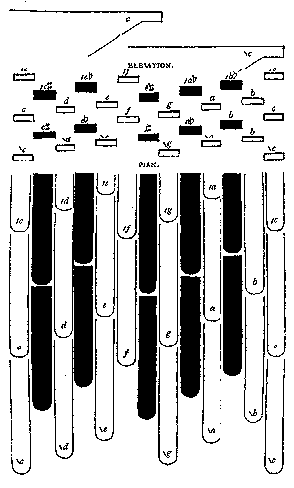
A key-board has been constructed, on the principle of "symmetrical arrangement," in the following manner: -
The octave is taken =6 inches horizontally (in ordinary key-boards the octave is 6 1/2 inches). This is divided into 12 spaces, each 1/2 inch broad. These are called the 12 principal divisions of the octave. A horizontal line gives the positions of an E. T. series where it crosses them all.
The keys are then placed at vertical and horizontal distances from the E. T. line corresponding to their departures, on the supposition that the arrangement is positive.
The departure of 12 fifths up corresponds to a horizontal displacement of 3 inches from the player, and a vertical displacement of 1 inch up.
These displacements are divided equally among the fifths to which they may be regarded as due, i. e. the displacement of g with respect to c is 1/4 inch back and 1/12 inch up; so of d with respect to g, of a with respect to d, and so on.
Although only 3 inches of each key are thus exposed on a plan, yet the keys are all made to overhang 1/2 inch, and thus the tangible length of each key is 3 1/2 inches.
The accompanying figure (p. 404) shows a small portion of the key�board, on a scale of half the real size.
The keys are each 3/8 inch broad, and their centers are 1/2 inch apart. There is thus 1/8 inch free between the adjacent surfaces of each pair of keys, and 5/8 inch altogether between the two keys which rise on each side of any given key. This is of importance; e.g., in the chord c - \e - g - c, taken with the right hand, the first finger has to reach \e between eb - f and under the overhanging e.
The keys in the five principal divisions which have "accidental" names (e. g. c# or db) are black, the rest white.
There are seven keys in each principal division; the seven c's are marked from \\\c to ///c, the unmarked c being in the middle. Thus there are 84 keys in. each octave. The keyboard controls an harmonium which contains the system of 53.
Application of the Positive System of Perfect Thirds to the "Generalized
Key-board" (Helmholtz's system, just intonation).
If the thirds, such as c - \e, are made perfect, and the fifths flat by .00244, a quantity which escapes the ear, we have the system here men�tioned. Helmholtz makes a mistake in describing it ('Die Lehre von den Tonenupfindungen,' ed. 3, p. 495); he supposes that the fifths are sharp instead of flat by the above interval; it is easy to see from the context that this is a mistake.
The notation of positive systems is applicable without specialization.
Application of the Notation of Positive Systems to the System of 53.
The notation introduced for positive systems is susceptible of various accessory rules, according to the system it is attached to. In the harmonium to which the above-mentioned key-board belongs the system of 53 is adopted. It is required to find rules of identification for passing from one principal division of the octave to another.
Rule. - In the system of 53 the notation of positive systems becomes subject to the following identifications: -
If two notes in adjoining principal divisions (e. g. c and c#) be so situated as to admit of identification (e. g. a high c and a low c#), they will be the same if the sum of the elevation- and depression-marks =4; unless the lower of the two divisions is black (accidental), then the sum of the marks of identical notes =5.
This can only be proved by enumeration of a case in each pair of divisions. This enumeration is made in the writer's original paper. It is founded on the following principles: -
Noting that the 5-fifths semitone is 4 units (scheme following Th. i.), we see that c - c#, is 4 units, whence ////c - c#, ///c - \c#, //c - \\c#.... are identities; or, again, c# - \d is 4 units, and ////c# - \d, ///c - \\d.... are identities.
Application of the System of 53 to the "Generalized Key-board."
An harmonium has been constructed which is arranged as follows: -
The note \\\c is taken as the first note of the series, and receives the characteristic number 1. Then c is 4, and the remaining numbers can be assigned by the rules for the identifications in the system of 53 given above.
A number of notes at the top of the keyboard are thus identical with corresponding notes in the adjacent principal divisions on the right at the bottom, e.g. //c = b = \\c#. These permit the infinite freedom of modulation which is the characteristic of cyclical systems; for in moving upwards on the key-board we can, on arriving near the top, change the hands on to identical notes near the bottom, and so proceed further in the same direction, and vice versa.
It is to be noted that, in positive systems, displacement upwards or downwards on the key-board takes place most readily by modulation between related major and minor keys - not, as has been commonly assumed, only by modulation round the circles of fifths. In negative systems, on the contrary, displacements take place only by modulations of the latter type.
Application of the System of 118 to the "Generalized Key-board."
The 5-fifths semitone is here 9 units, and the 7-fifths semitone is 11 units. The major tone (2-fifths tone) is consequently 20, and the minor tone (10-fifths tone) is 18. Hence the notes in the successive principal divisions are alternately odd and even, and the identifications lie in alternate columns. These are not here further investigated, as no practical use has been made of the system.
If c = 1, c# = 10, /c# = 12, d = 21,....
It would be possible to construct a keyboard on the principles already explained, which would give complete control over the notes of the system of 118. A portion of such a keyboard would be practically indistin�guishable from one tuned to the positive system of perfect thirds, as the error of the thirds of the system of 118 is too small to be perceived by the ear.
Application of the Negative System of Perfect Thirds (Mean-Tone System)
to the "Generalized Key-board."
If the thirds, such as c - e, are made perfect, and the fifths .05376 flat, we have the mean-tone system. The forms of scales and chords in nega�tive systems are different from those in positive systems. The scales are very easy to play, and the chords also. It is expected that this applica�tion may prove of practical importance.
Following the scale of unmarked naturals on the plan, we can realize the nature of the fingering. It is the same as that of the Pytha�gorean scale with the system of perfect fifths. The tones are all 2-fifths tones, and the semitones both 5-fifths semitones.
Application of the Negative System of 31 to the "Generalized
Key-board."
The fifths are a little better than in the last case, viz. .05181 flat; the thirds .00783 sharp. The only difference in the employment of the system is that the arrangement is cyclical. The tones all consist of five units, semitones of three.
The Investigation of Cycles of the Higher Orders - the new Cycle of 643
and others.
The system of 301 is of interest, as combining the properties of a tolerably good positive cyclical system with the representation of intervals accurately to three places by means of logarithms. Mr. Ellis has lately used this system, in particular, for approximate calculations. It appears to be of some interest to investigate generally what systems of higher orders do represent either of the systems with perfect thirds, and with what degree of accuracy they do so.
First, with respect to positive systems. If a system n of the rth order be a close approximation to the system of perfect thirds, then will -8(r/n) (the departure of its third) approximate in value to -.13686; or
r/n = (.13686)/8 = 1/(58*4526) nearly,
or
n = r 58.4526 nearly.
Now, when r = 2 we have the system of 118, which affords the c1osest approximation to what is required of any cyclical system known hitherto, the error of its third being .00127.
Referring to Th. v., it is easy to see that no other even system of an order much below the 24th can afford a better approximation; for the number 118 differs from the value given by the above condition by little more than unity. Its multiple is always of the right order (Th. v.); there can therefore be no other system of the right order within 12 digits of the multiple either way, and the deviation of the value given by the condition cannot amount to 12 digits till near the 24th order; we there�fore confine ourselves to systems of uneven orders.
Casting out 12's from 58.4526, we can take the remainder as 10.45 for the purposes of the search: -
| r. | r.10.45. | Remainder, casting out 12's | Remainder re- quired for order r (Th. iii.). | |||
| 3 | .... | 31.35 | .... | 7.35 | .... | 3 |
| 5 | .... | 52.25 | .... | 4.25 | .... | 1 |
| 7 | .... | 73.15 | .... | 1.15 | .... | 11 |
| 9 | .... | 94.05 | .... | 10.05 | .... | 9 |
| 11 | .... | 114.95 | .... | 6.95 | .... | 7 |
The coincidence at the 11th order is the closest so far; and it is easy to see, by considerations analogous to those above, that no subse�quent system can afford another till a much higher order is reached.
For the 11th order, then, we have 11x58.4526=642.9786; and 643 is a system of the 11th order, as shown by its giving remainder 7 on dividing by 12 (Th. iii.).
Calculating the third of this system (8.11/633 = dep.), and taking seven places, we have: -
| Departure of perfect third | = | -.1368629 |
| Departure of third of 643 | = | -.1368585 |
| Error | = | .0000044 sharp. |
To five places both thirds are represented by -.13686.
The intervals of this system will furnish us with simple numerical ratios, which represent with great accuracy the intervals of the perfect system.
We have (see the section on the number of units in any interval) -
7-fifths semitone = 60 units,
5-fifths semitone = 49 units ;
| Departure of perfect third | = | -.1368629 |
| Departure of third of 205 | = | -.1369002 |
| Error | = | .0000373 flat. |
The following is a resume the properties of these higher systems: -
| System. | Order. | Δ=12δ. | Error of fifth. | Error of third. |
| 289 | 5 | .20761 | -.00225 | -.00155 |
| 643 | 11 | .20529 | -.00244 | +.0000044 |
| 301 | 5 | .19934 | -.00294 | +.00397 |
| 205 | -7 | -.41070 | -.05377 | -.000037 |
On Instruments of Just Intonation (1876)
On the Hindoo Division of the Octave (1878)
