
| "On the Hindoo Division of the Octave, with some Additions |
| to the Theory of Systems of the Higher Orders" *. By R. H. M. |
| BOSANQUET, Fellow of St. John's College, Oxford. Commu- |
| nicated by Prof. HENRY J. S. SMITh, F.R.S., Savilian Pro- |
| fessor of Geometry in the University of Oxford. Received |
| January 5, 1877. Read February 8+. |
* Some time after the paper was read, the author's attention was colled to M. Fetis's work, a reference to which is embodied in the paper.
+ See Proc. Roy. Soc. vol. xxv, p.540.
My attention has been recently drawn to some publications which appear to afford trustworthy information concerning the musical intervals in use among the Hindoos*. In particular it appears that the foundation of their system is a division of the octave into 22 intervals, which are called S'rutis. I propose to discuss this system in the light of the theory formerly communicated to the Royal Society+ ; and as it is one of what I have called the higher systems, and the theory of such systems has not been sufficiently developed, I take the opportunity of adding what is necessary for the classification, discussion, and practicla treatment of the principal systems of this character.
Some light may be thrown on the object of the paper by the following quotation from the work of Fetis before referred to. After an exhaustive treatment of the various accessible scales, tunes, &c., from the artistic point of view, he sums up in the following words :-
"D'ailleurs, pour établire d'une manière certainer l'état véritable da la musique indienne de nos jours, il faudrait qu'elle eût été étudiée sur les lieux par un musicien possédant une connaissance complète de l'art et de la science, ce qui n'a pas eu lieu jusqu'aujourd'hui. Cette étude exigerait, pour être bien faite, non seulement le savoir technique, mais un esprit observateur dégagé de tout système préconçu. Dans ces conditions seulement, on parviendrait à déterminer avec exactitude la nature de la tonalité des chants de l'Inde moderne, ce que n'ont fait ni Fowke, ni W. Ouseley, ni Willard, ni même W. Jones ; car leurs appréciations à ce sujet n'ont pas la rigoureuse précision qui est indispensable dans les recherches de ce genre."
The point of the present paper, so far as it relates to Hindoo music, is that until we have a general means of producing and controlling systems as are likely to be met with on instruments with fixed tones (e. g. the harmonium), and of thus comparing such systems with actual facts, we can have no certainty as to the results, at least in the present state of musical education.
Fétis employs the principle of the comparison of intervals with equal temperament semitones, which is the basis of the writer's methods ; but he uses it only for the purpose of speculating on the connexion between the Hindoo system of 22 , and a division of the octave into 24, or of each semitone into two equal parts, a comparison by which nothing appears to be gained. The use of the method for instituting comparisons with perfect consonances has escaped him. And yet it appears (Fétis, vol. ii. p. 278) that the vina (the historic instrument of Indian music) is tuned by concords, forming a complete major chord on the open strings. This is enough of itself to suggest the necessity of an inquirey into the relations between the systeme of 22 and perfect concords.
* 'Hindu Music, from various Authors.' Part I., S. M. Tagore, Pres. Bengal Music Schools, &c. Fetis, 'Histoire Générale de la Musique,' vol. ii;
+ Proc. Roy. Soc. 1875, vol. xxiii. p.390 ; and 'An Elementary Treatise on Musical Intervals and Temperament' (Macmillan, 1876).
The Hindoo scale has several forms ; that which is describled by most of the writers, and seems accepted as fundamental, is represented commonly as follows, S'rutis being such that 22 of them make an octave :-
| S'rutis. | Hindoo names. | European names. |
| Sa | C | |
| 4 | { | |
| Ri | D | |
| 3 | { | |
| Ga | E | |
| 2 | { | |
| Ma | F | |
| 4 | { | |
| Pa | G | |
| 4 | { | |
| Dha | A | |
| 3 | { | |
| Ni | B | |
| 2 | { | |
| Sa | c |
The above scale is called the Shadja Gráma.
Another form called Mahjyama Gráma is precisely similar to the above except that the intervals Pa-Dha and Dha-Ni are inverted ; so that we have
| Pa | G | |
| 3 | { | |
| Dha | A | |
| 4 | { | |
| Ni | B |
There is a third principal form, the consitution for which appears uncertain ; but the two above given are suggestive, and are enough to make clear to us the general nature of the arrangement.
In fact, if we suppose for a moment that the fifths and thirds of this scale are perfect, which is not exactly true, we see that the first form, Shadja Gráma, is the form we should give to the scale in just intonation, when we wish to retain the ordinary second of the key, and raise the sixth of the key, so as to form a good fifth with the second (e.g. in the key of c we should raise \a to a, so as to get the good fifth, d-a). The other form, Madhyama Gráma, corresponds to the diatonic scale as ordinarily given.
Are the S'rutis all equal in value? The native writers say nothing about this, but the European ones for the most part suggest that they are not. For instance, an English reviewer recently wrote, "A S'ruti is a quarter tone or a third of a tone according to its position in the scale." This appears to be a misapprehension arising from the modern idea that each interval of a tone in the scale is necessarily the same. But the language in which the different forms of the scale is described distinctly indicates that a note rises of falls when it gains or loses a S'ruti ; consequently we may infer that the S'rutis are intended to be equal in a general sort of way, probably without any very great precision.
We shall now show that the fifths and thirds, produced by a division of the octave into 22 equal intervals, do not deviate very widely from the exact intervals, which are the foundation of the diatonic scale.
For this purpose we shall only need to recall the values of the perfect fifth and third in terms of equal temperament semitones of 12 to the octave. A simple calculation will give us the values of the corresponding intervals of the system.
| The perfect fifth is 7.01955 semitones, |
| or 7 1/51 nearly. |
| The perfect third is 4-.13686 semitones, |
| or 4-1/73 nearly. |
To find the interval in semitones made by x units of the system of 22, we have (12/22)x or (6/11)x.
Hence we obtain the following values:-
| System of 22. | |||
| Intervals. | No. of units. | Interval in semitones. | Exact interval in semitones. |
| Major third ........ | 7 | 3.8182 | 3.8631 |
| Fifth .............. | 13 | 7.0909 | 7.0195 |
Hence the fifth of the system of 22 is sharp by about .07, or 1/3 of a comma very nearly.
The major third is flat by .045, or 1/5 of a comma nearly.
(Comma of (81/80) = .21506.)
The system of 22 possesses, then, remarkable properties ; it has both fifths and thirds considerably better than any other cyclical system having so low a number of notes. The only objection, as far as the concords go, to its practical employment for our own purposes lies in the fifths ; these lie just beyond the limit of what is tolerable in the case of instruments with continuous tones. (The mean tone system is regarded as the extreme limit ; this has fifths 1/4 of a comma flat.) For the purposes of the Hindoo, where no stress is laid on the harmony, the system is already so perfect that improvement could hardly be expected.
It is thus wrong to suppose that the system of 22 would need much tempering to bring its concords into tune. These are probably quite as accurate as rough adn poorly intoned instruments admit of.
But although the consonance error of fifth and third is small, it is far otherwise with the deviations of the other intervals of the scale from the values to which the Europeans are accustomed.
| System of 22. | ||||
| Interval | Difference of | Units. | Interval. | Exact interval. |
| Fourth ..... | Fifth and Octave | 9 | 4.9091 | 4.9805 |
| Major tone . | Fourth and Fifth | 4 | 2.1818 | 2.0391 |
| Minor tone . | Third and Major tone | 3 | 1.6363 | 1.8240 |
| Major semitone | Third and Fourth | 2 | 1.0909 | 1.1174 |
| Minor third | Fifth and Third | 6 | 3.2727 | 5.1564 |
| Minor semitone | Major third and Minor third | 1 | .5454 | .7067 |
In regarding these numbers we must remember that, as far as European musicians are concerned, the deviation from equal temperament is the most important thing in a melodic point of view ; and this is expressed in every case by the notation adopted for the intervals. Intervals which deviate widely from equal temperament sound out of tune to the European ear ; and, as harmony is not employed, the justification which derivation from perfect concords is felt to give in harmony has no opportunity of asserting itself.
The only method by which it will be possible to make reliable investigations on the intervals practically used in India will be to provide some instrument suitable for manipulating the system of 22 divisions in the octave, and then to compare its intervals with those given by the Indian musician. It will thus be possible to find out what is the extent of the tempering, if any, which they employ. The education of the European ear is as yet so imperfect that no reliance can be placed on estimations of intervals, other than integral numbers of equal temperament semitones, if made by ear only, even with skilled musicians. The habit of estimating fractions of intervals numerically by ear is completely uncultivated among us ; and the value to be set on the dicta of casual European observers is in consequence little or nothing.
I shall presently indicate the mode in which the principles of the generalized keyboard permit us to construct an instrument that will deal practically with this system of 22, and exhibit in a graphical manner the singular laws of harmony to which its notes are subject.
Theory of the Higher Systems.
Let us recall what is meant by the order of a system.
(The letters E.T. are used as an abbreviation for "equal temperament.")
| The E. T. fifth is 7 semitones ; |
| the octave is 12 semitones. |
| [therefore] 12 E.T. fifths = 7 octaves = 84 semitones. |
The perfect fifth, on the other hand, is (very nearly) 7 1/51 ; so that 12 perfect fifths = 84 12/51.
And in other systems there is always a small difference between 12 fifths and 7 octaves. Now the simplest way in which this can be treated is to make this small difference the unit of the system. When this is done the system is said to be of the first order.
But sometimes this small difference is more than one unit : if it is divided into two units, we say that the system is of the second order ; if into three, of the third, and so on.
The forms of arrangement into scales and laws connecting the harmony of fifths and thirds depend primarily upon the orders of systems.
Referring back for the details of the investigation to my previous communication already cited, I recall only that the systems of each order preceed by differences of 12, and that for the first three orders they are as follows:-
| Order. | ||||
| 1. | 17 | 29 | 41 | 53 |
| 2. | 22 | 34 | 118 | |
| 3. | 15 | 27 | 39 |
The accompanying illustration (Diagram I.) will make clearer what is meant by saying that the system of 22 is a system of the second order. The numbers are the characteristic numbers of the system ; they are arranged in order of fifths, i. e. they proceed by differences of 13, 22 being always cast out. The departure of the sharp fifths from E. T. is represented by displacement in a vertiical direction.
Then the circle of 12 fifths has its terminal points 2 units apart.
Similarly in systems of the rth order, the circle of 12 fifths has its terminal points r units apart.
In the illustration we see how the notes may be introduced which form the intervals intermediate between the terminal points ; thus the note 1 is introduced midway between 0 and 2.
| DIAGRAM I Characteristic numbers of system of 22 in order of fifth. | ||||||||||||
| c | g | d | a | e | b | f# | c# | g# | eb | bb | f | c |
| 0 | 2 | |||||||||||
| 11 | ||||||||||||
| 20 | ||||||||||||
| 7 | ||||||||||||
| 16 | ||||||||||||
| 3 | ||||||||||||
| 1 | 12 | 1 | ||||||||||
| 21 | ||||||||||||
| 8 | ||||||||||||
| 17 | ||||||||||||
| 4 | ||||||||||||
| 13 | ||||||||||||
| 0 | 0 | |||||||||||
Formation of Thirds.
Thirds may be formed either by the notes of the circle of fifths with which we start, or by the notes of a nother circle any number of units above or more generally below the first.
In the system of 22 we have seen that the third is 7 units. Looking at the circle of fifths, the third by 4 fifths up is 8 units. We may form the third to any note therefore by ascenting through 4 fifths of the series and then descending one unit, i. e. the third is formed in the circle of fifths one unit below which contains the fundamental.
This mode of formation has not been previously considered. It leads to the following observation, which is important in the practical employment of the systems: -
Modulation through a third, in systems of this character, cannot be generally treated as equivalent to modulation through any number of fifths.
We proceed to a further classification of the higher systems, based on this property.
By definition, the interval between the two ends of the circle of fifths is r units. Let
Then we shall define a system as being of class x, when the third lies in the xth series below the upper one.
In the system of 22, the third (7) to c (0) lies one series below that in which c is, so that we may define the properties of the system of 22 by saying that it is of order 2 and class 1.
The simplest systems of higher orders are those which form their thirds either by 4 fifths up or 8 fifths down in the same series ; these may be spoken of as of order r class 0, and order r class r respectively. Both have been considered in my paper already referred to.
I proceed to indicate shortly the general expressions by means of which systems can be discussed.
The departure of the third formed by 4 fifths up is
4 r/n.
In a system of class x, the third is x units lower, and its departure is
And this has to be compared with the departure of the perfect third,
= -/13686,
= 1/7.3 nearly.
So that for a determination of the class of any system n of the rth order, we have the approximate condition

The formulae (1) and (ii) are sufficient for any required discussion ; they present no difficulty, and I confine myself to a statement of a few of the principal results.
The departure of the third of all systems of order 2 class 1 is represented by
-4 / n.
The system of 34, of order 2 class 1, presents both fifths and thirds of exceptional excellence. This system may be of interest for modern purposes.
Systems of the third order and first class have equal-temperament thirds ; for (i) vanishes when x = r/3 : or, more generally, a system has E. T. thirds when the number of the class is 1/3 that of the order.
Systems of order r class x which make 3x-r negative need not be considered , as their thirds are sharper than E. T. thirds.
| In the third order, class 2, there is a good system of 87. |
| In the fourth order , class 2, there is a good system of 56. |
Neither of these are likely to be of practical interest.
Practical Applications.
In the light of the foregoing investigation we see that the generalized keyboard, as hitherto constructed, is of limited application ; it is capable of controlling only systems which form their thirds by either 4 fifths up or 8 fifths down. The systems included by these conditions are all those of the first order, positive and negative, and all systems of any order of class 0 or class r. These embrace all that are likely to be interesting with reference to European harmonious music, with the possible exception of the system of 34 above alluded to.
The principles of position on which the keyboard is founded are, however, applicable to all higher system ; and I shall presently investigate its trasformations. The keyboard of the second order thus obtained wull afford a means of controlling, in a convenient manner, systems of the first class in that order, and dealing with facility with either the Hindoo system of 22, or the system of 34 above mentioned.
But before proceeding to discuss these arrangements, it is desirable to provide the extension of our notation, which is necessary for dealing with systems of the
Generalized Notation.
The notation which I have hitherto employed has always assumed that the deviation, or departure, due to a circle of 12 fifths is identical with one unit of the system employed.
Thus c - /c represented both the departure of 12 fifths and the smallest interval, or unit, of the system. In non-cyclical systems, and in systems of the first order, this representation is consistent and satisfactory ; but in systems of higher orders these two conceptions diverge. The departure of 12 fifths and the unit of the system can no longer be represented by the same symbol.
The choice we will make is , that the symbol of elevation or depression shall represent primarily one unit of the system. Thus c - /c will always represent the unit, but will only represetnt the departure of 12 fifths in systems of the first order.
c - //c will be the departure of 12 fifths in systems of the second order ; c - ///c in systems of the third order, and so on.
It follows that, in a continuous series of fifths, at the point where two consecutive series of the notation join, the difference of the marks, on the two notes which constitute the joining fifth, will be r. Thus the following are fifths which join the unmarked series to that next above it :-
| In the first order, | b - /f#. |
| 2nd " , | b - //f#, |
| 3rd " , | b - ///f#, |
| and so on. |
We now require only to find the thirds. Introducing the condition that the system be of class x, we find the third as follows: - Pass up four steps in the series of fifths, and then x units down.
| Example. - Order 2, Class 1. | ||
| Third to c: | ||
| 4 steps up give | e, | |
| 1 unit down | \e, which is the required third. | |
| Third to b : | ||
| 4 steps up give | //d#, | |
| 1 unit down | /d#, which is the third. | |
Whence, in order 2 class 1, b, e, a, d (letters of the memoria-technica word) form thirds by one mark up, and all remaining notes by one mark down.
Similarly, in a system of order r class x, b, e, a, b form thirds with r - x marks up, and all the remaining notes with x marks down. Transformations of the Generalized Keyboard.
It is only necessary to require, in the construction of the generalized keyboard, that all the keys shall equally fit all the bearings, to render it possible to produce any required position system with a sufficient number of the ordinary keys. This requirement has always been attended to in the plans for the sake of simplificcation ; though the important results which flow from it were not originally foreseen. But it is found that unless the attention of tha maker is specially directed to the point, the nature of the finishing processes does not secure the result in qquestion ; there is, however, no difficulty in securing it when it is desired.
The distance of the end of the key on the plan (projection on a horizontal plane) from a line of reference drawn from right to left determines the form of the key completely.
There are 12 such fundamental positions ; so that we may describle the pattern of any key completely as a function of a series of numbers running from 1 to 12. After 12 the same patterns recur, with reference to a new standard line, such that the old 12 has the same position as the new 0.
The ordinary arrangement of a series of 12 fifths may be simply exhibited by writing under each note of the series the number of which its pattern is a funtions.
Direct Keyboard.
| c | g | d | a | e | b | /f# | /c# | /g# | /d# | /a# | /f | /c |
| 1 | 2 | 3 | 4 | 5 | 6 | 7 | 8 | 9 | 10 | 11 | 12 | 1 |
Increase of the numbers denotes increased height as well as increased distance from the front ; so that according to this, the original arrangement, rise on the keyboard corresponds to rise in the series of fifths.
Inversion.
Before the keyboard was originally constructed, it became matter for investigation how far it would be advantageous to make rise in the series of fifths correspond to fall on the keyboard, and vice versá. It is a question of manipulation ; the advantages are in some cases rather evenly balanced, and it is very desirable to examine this arrangement practically.
The first example of Transformation will bear upon this problem :-
It is possible to convert a generalized keyboard of the "direct arrangement " above described into an "inverted on" by rearranging the keys
Inverted keyboard.
| c | g | d | a | e | b | /f# | /c# | /g# | /d# | /a# | /f | /c |
| 12 | 11 | 10 | 9 | 8 | 7 | 6 | 5 | 4 | 3 | 2 | 1 | 12 |
To complete this transformation in an extremely practical manner, we have only to determine the condition that white and black notes shall remain the same.
Looking at the keyboard of an ordinary piano, which presents the same order of white and black, we see that, as far as colour is concerned, it is symmetrical about two points, d and ab. Portions of a keyboard, therefore, which terminate in these points, or in points equidistant on opposite sides from either, present, when inverted from right to left, the same sequence of black and white as before.
The most convenient arrangement for this purpose consists of a compass of keys from c to e, any number of octaves included.
When inverted , i.e. when the note on the extreme right is placed in the same row on the extrement left, and so on, such an arrangement presents the same sequence of black and white as before.
The e becomes a c, and the sequence of patterns is that of an inverted series.
General transformations of the rth order.
Systems of the rth order were defined as those in which the ends of the circle of 12 fifths include r units of the system. Similarly the keyboard of the rth order may be defined as that which has r unit intervals (r - 1 notes) in the vertical line between the endsd of a circle of 12 fifths.
It is easy to obtain the condition of arrangement in the general case. the difference of level of the ends of the series of 12 fifths must amount to 12 steps by course of fifths, and to r steps by course of units. Consequently the whole difference of level of the ends of the series of fifths must be made up of 12 r primary steps, or steps made by the patterns ; each step in course of fifths must be made up of r primary steps, and each step in course of units must be made up of 12 primary steps *. In this manner, with a sufficient supply of notes of the 12 given patterns, a generalized keyboard of any order can be at once arranged.
* Any common factor of r and 12 may be divided out, since it is only necessary that the two classes of steps should be to each other as 12 : r
Although systems of any order can always be constructed in this manner, it will not generally be the case that they can be played upon with facility - simply because the large space covered by related notes cannot be, in the general case, brough within the reach of the hand. But any system can be demonstrated in this manner.
Keyboard of the Second Order.
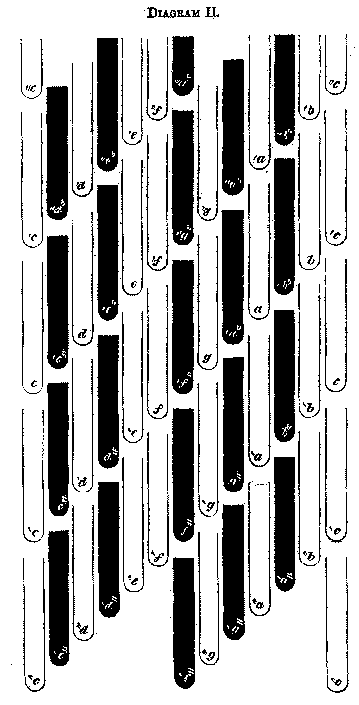
The keyboard of the second order furnished results of some interest. It can be easily arranged according to the foregoing rules. The peculiarity in the result is, that performance on a complete system of the second order and first class, by means of it, is nearly as easy as performance on systems of the first order by means of the keyboard formerly constructed. The problem of representation and performance is thus solved both for the Hindoo system of 22 and for the system of 34, the interest of which has been already indicated.
Diagram II (p.382) represents a portion of the keyboard of the second order.
c - \e - g is a major triad ; whence the major thirds are better situated for the finger than on the first-order keyboard with positive systems ; but the presence of continuous rows of keys in all twelve divisions is somewhat less advantageous than in that arrangement.
c - /eb - g is the minor triad.
In the general transformation of the rth order, transformation with regard to colour (white or black) is not generally practicable. For the most general purposes it would be necessary to have a sufficient supply of keys of both colours for every pattern ; for any particular case the requirements are more limited.