Explanation:
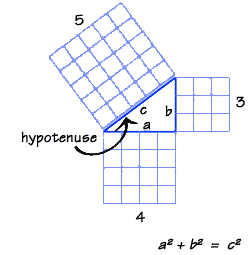
A Greek mathematician named Pythagoras developed a formula, called the Pythagorean
Theorem, for finding the lengths of the sides of any right triangle. He
treated each side of a right triangle as though it were a square and
discovered that the total area of the two smaller squares is equal to the area
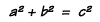
of the largest square. He wrote this discovery as a formula:
where c is the
hypotenuse
and a and b are the other two legs
of the triangle.
To
find the area of a triangle...
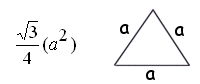
...To
find the area of a Equilateral triangle...
To
find the perimeter of a triangle...
Heron's
formula
a + b + c
triangle given SAS (two sides and the opposite angle) = (1/2) a b sin C
triangle given a,b,c = [s(s-a)(s-b)(s-c)]
when s = (a+b+c)/2
regular polygon = (1/2) n sin(360?n) S2
when n = # of sides and S = length from center to a corner








 [s(s-a)(s-b)(s-c)]
when s = (a+b+c)/2
[s(s-a)(s-b)(s-c)]
when s = (a+b+c)/2