Solent Landmarks Needles battery The Main Features The Guns
| A
Quick History
The battery was one of Palmertson's famous follies. Coastal fortifications built in the 1860's to counter a perceived French threat. When the battery did get to engage the enemy it was not to be the French but the Germans in the Second World War |
|
||
| A Time Line | Guns to rockets | ||
| The Victorian years
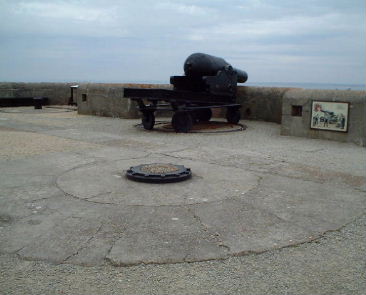
The battery is built 1861-63 Needle point battery is built with 7 "RBL 1873 Guns replaced with 9"RML 1889-92 Empacements built at water level. 1893 New needles battery built,armed with 9.2" BL guns |
The original specifications
The chalk ridge on which the fortification is built gives it a natural defence from the sea and a dominating position. It also gave the military engineers continuos problems. Fissures opened up, banks collapsed in heavy rain, ground was unable to support concussion from guns, observation positions subsided or became undermined by cliff erosion. |
||
| The World Wars
The battery in action 1913 First british AA gun is tested at the site 1914 Batteries are manned during the First world war 1918 Batteries placed in care and maintenance 1939 Batteries manned during second world war 1940 signal station built 1941 Radar Station built 1945 Battery placed in reserve |
Wartime Action: When
the main threat came from the air
The radars installed enabled the guns to engaged targets at night. Both the E boat engagements resulted from radar detected targets. However the radars made the battery a possible target for German parachutist attempting to capture the equipment. The headland had to fortified against attack with ditches, barb wire and trenches. Training for D-Day
|
||
| 20th Century
New uses 1954 Guns scrapped 1956 Black knight space rocket Programme 1975 National trust obtains headland. 1981 First phase of restoration completed |
A major task
Nowadays the area around the Needles battery makes a popular visitor attraction. This is only as the result of a large amount of work by the National Trust and volunteers to remove much of the debris and ruins left by military occupation. Many of the more modern structures erected by the space programme had to be removed to leave the original batteries in their current restored condition. |