 |
|
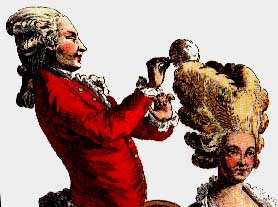
| Figure 2: Detail from a French fashion plate 1778. A woman getting her wig powder.d. |
| In the later point of this era the wigs worn my men changed from a softer more flowing style changed for a much higher, more ridged style, and the fullness of the wig now seemed to weigh more in the back. But during the mid eighteen hundreds the wig dribbled its way out of fashion, until they were exclusively worn my men of prestige, such as medical doctors, and lawyers. And as time moved on, the wig left popularity more exclusively to Judges, leaving the wig for men completely excluded from fashion. |
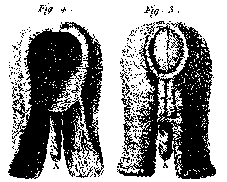 |
| Figure 3: The wig of a French Judge. Shown in frontal and back views. |
| A different sort of hairstyle that erupted in the seventeenth century was the �love lock� (Tortora & Eubank pg. 208), which was one lock of hair that was grown longer then the rest, worn by French and English men, and usually tied with a ribbon. Women�s hairstyles in the seventeen to eighteen hundreds was not that much different then the men�s. They started off simple, and then styles of extreme elegance, and structure were among extreme popularity. The early seventeen hundred women worn a simple hairstyle which required them to make �a part (that) was made behind the ears and the back hair drawn into a roll or chignon at the back of the head while the front hair was arranged in curled locks around the face.� (Tortora & Eubank pg. 214). In the Early eighteen hundreds, hairstyles built upwards. Women would build their hair high up onto their heads, going as far as you use supports to hold it up. These supports were �made of a series of ruffles held in place with wire supports and known as fontange (fone-tanj�) in France and the commode in England and American colonies� (Tortora & Eubank pg. 217). This large structural hairstyle actually evolved from but a simple style of tying the hair up in a small ribbon. See figure 4 for example of fontange. In the case of this outrageous fashion, it is said that the incident in which is responsible is that of a mistress of Louis XIV. Supposedly she was to be found coming from the woods one afternoon in quite disarray. Most thought her state was due to fervent encounter with the king, and in the event, used her garter in order to tie back her hair in attempts to hide the rendezvous. |
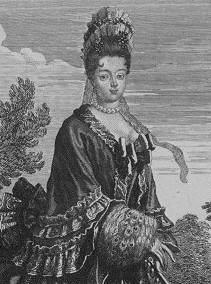 |
| Figure 4: Princess de Conti 1713 wearing a fontange. (Period Images) |