|
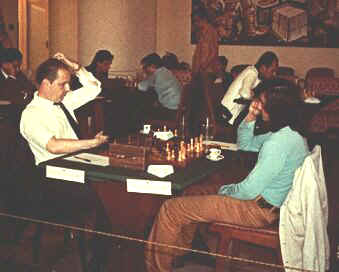
Faleceu Eugênio German
The International Master Eugênio Maciel German has died the day 01 of April
of the present year in Belo Horizonte, Brazil, 70 years old. He was born October
24 1930 in Ubá (MG).
Germán got the title of MI in 1952, in the Olympiad of Helsinkin. It was the
first Brazilian player in obtaining this title.
Eugênio learned how to play chess to the 8 years, with its brother Henrique.
When he left he is necessary to live to Belo Horizonte to study scientific in
1948, with 18 years, he finished the Campeonato Mineiro in the second position,
from behind of the experienced Jayme Moses.
Next year he participated in 17º Campeonato Brasileiro tiing in the third
position with the cearense Rônald Câmara. It was a championship maratoniano
with 22 participants. German made 14 points of 21 possible, behind Walter
Oswaldo Cruz and Márcio Elísio of Freitas, com 10 victories, 8 ties and 3
defeats.
In 1950, it traveled to River, to participate in the final of championship
brasileiro. With 7 points of 11 possible, it shared the 5º position with the
"campeonísimo" João of Souza Mendes, and from behind of José Thiago
Mangini, Eduardo Hasbum Asfora, Nelson Dantas and Fernando De Almeida
Vasconcellos.
At the end of 1951 their first great consecration came. It conquered in the
Clube two Diários, in Strength, their first title brasileiro, only losing a
departure, tiing two and winning anything less than 14. German led on the dot
and half to Luiz Gentile Campelo and José Thiago Mangini.
In 1952 it finished em 2º place in the Campeonato Brasileiro, disputed in the
Clube of Xadrez São Paulo, in an unbeaten way, beside Luciano Belém, and a
point from behind of Flávio of Carvalho Jr. Neste, German passed then to the
first international plane.
He participated in San Rafael's tournaments, Uruguay (4º) and Sea of the Silver
(7º/8º). AND their definitive consecration was in in the Olympiad of Helsinkin,
where it defended the first board of Brazil, obtaining 68% of the possible
points. This perfomance was worth him International Teacher's title, being the
first Brazilian player in to obtain so valuable distinction.
Of 1953 at 1958 was devoted of full to their engineering studies, and once
formed, it returned with all their force. It conquered in those or Campeonatos
Mineiros of 1959, 1960 and 1961, in the Tournament Zonal Center (1960) and in
the Troféu Cidade of Vitória (1960), with 100% of the points, defeating Ludwig
Engels inclusive.
In Ainda 1960, German finished tied in the third position of the South-American
Zonal Tournament and in the following year it conquered in a categorical way the
square for the Torneo Interzonal. Both tests were celebrated in São Paulo.
Its going to the Torneo Interzonal of Estocolmo was tumultuous, although he
received the help of some friends to make in front of the trip expenses. Their
result can be considered quite good, with victory before Lajos Portisch, and tie
before Korchnoi, Gligoric, Stein and Geller, were enough significant. German
finished in the 19º place (among 23), with 7 points.
In the 1965 he obtained the victory in the Zonal Center, Belo Horizonte, and he
desisted of participating in the final of the Campeonato Brasileiro starting
from 1968. It participated in the Campeonato Mineiro and invited by the CBX, he/she
went to the Olympics of Lugano. Playing from behind as second board of Mequinho.
German made a quite regular punctuation with 43% of the points. Em 1970 disputed
the Campeonato Mineiro again and in 1972 it won another time the Zonal Center
that took place in Brasília.
he participated em Blumenau again, after 20 years far from the boards. It lost
in the first beat with Vitório Chemin (picture), and outstanding victories
before Antonio Rocha and Francisco Trois. German conquered, to the 41 years of
age, its second title national, half point for before Francisco Trois, Adaucto
Nóbrega
and Peter Toth.
That same year played in their third Olympiad, in Skopje, capital of Macedônia.
As first board, getting 60% of the possible points, and crowning this way a
beautiful chess career.
Johan Lundström
Estocolmo, 2 de Abril de 2001
|