|
"The disc [allegedly observed at the second crash site on the Plains of San Agustin] seemed to be made of a metal that looked like dirty stainless steel." Timothy Good, author of Beyond Top Secret.
"The color was in between tinfoil and lead foil." Bill Brazel, an original witness who saw the metallic foil in action at the first crash site.
"Several witnesses to the Roswell, New Mexico, incident [ie. first crash site] of July 1947 described some of the recovered metal foil as being impervious to bending or folding, in that it always returned to its original shape." Timothy Good, author of Beyond Top Secret.
There is a belief that if interstellar travel should be a reality thanks to a little known principle in electromagnetism as revealed in the UFO CD, why haven't we seen one of these devices crashing to earth for us to investigate?
Well, some US investigators believe it may have happened not far from the city of Roswell, New Mexico.
What are the witnesses' claims?
Something crashed in the deserts not far from Roswell, New Mexico, in the early days of July 1947 as confirmed by radio and newspaper reports.
First-hand witnesses claimed they heard an odd explosion in the midst of a severe electrical thunderstorm on the night of 2 July 1947. The following morning, wreckage was found scattered over a wide area. On the same morning, nearly 200 kilometres to the west, other witnesses claimed they saw a damaged metallic disk with unusual bodies in an area known as the Plains of San Agustin before it was taken away by the US Army for investigation.
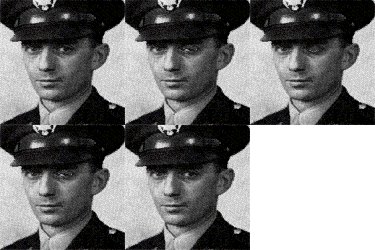 Major Jesse A. Marcel, one of the first-hand witnesses to the scene of the first crash site, claims that it '...was definitely not a weather or tracking device, nor was it any sort of plane or missile.' (1) Major Jesse A. Marcel, one of the first-hand witnesses to the scene of the first crash site, claims that it '...was definitely not a weather or tracking device, nor was it any sort of plane or missile.' (1)
Bill Brazel, another first-hand witness claims he saw pieces of a dark greyish metallic foil found at the crash site (the same thing was observed at the second crash site) among other odd materials as 'very thin and extremely lightweight. The odd thing about this foil was that you could wrinkle it and lay it back down and it immediately resumed its original shape.' (2)
Other witnesses, including those claiming to have loaded the material on several B-29 Bombers under strict security for scientific examination at Wright Field Army Air Base (now Wright-Patterson Air Force Base) in Dayton, Ohio, USA, said they saw a lead-coloured, 'dirty stainless steel' (3) or dark-grey metallic foil that 'could unfold itself' after slightly warming it with their body and bending it in one hand.
How does the US government explain the crash?
On 8 July 1947, Brigadier-General Roger Maxwell Ramey, commanding officer of the Eighth AAF at Fort Worth AAF, Texas, USA, held a media conference in his office at around 6.00pm. During the conference, reporters were shown the remains of a torn-up weather balloon made of balsa wood, plastic and aluminium foil.
However this explanation wasn't sufficient to solve the controversy. As former New Mexico Congressman, the late Steven Schiff, noticed, why are the US military and government officials still acting in a highly secret and evasive manner to this day whenever questions are asked about the incident?
Then in July 1994, the US Air Force concluded in their detailed 231-page report titled, The Roswell Report: Case Closed, claiming that the wreckage found in the deserts outside Roswell was nothing more than the remains of a secret weather balloon experiment called Project Mogul designed to test for Soviet nuclear explosions during the Cold War period. (4)
This official explanation did not change in the latest report from the US Air Force issued in 1997.
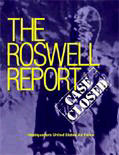
And to this day, the US government has continued to support this conclusion, including the argument that no unusual materials were used in the construction of this secret weather balloon experiment - that is, only aluminium foil, balsa-wood, plastics and tape with pinkish-purple flower-like designs.
The Nitinol-Roswell connection
After carefully researching the witnesses claims, an Australian researcher from the Australian National University has discovered in 1995 how the dark greyish "shape memory" metallic substance is almost certainly an alloy composed of nickel and titanium called nitinol, the alloy which began the official study of shape memory alloys and is the most powerful known to science.
The origins of nitinol are even more mysterious. We know, according to a metallurgical journal about the alloy, how the US Air Force at Wright-Patterson AFB (the official location for where the Roswell debris would eventually end up) had studied this alloy at the right time (ie. in the 1948-49 timeframe) and were asking US scientists at the Battelle Memorial Institute in Ohio, USA, to study it as if the military did not have the technology to make it and study it for themselves in secret.
US scientists would not officially begin the study of "shape memory" alloys until 1958 when a US Navy metallurgist accidentally subject the alloy to his cigarette lighter.
But for some reason the US Air Force appeared to be the first to know about nitinol and needed to make the alloy to an unprecedented level of purity after 1947, at a time when major upheavals in the US military aerospace and the titanium industry were taking place. Titanium, one of the critical metals needed to making nitinol, was at the centre of the US military's aerospace transformation. In fact, the US military had instigated the change in attitude towards titanium and its alloys after 1947 for some reason as revealed by numerous sources (eg. the Encyclopedia Britannica).
To this day, the US Air Force has never explained what it was doing with the alloy, how it began the work, and why it was never mentioned in their official report on the Roswell case in 1994 and 1997. As the alloy would precisely explain the metallic foil's appearance and behaviour as seen by military and civilian witnesses.
Is the US Air Force telling us everything we need to know about this incident and their involvement in the study of nitinol and shape memory alloys? Or are they hiding something?
And why did the US Air Force need outside scientific assistance to study nitinol if they had already made the substance in secret (ie. the technology to make nitinol was available) and which we are led to believe was used in yet another undisclosed balloon experiment or aircraft crash that went horribly wrong?
Or is nitinol a coincidence?
However if Battelle had made nitinol on behalf of the US Air Force, strangely the refinement process and the ability to mass produce pure nitinol for military aerospace applications would not come until after 1947 according to the 1949 Scientific American article on titanium and the conclusion should have been that the metal was a success and the object had retained its original shape it is just that the US Air Force has to remember not to fly the object into a thunderstorm.
Yet extraordinarily we find no evidence the US Air Force requested mass-production of nitinol to manufacture jet fighters with this material. In fact, the first titanium jet in 1953 was not made of a shape-memory alloy. Why? Or is the US Air Force trying to hide the implications of the large amount of shape memory alloy found near Roswell because of the bomb-shell nature of the discovery they had found?
What exactly is the US Air Force hiding from the public?
The Nitinol-Roswell connection is also published in the 2009 edition of Witness to Roswell
Thomas J. Carey and Donald R. Schmitt, authors of Witness to Roswell, were notified of the Australian researcher's nitinol-Roswell research work on 21 January 2008. For his protection, we have decided to keep his name anonymous. We recommended to Mr Carey in making a sample of nitinol and show to remaining witnesses to see if our information is correct.
Anthony Bragalia, a US researcher working with Mr Carey has contacted SUNRISE on 21 July 2008. He has obtained information on nitinol from our free research work online and now appears in the final chapter of the latest 2009 edition of Witness to Roswell.
If you require further information about the nitinol-Roswell research conducted by the Australian researcher, please contact us.
Free research
Originally published as a first and second edition CD publication for the Australian market in 1998 and 1999 respectively, our essential and latest results are available below:
- INTRODUCTION (1.8MB)
The case of an alleged UFO crash in early July 1947
- THE ESSENTIAL HISTORY (6.8MB)
How did it happen?
- THE WITNESSES SPEAK (1.8MB)
The description given for the metallic foil and other materials
- THE US GOVERNMENT SPEAKS (1.2MB)
The US military's official explanation for what happened
- AN AUSTRALIAN RESEARCHER SPEAKS (5.6MB)
The Nitinol-Roswell connection
- AN AMERICAN RESEARCHER SPEAKS (1.1MB)
Could it be nitinol or something else?
- THE PUBLIC SPEAKS (<1MB)
Could the US Air Force have figured it out before July 1947?
- CONCLUSION (1.1MB)
Why keep the alloy secret to this day?
- APPENDICES
NOTE: Please refer to the CD
- BIBLIOGRAPHY
NOTE: Please refer to the CD
CD Available
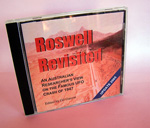 The full results are available on our CD (ISBN 978 0 957735 00 2). It contains the following information for all researchers and scientists: The full results are available on our CD (ISBN 978 0 957735 00 2). It contains the following information for all researchers and scientists:
- Newspaper clippings and rare original US government documents relating to the Roswell incident
- Contains the full and original 1994 USAF Roswell Report and the latest Executive Summary.
- Original copies of metal reference abstracts and articles on the alloy.
This CD is sold as non-profit (to recover research and publishing costs).
NOTES
- Berlitz & Moore 1988, p.72; Berlitz & Moore 1982, pp.68-69.
- Berlitz & Moore 1988, p.88. Other sources to confirm this memory-shape behaviour may be found in Good 1997, pp 456, 461 and 463; Friedman & Berliner 1992, p.73. Also check the statements made by Ms Sally Strickland-Tadolini and Sargeant Robert E. Smith for further confirmation. For other quotes and their full references, please purchase the CD from SUNRISE.
- The term 'dirty stainless steel' was mentioned by L. W. "Vern" Maltais and his wife Jean Swedmark Maltais as the words used by their close friend the late Barney Barnett, the man who allegedly saw a large dark-greyish metallic disk-shaped object with unusual bodies in the Socorro region on the morning after the odd explosion on a local ranch near Roswell according to Berlitz & Moore 1988, pp.60-61. Walt Whitmore, Jr., son of the Roswell radio station KGFL owner, also described the colour of the metallic foil brought into Roswell by a local rancher as lead foil as shown on page 73 of Friedman & Berliner 1992 book, Crash at Corona: '[It was] very much like lead foil in appearance but could not be torn or cut at all...extremely light in weight...'
- Good 1997, pp.462-462 & 480-482.
SAMPLE REFERENCES
Berlitz, Charles & Moore, William. 1982, The Roswell Incident. London: Granada Publishing Limited.
Berlitz, Charles & Moore, William, 1988, The Roswell Incident. New York: The Berkley Publishing Group (for confirming witnesses' quotes published in the original 1982 version of the book with the same title).
Good, Timothy. 1997, Beyond Top Secret: The Worldwide UFO Security Threat. London: Pan Books.
Friedman, Stanton T. & Berliner, Don. 1992, Crash at Corona. New York: Paragon House.
Saunders, Keith. NITINOL: The Miracle Metal that Science Can't Explain: Omega Science Digest. March/April 1982, pp.10-13 & 119.
|