STEPS will introduce you to
some basic and intermediate concepts of capital market analysis.
This session, STEPS
will provide you
some important concept of Technical Analysis. Technical Analysis is one of the
analysis, which popular among professional analyst. This concept can be used
with other analysis concepts and techniques, to increase analysis result
accuracy.
STEPS contents will be up
dated time to time, to increase investors knowledge of market analysis
techniques. This column is important to every investor, to be prepared with
maximum knowledge and skills before makes any investment decision.
Well-preparation can reduce potential risk, through a proper analysis and
decision making process. It also increase investor's confidence.
WHAT IS
TECHNICAL ANALYSIS ?.
Currently, there are a lot of
analysis techniques used by market analysts. For example, Statistical Approach,
Financial Approach, Economics Approach and Technical Approach.
Technically, all of the
techniques used are technical. It based on quantitative and geometrical
techniques. But some focus on quantitative only, mixed of quantitative &
geometric and some focus a lot on geometry. Technical Analysis is in third
category, focus on geometrical analysis.
No any
calculation ?.
Geometrical is a part of
mathematics. It widely used in applied mathematic such as physics and
engineering. It is analysis of graphics. And it is an interpretable graphics !.
Geometric in technical analysis
need a lot of mathematical skills. It is applied, to calculate slope,
correlation, volatility, value, objective and so on.
Mathematic also used to
calculate indicators value, such as Exponential Moves, Relative Strength Index,
Stochastics and etc. To be a professional analyst, the person must fluent in
using at least 40 market indicators.
Is it
difficult ?.
It is very complex !. You must
understand history to predict future. And there is a lot of risk.
It is important to say, that
this technique is not perfect. There is no future window, but we can trace the
trend which we think will happen in future. And also we must ready and quick
response to any changes. But all are our predictions and thinking !.
It
looks risky . . .
No risk, no returns. This is a
fact and has proven true by scientific research. Nobody can ignore the
importance of the risk.
Risk is interesting, because
without it , we get nothing. And bigger risk means bigger problem. We must be
patient to understand the risk. Research shows that risk is manageable and can
be reduced. Well-managed risk, open you to wide opportunity to succeeds.
Manageable
risk ?.
A series of research shows
that, normally only 5% to 10% of the population are the best. Others can be
categorized as average and lower. This Normal Distribution is "normal"
in investment field.
Analysis shows that, only 10%
well-understood on what and how to use Technical Analysis, others are
failed. All in 90% group are failed to understand the technique and make
mistakes in their prediction. They lost a lot of money, in process to
understand the market.
Markowitz, a Nobel price winner
proved that the risk can be reduced by diversification. "Do not put all of
the eggs in only one basket, because if the basket dropped, than ...",
trust me you will not only lost those eggs but more, time, efforts, money .....
.
Diversification
?.
By distribute those eggs in
more baskets, can reduce total loss, if only a basket drop down and else are
saved.
Diversification concept is
simple but meaningful and can be applied in many situation and elements. Either
it is a physical or money investment, both can be diversified to reduce risk.
Too
many things . . .
To be a professional, the
person must masters his/her profession. He/she must be a true professional.
He/she must do a lot of research, to wider his/her knowledge. Too many things to
be studied is not a question. Well-prepared is the answer of a good
professional.
To some investors, it is
difficult to them to master the technique. A good advice is to get a
professional in this field and work together with them. Work or get advice from
professional can reduce your risk, by getting a lot of advices from various
sources.
True
Professional ?.
The 10% group or the masters
are the real professionals.
How we
know ?.
Every investor must know the
quality of the professionalism. Mastering and ethical are some elements of a
true professionalism.
Every investor must always
remember his/her investment objective. The objective is to get return. Other
way, the professional must consult the investor on how to maximize his/her
investment return.
This column can help investor
to understand the concept of analysis. By understand the concept, the investor
can understand the quality analysis and analyst. This can help investor to find
a reliable analyst or professional.
In Information Technology era,
the financial industry is transparence. Information of market performance can be
easily get through television, internet or cable system. Investors must always
check the analyst or professional performance by compare their advice and
prediction to the real result. If a lot of mistakes done, the analyst or
professional is not mastering his/her profession which is an element of a true
professionalism.
ANALYSIS ( First Lesson ).
In this session, we provide example of
mini report by our analyst, dated Friday, April 7, 2000. We will add more
information on analysis in future.
EXAMPLE
OF OUR REPORT
|
KLCI
Market Performance (Daily Basis Analysis).
Friday
( April 7, 2000)
1)
Last
Week Market Performance.
Open
: 977.51
Close
: 949.85
High
:
979.49
Low
:
947.88
2)
Trendlines
Analysis.
Support Trendline :
950.00.
- possible up bounce at 950.00, otherwise the price will going
lower.
Resistant Trendline : 965.00
- If the price is higher then the resistant level, up trend is
intact.
3)
Bollinger
Bands Analysis.
It
is a dynamic oscillator, for overbought/sold analysis.
On
Wednesday, the price reached the lower average line. It's means the
price in the oversold zone, and it will
bounce to a stabile or neutral zone (stabilize).
4)
Stochastic
Analysis.
It
is a momentum analysis.
-
The indicator reached the oversold zone (under 20 zone). The
price will bounce to a
stabile zone.
-
It also shows that the indicator will intercept it's average line
(Buy indication).
-
The price and the indicator moved in different directions or Divergence. In the short term, the price will reverse from negative
trend. (Reversal )
5)
Relative
Strength Index Analysis.
It
is a momentum analysis.
-
RSI reached the neutral zone at 50. It means the price will
stabile and down trend has finished in a shorterm. (Stabile
)
6)
Momentum
Indicator Analysis.
It
is a momentum analysis.
-
The indicator currently reach the neutral zone or 100. It means
the previous up trend has finished and the price
is stabile. No up trend or down trend indication.
7)
CCI
Analysis.
Divergence
Analysis.
-
The indicator has intercepted it's average line, and in reversal
position. It means the price and the indicator moved in different
directions or divergence. It shows that the momentum or the
speed of the price has slowed and possible reversal movement in shorterm.
CONCLUSION
All indicators show that the previous
up trend has finished. It means that in intermediate term, the price is stabile.
Many indicators are in stabile zone. It means that, last week down trend has slowed
and more stabilize. The price stabilization will be continued in
shorterm or within 3 to 4 days.
Although many daily-basis indicators show that the price will
stabilize, but in longer
time basis analysis show that the down trend still intact. It
means the
price stabilization is only in shorterm (3 - 4 days) or as a correction.
Any price incremental is a temporary moves.
Longer
time basis analysis show that the down trend will continue for another 2
- 3 weeks.
Although our economic fundamentals are good, any down trend is
anticipated because of
international risk, for example U.S Economy dan Dow Jones performance
*
ALL TERM USED ARE LESS THAN 2 WEEKS.
***************************************
Report
of Accuracy Analysis ( RAA )
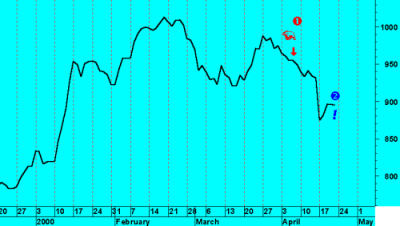
This is an accuracy
statistics report. All of the analysis will be checked by a comparison
study.
FINDINGS:
1) All indicators show that the previous
up trend has finished
In
mid of March, Composite Index rose near 1000.00 points. Then the index
fell near to 970 marks on April 7, 2000. Our analyst found that the
previous up trend (mid-March) was finished.
This
is true, the market went down or down trend and the index fell below 900
points.
2)
Our analyst also mentioned about the price will stabile in intermediate
term.
Intermediate
term means 3 - 6 days later.
This
is correct when the index became sideways in April 11, 2000 which 4 days
after our comment.
3)
Our analyst warned the market players about the down trend was still
intact, in longer term.
Longer
term is longer than intermediate term, which is about 7 days more or
average 12 trading days.
This
is absolutely correct when the index fell near 100 points between April
15, 2000 and April 19, 2000. It was 10 days after our comment.
COMMENT:
All
of the findings and recommendations are correct and credible.
|
( (
( A N A L I S Y S <<< B A C K >>> )
) )
|
S-T-E-P-S
S-T-E-P-S
S-T-E-P-S
|