Ganapathyam - Worship of Sri Maha Ganapathy or Sri Ganeshwara
Oum Gam Ganapathaye Namaha
Sri Vallabha Shakthy Samedha Sri Ganeshaya ParaBrahmane Namaha
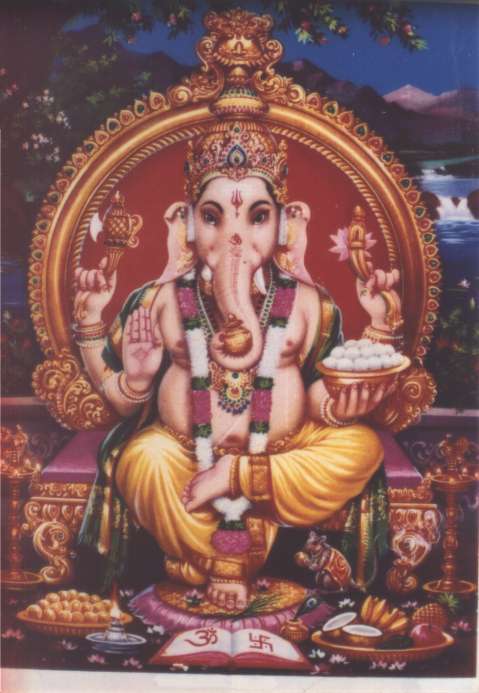 |
| Sri Maha Ganapathy |
Sri Ganapathyam is the religion, in which Sri Maha Ganapathy is worshipped as the manifestation of the formless God or Nirguna Bhramhan. Unlike all others of the six
Religions, Sri Ganeshwara has the special privilege of being worshipped before performing any deeds - good or bad. In the case of good karmas ( like marriage, birth) he is
worshipped in a small idol made up of turmeric powder & in the case of bad ones like death he is worshipped with the following hymn:
Shuklambharadharam Vishnum Shashi Varnam Chathur Bhujam
Prasanna Vadhanam Dhyayeth Sarva Vigno Upashanthaye
Explanation: On meditating the Lord, who wears white clothes,white-colored,four-handed,charming-faced all the hurdles & obstacles would be gone or escaped. The above hymn is chanted & the for head is being knocked, which is said to simulate the spilling of amrutha from the amrutha nadi in our fore-head.
The below hymn is used as a prarthana to Lord Ganeshwara.
Vakrathunda Mahakaya Sooryakoti Samaprabha
Nirvignam Kurume Deva Sarva Karyeshu Sarvataha
Explanation: This is a direct appeal to Lord Ganesha & translates to: "Oh! broken-tusked one! Oh! big-bodied One! Oh! the one with the brightness of millions of Sun! Please remove all the hurdles from all my deeds & make them get completed successfully!!"
Great epics like Thiru Manthiram, Thevaram, Ramayanam.. have verses in praise of Sri Gananatha in the beginning. In the case of yoga & tantra, Sri Ganesha is believed to be present in the mooladhara chakra, which is the first of all the six chakras. Even while writing anything, a small "suzhi" is drawn to offer the salutes to Lord Gananatha.In most of the celestial marriages like Meenakshi-Sundareswara, Shanmuka-Devasena,Parvathy-Parameswara, etc. Sri Ganeshwara would be physically present to accept the initial Puja before the marriages. In any of the temples, the first shrine or sannidhi would be the one for Sri Maha Ganapathy.
The legend goes that, Sri Ganesha was taking care of his mother Sri Gowri, & didn�t let Lord Parameswara to see his consort Sri Ambika. As Lord Shiva has gone to do the
Gajamukasura Samharam, Sri Ganesha, had not seen his dad until then. So, Lord Ganesha thought that, it was some trespasser. But Lord Shiva was enraged by that
action & cut the child's head with his trident or thrishoolam. When Sri Gowri came after mangala snanam, she found her son head-less & enquired the reason to Gowripathy.
Lord Shiva told her the reason & also granted the boon that, he would replace the head with a different one. as Lord Shiva had done the Gajamukasura Samharam,
the head of the demon was placed on Ganesha's body. Thus Lord MahaGanapathy got the face of an elephant.Lord Ganesha, destroyed a demon called Mooshikasura, who became his vehicle - the rat or mooshika. During his threading ceremony or upanayanam, the demons cut the thread in to pieces & Lord Parameswara, used the cobra snakes or the "Naga" as the threads for the Lord. So, he is being praised as "Naga Yajnopaveedadharana". At the event of helping Veda Vyasa to write Maha Bharatha, Lord Ganesha used his tusk ask the pen. So, he has one of his tusks cut. He has a big stomach, which indicates that, the whole world is present in him. He rides on a rat. It indicates that, the mind, which is very big & powerful like Lord Ganesha is present inside the body, which is small like a rat. His elephant face, represents the word "Om", which is the basis of all the creation, protection & destruction in this Universe. Thus Sri Ganeshwara is totally philosophical representation. Each of his body parts & weapons represent a specific truth in our life.
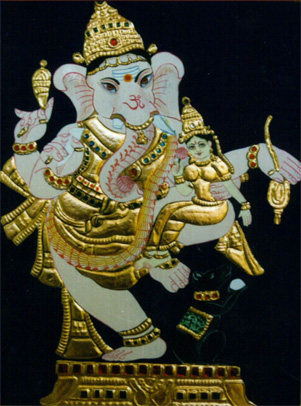 |
| Sri Vallabha Shakthy Samedha Sri Maha Ganeshwara |
All the greatest music composers inclusive of Sri Purandaradasa, Sri Thyagaraja, Sri Dikshitar, etc. have composed numerous compositions on Lord Ganeshwara. It's a
tradition to start any musical concert with a song attributed to Lord Gananatha. Since the ragas like Nattai,Hamsadhwani,etc.. are sung in the starting of the concert, there
are lots of songs in these ragas on Lord Ganesha. The credit of composing numerous kruthis in Gana ragas(Varali,Gowlai,Harabhi,Nattai & Sree Ragam) on Lord Ganesha
goes to Sri Dikshitar. Un-doubtedly his songs again depict various puranas & Upanishads in musical forms. In addition to those people, the poets of the sangham time in
Tamil, have composed hymns like gems on Sri Gananatha. We have a wonderful collection of Tamizh songs, which serve as "Kappu" or protection to their literature
compositions. The famous hymn, which starts with the verse "Gananamthva" is a part of Krishna Yajur Veda & is chnated by any Vedic Chanter before he starts the
chanting.
Sri Ganapathy Atharva Sheersham is the Upanishad, which exclusively elaborates the greatness & glories of Sri Maha Ganapathy. It is this Upanishad, which glorifies Sri Maha Ganapathy or Ganeshwara as the manifestation of the Nirguna Bhramhan. As we have seen already, all of these forms, which were specified in the six religions of Sri Shankara Bagavadpada, are highly philosophical or scientific & are the manifestation of one's own consciousness & self. Thus devoting oneself to the services of these
Deities, would eventually lead a person to understand the greatest truth of the Vedic MahaVakyam, "Thathwamashi" . The greatness of the wisdom of self-knowledge is that,
it clarifies any doubts an individual has about the God or bakthy & makes him/her devote her completely to the Almighty. This is called as "Ananya" bhava. If a person
becomes one with the Almighty, he / she would have no thoughts other than God. Thus, he/she can do the devotion in a very perfect way as there would be no hurdles or
obstruction. Thus one understands the greatest truth of oneness with the God. This has been mis-understood as people think that, once they gain the self-knowledge they
cant do bakthy as the devotee claims himself none other than the devoted/ Almighty. But the true wisdom of self-knowledge would make a person simple & ego-less & make
him/her none other than the God with which they can do bakthy in a perfect way rather than with a dualistic approach.
1. Declaration of Sri Ganesha as Supreme Bhramhan
Thvam Vgamayas Thvam Chinmayaha || Thvam Anadamayas Thvam Bhramhamayaha ||
Thvam Sachidanadas Dwithiyosi || Thvam Prathkyasham Bhramhasi | Thvam Gnanamayo Vignanamayosi ||
Explanation : The above verse declares that, Lord Ganeshwara is filled with wisdom, & the Bhramham. He is the representation of the Sachidanandham or eternal bliss.
Sarvam Jagaditham Thvatho Jayathe || Sarvam jadadhidam Thvathatistathi ||
Sarvam jagadidham Thvayi Layameshyathi || Sarvam Jagadidham Thvayi Prathyethi ||
Thvam Bhoomi Aapo Nalo Nilo Nabaha || Thvam Chathvari Vaghpadhani ||
Explanation: The above verse states that, all the worlds were created, protected & destroyed by Lord Gananatha. Lord Ganesha is omni-present & is present in all the lokas like the Earth(Bhoomi) & the pancha bhoothas (land,sky,air,water & fire).
Thvam Guna Thrayatheethaha || Thvam Deha Thrayatheethaha || Thvam kala thrayatheethaha ||
Thvam avastha thrayatheethaha || Thvam Mooladhara Sthithosi Nithyam || Thvam Shakthy Thrayathmakaha ||
Thvam Yogino Dhyayanthi Nothyam ||
Thvam Bhramha Thvam Vishnus Thvam Rudras Thvam Indras Thvam Agnis Thvam Vayuss Thvam Sooryas Thvam Chandramaas Thvam Bhramha Boor Buvas Suvar Om ||
Explanation: Lord Sri Ganapathy is beyond the three Gunas(Sathvam,Rajo & Thamo), he is beyond the three bodies (sthoola, sookshma), he is beyond the three states/avasthas ( Jagrath,swapna& sushupthi), he resides in the Mooladhara chakra for ever, he is the representation of the three shakthies (Icha Shakthy, Kriya Shakthy & Gnana Shakthy) & he is being meditated by the Yogis always. He is Bhramha, Vishnu,Shiva,Indra,Agni,Vayu,Sun,Moon & everything.
2. Sri Ganesha MahaManthram & Sri Ganesha Gayathri
Tharena Ruddham || Ethath Thavam Anuswaroopam || Gakara Poorva Roopam || Akaro Madhya Roopam || Anuswarascha Anthya Roopam || Bindur Uthara Roopam ||
Nada Sandhanam || Sagum Hidha Sandihi || Saisha Ganesha Vidya Ganaka Rishihi || Nicruth Gayathri Chandaha || Ganapathir Devatha ||
Oum Gam Ganapathaye Namaha ||
Eka Danthaya Vidhmahe Vakra Thundaya Deemahi ||
Thanno Dhanthi Prachodayath ||
Explanation : The above verses declare the meter of the verses (Nicruth Gayathri), rishi, devatha & the siginificance of the Ganesha Moola Manthram, followed by the manthra itself. Then comes the Ganesha Gayathri. It could be translated as, "Let's salute the Lord, who is one-tusked & broken-tusked".
3. Description of the divine from of Lord Ganesha (Thiru Kolam)
Eka Dantham Chathur Hastham Pasha Ankusha Dhaarinam || Radham Cha Varadham Hasthair Bibhranam Mooshika Dhwajam || Raktham Lambodharam Shoorpa
Karnakam Raktha Vasasam || Raktha Gandhanu Lipthangam Raktha Pushpair SuPoojitham || Baktha Anukambinam Devam Jagath Karanam Achyutham ||
Avirbhootham Cha Srustyadhou Prakruthe Purushathparam || Evam Dhyayathi Yo Nithyam Sa Yogi Yoginam Varaha ||
Explanation : The above verse describes Lord Ganesha as one-tusked, four-handed, & the one bearing the rope & ankusham. he shows "Varadham" in one hand & has a flag with the mouse's symbol in it. He is blood red-colored , has a pot belly, & big ears. He wears a blood red colored paste (Raktha Chandanam) & is worshipped with red-colored flowers(Hibiscus). He blesses his devotees & is the basic cause of this Universe. He is the cause of creation . Anyone, who meditates Lord Sri Gananatha this way would become the best of all Yogis!
4. Salutations or Vandanam
Namo Vraatha Pathaye Namo Ganapathaye Nama Pramathapathaye Namasthe Asthu Lambodharaya Ekadanthaya Vigna Nashine Shiva Suthaya Sri Varadha Moorthaye
Namaha ||
Explanation: I salute Lord of all the Ganas, the one with a pot belly, one tusk & who is the remover of all the hurdles. I salute Sri Ganesha, who protects his devotees.Sri Ganapathy Atharvasheersham, glorifies Lord Ganesha as the Supreme Lord, who is the Saguna Bhramhan & the manifestation of the Nirguna Bhramhan. The verses of this grantham are very rhythmic & simple. They start with salutations to the elephant-faced one & then declare the supremacy of Sri MahaGanapathy. Then this Upanishad reveals Sri Maha Ganapathy as "Sarva Antharyami" - the one who is omnipresent. Then this Upannishad declares the MahaGanapathy Moola Manthram with the
chandhas,rishi, Devatha,etc. After the moola manthram is the famous Ganesha Gayathri & dhyanam for Sri Ganeshwara, which gives a clear description of Sri Ganesha's
form & color. Finally comes the "Phala Stuthi", which describes the effects of chanting Sri Ganapathy Atharvasjeersham. There is no doubt that, chanting this hymn 21
times at the time of Ganesha Chathurthy or three times on ordinary days, would remove all the hurdles in our life & make us eligible for the graces of Lord Vishwaksena.
Although there are lots of devotees for Lord Ganesha, Sri Avaiyar is the well-known celebrated one for Sri Ganesha's bakthy. Likewise, in the state of Maharastra Lord
Ganesha is the main deity. There the Ganesha Chathurthy Pooja is celebrated for 10 days with pomp (starting from the Shuklapaksha Chathurthy of Pathrapada lunar month
to shulka Chathurdashi or Anantha Chathurdashi) at the end of which, the Moorthy or idol(made of clay) is immersed in the ocean.(Visarjanam). The Ganesha Pooja is a lot of fun for all. For people with wisdom, it is a "Athma Vaibhavam",- celebrating one's own Athma & for children it is a festival of sweets & leaf collection & flower collection. Unlike all other poojas Sri Siddhi Vinayaka Pooja is unique in several ways.
- Eka Dhwim Shathi Pathra Pooja
- Eka Dhwim Shathi Pushpa Pooja
- Eka Dhwim Shathi Dhoorwa Yugma Pooja
Ganesh Puja 2003 Details...
Explanation: The Eka dhwim shathi Pathra pooja involves offering of 21 different fragrant/medicinal leaves to Sri Ganesha. The word "Eka Dhwim Shathi" means the numeral twenty one (21) in Sanskrit. Similarly the Pushpa Pooja is offering of 21 different fragrant flowers to Lord Sri Maha Ganapathy. Among all other leaves Lord Ganesha's leaf or pathram is Dhoorvam Pathram or a special kind of grass, which grows as weed in India. This grass is used extensively in the Pooja of Lord Ganapathy. It is of very high medicinal value. People, who have anemia have juice made of these leaves, as they are rich in iron content. Similarly, the collection of the 21 leaves has a medicinal siginificance. All the twenty one leaves, have different medicinal values. In India, there would be bare lands, where these moolikas or plants grow. Location of these plants in the forests/barened lands is very important for any house-hold man, as he might need it to cure various common diseases/infections like cold, fever, diarrhea, etc. during the following winter. The time when Vinayaka Chathurthy is celebrated is exactly one month after the start of "Dakshinayanam" or the dark phase of the earth, which is associated with rain, winter & darkness. During this time our body would be susceptible to various infections or diseases. Locating all these medicinal plants/ leaves would be helpful to cure the diseases instantaneously. In these days English medicine has become more popular. The siginificance or AyurVedha or Siddha Vaidhya medicines are known by the people slowly. All these leaves are associated with the curing of a specific disease & prove to be very effective. Our ancestors are very good planners & they have made religion & religious observances nothing different from science & medicine. That is the uniqueness of the ancient, Vedic, perennial Sanathan Dharma.
Among the various names of Lord Ganesha, the following are very renowned & are chanted during the Ganesha Pooja on any happy occasions. Let's see the m in detailed & their meanings.
Sumukascha Ekadhanthascha Kapilo Gaja Karnakaha
Lambodharascha Vikato Vignarajo Ganadhithapaha
Dhoomakethur Ganadhyaksho BalaChandro Gajananaha
Vakrathunda Soorpakarno Heramba Skandapoorvajaha
Indvidual Names or Pada Artham:
- Sumuka - The one with a pleasant face
- Ekadantha - The one with a single tusk/teeth
- Kapila - One who is smoky white-colored
- GaajaKarnaka - the one with an elephant's ears
- Lamodhara - The one with a pot belly
- Vikata - The one who is ferocious or dreadful
- Vignaraja - The one, who removes all the hurdles
- Ganadhipa - The one who is the commander of the forces (Bhootha Ganas) of Lord Shiva
- Dhoomrakethu - The one, who is like fire
- Ganadhyaksha - The one, who is as cool as a young moon
- BalaChandra - The one who bears a child moon on his head.
- Gajanana - The one with an elephant's face
- Vakrathunda - The one with a cut teeth
- Soorpakarna - The one with very big ears
- Heramba - five-faced one
- Skandapoorvaja - The one who, is elder to Sri Shanmuka or Skanda.
Explanation: The above sloka is very powerful in removing the hurdles in any of the activities we do in our lives. Chanting this with true devotion to Lord Ganesha, would be very effective & would make us eligible for the graces of the elephant-faced sweet Lord.
Let's all meditate on the lotus feet of Lord Ganeshwara & get the hurdles removed from the path of attaining self-knowledge, wisdom & salvation.
Sarvam Sri Ganesha Arpanam Asthu


