
Previewing
the NL West
Posted
March 12, 2005
1.
Yeah, that’s right people,
the Padres. With the rest of the division trotting out a wide selection of 38
year-old garbage and overpaid refuse, San Diego can take solace in sending a
nice array of cheap talent onto the field. This could be the year the Pads return
to the playoffs. They were solid a year ago (87-75) and this isn’t a particularly
strong division. Ninety wins could win this thing, and this is a team fully
capable of that.
The Padres didn’t make a lot of off-season waves like their divisional
counterparts (Los Angeles, Arizona), but they’re returning the key components
of their decent 2004 squad. Catcher Ramon Hernandez, acquired from Oakland before
the 2004 season, was solid in his first Padre year, hitting .276/.341/.477 with
18 homers in 384 at bats. Look for more of the same from Hernandez at the plate,
along with some good glove work behind it. Mark Loretta and Khalil Greene make
up a great middle infield. Loretta has emerged as one of the better second basemen
in the game after two straight great seasons, and Greene is a 25 year-old emerging
star. Greene was great as a rookie in 2004, playing spectacular defense and
hitting .273/.349/.446 with 15 homers. He’ll continue to improve. Phil
Nevin will return at first base, continuing to be old and fairly productive.
Nevin hits for a decent average, has good power, and draws a walk here and there.
He’s not a star, but he’ll do. Third base will likely be up in the
air for San Diego in 2005. Sean Burroughs has failed to have any power whatsoever,
and the ultra-powerful Xavier Nady has reportedly added the position to his
resume. Whatever they do, hopefully Nady finds some at bats somewhere, because
he’s a pretty good player in the making.
The Padres outfield, much like the rest of the offense, is decent but unspectacular.
Brian Giles returns after a disappointing 2004, largely due to the vast expanses
of brand new Petco Park. Still, Giles can hit a little, and something like .300-25-100
is still a possibility. Ryan Klesko prepares for another season of hobbling
about the outfield and getting on base as the team’s leftfielder. If nothing
else, he’s a safe bet to contribute a .380 OBP, even if his power is quickly
fading away. In center is newcomer Dave Roberts, who’ll bring good defense
to the outfield and speed to the top of the order. He’s not great, but
he’s cheap.
The pitching staff is where the Padres at least partially shine. The starting
rotation is headed by the awesome Jake Peavy, who had the best ERA in baseball
a year ago. If he can withstand any injuries, he’ll continue his emergence
as one of the best hurlers in the game. He’s upped his strikeouts, dropped
his walks, and has Petco on his side. Behind Peavy is Woody Williams, returning
to the Padres after contributing a few solid seasons to the Cardinals (he looks
like Freddy Krueger). Williams is a good bet to be decent in 2005, as he does
throw strikes and has a big field to work with half the time. Adam Eaton, who
is certainly talented, falls in as the team’s likely third starter, and
despite his occasional struggles, has good stuff and the ability to strike people
out. Brian Lawrence is either the third or fourth starter, featuring little
in the way of an impressive repertoire, but much in the way of marginal success.
He’ll keep his ERA around 4.00 and keep his team in games. Darrell May,
who enjoyed some success in 2003, had a poor 2004 for the Royals and will be
the Padres fifth starter. May surrendered an appalling 38 home runs last season,
and that figure will surely drop as a National Leaguer pitching in Petco. If
he can keep his ERA under 4.50, he’ll round out the rotation nicely.
As for the bullpen, some things never change. Trevor Hoffman and his changeup
of death return for yet another season of getting people out and saving games.
Japanese sensation Akinori Otsuka will also be back in 2005 after a lights-out
2004. Otsuka featured a 1.75 ERA with 87 strikeouts in 77 1/3 innings last season,
and will remain an excellent setup man. Scott Linebrink is also back in the
pen for the Pads after having 83 K/26 BB season with a 2.14 ERA. All in all,
the pitching looks pretty good in San Diego.
This team full of young hopefuls, emerging stars, and decent, fading veterans
looks to pan out as an all-around success in 2005. They’ll be in the race
all year and they have as good a chance as anyone in the NL West to get in the
playoffs and do some damage. They’ve spent far less money than their contemporaries,
but they look better anyway.
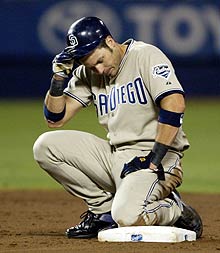
Ryan:
Quit whining about how mean
Petco Park is and concentrate on hitting
more than nine home runs in '05.
2. 
The Dodgers have made a lot of progress
in becoming a good baseball team, and they should challenge for the NL West
title all season long. It certainly wouldn’t be surprising if they pulled
it out, a la 2004, when they finished strong to make the playoffs. They’ve
ridded themselves of Shawn Green’s disappointing contract and they’ve
got a few shiny, new acquisitions to show off. They’ve got talent in the
minors, money in the bank, and they’re ready to go. If they need to make
a big deal late in the season, they certainly can afford to.
L.A. dealt catcher Paul LoDuca (wisely) to Florida near the end of last season
for a plethora of potential talent (Hee Seop Choi, Brad Penny) and now we’ll
see David Ross and Paul Bako handling the Dodgers’ staff. Ross has a little
bit of power, but had a miserable 2004 (.170/.253/.291 in 165 AB). As for Bako,
he’s got a good defensive reputation, but offers no bat to speak of. Things
might be a bit rough behind the plate for the Dodgers this season. At first
base, Choi will be the starter, and could very well expand upon his nice 2004
campaign. He showed nice power in Florida (15 HR) and he’s still only
26. Jeff Kent comes in to play second this season after signing in the off-season.
Expect Kent to continue hitting, but not quite at the clip he’s become
known for. He’s getting older and Chavez Ravine isn’t all that forgiving
of a hitter’s ballpark. Cesar Izturis is back at short to play great defense
and hopefully retain the offensive improvement he made in 2004. Third base is
a gaping, black hole for L.A. this season, and it looks like Jose Valentin will
be the starter. Valentin hit .216/.287/.473 last season, and other than his
power (which is likely to decrease as a Dodger), isn’t valuable as a hitter.
The outfield features former Cardinal
and Brave J.D. Drew who was amazing for Atlanta in 2004. Drew should be a good
hitter for the Dodgers as well and will succeed if healthy. Milton Bradley will
be good as well, so long as he doesn’t maim anyone in the meantime. It’s
certainly possible he’ll post a very good 2005 and help the Dodgers make
a run. Thirty foot tall Jayson Werth will fill out the Dodgers outfield in left,
and has enough power to help them out. Werth hit 16 homers in his 290 at bats
last season and could certainly hit 30 if given the chance.
The Dodgers’ starting pitching is pretty much anyone’s guess. Odalis
Perez has been resigned for three more years (at $24 million, almost a bargain
compared to the other off-season pitching signings) of solidity. Perez is a
good bet to remain a sub-4.00 ERA pitcher for the duration of the contract,
whether or not he remains the Dodgers’ number one starter. Following Perez
is former Red Sock Derek Lowe. Lowe really hasn’t been all that good,
especially not good enough to garner the four year, $36 million contract the
Dodgers gave him this winter. But Lowe is a ground ball pitcher, and he is pitching
in L.A. Put it all together and Lowe might turn out to be a league average pitcher
or slightly better, but not worth the cash he’ll be receiving by any means.
Jeff Weaver, always the underachiever, will return to eat innings and keep his
ERA under 4.50. Brad Penny is on hand to hopefully become what he certainly
could. Penny’s got great stuff and had a very good 2004, but he’s
sustained quite a few injuries to his pitching arm. If Penny can stay healthy,
the Dodgers could have a great number two on their hands (or maybe number one).
Rounding out the rotation is Kazuhisa Ishii, who is sure to be terrible. Ishii
walks everyone (98 last season, a career low!) and never strikes anyone out
(99 last season). All of this “being bad” stuff is starting to catch
up with Ishii, as he posted a 4.71 ERA last season. Look for it to only get
worse, and for Ishii to find himself nowhere near this rotation at some point
in the near future.
Eric Gagne: that about sums up the Dodgers’ bullpen situation in two succinct,
dominant words. Gagne continued his unbelievable run in 2004, striking out 114
in 82 1/3 innings while having a 2.19 ERA. That’s not quite up to his
2003 standards, but who cares? He’s amazing, goggles and all. Twenty-five
year-old Yhency Brazoban is pretty great as well, putting up great numbers a
year ago (2.48 ERA, 27 K in 35 2/3 IP). He’ll be a nice option to set
up Gagne and make no team want to trail the Dodgers after seven innings. The
rest of the pen should be sufficient as well, with guys like Duaner Sanchez
providing at least mediocrity around the sure-to-be unstoppable Gagne/Brazoban
duo.
The Dodgers look about as good as they did a year ago, and it certainly wouldn’t
be unreasonable to expect them to win the NL West again. However, there are
certainly some questions not yet answered, and I don’t think they’ll
quite get to where they need to be. They’ll win 85-95 games, but they
won’t beat out the Padres, who’ll be this year’s lovable little
fighting team.
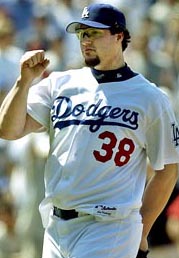
Opposing
teams should have the
option of forefeiting when this
man takes the mound.
3. 
If nothing else, the Giants can kick
back and realize that they do, in fact, have Barry Bonds. This is a very old
team with little left in its tank, but they’ll find a way to put themselves
right in the middle of the playoff race once again. This time they’ll
fall a little further away from first, though. Somewhere around 85-90 wins is
what we should all probably expect.
The Giants have brought in a few new hired guns, but you could argue that most
of them are nothing more than water pistols. Included in this category is new
catcher Mike Matheny, who’ll play good defense and not hit anything. Why
GM Brian Sabean wanted to throw $10.5 million (for three years) at this guy,
I don’t know. At first base (once again) is J.T. Snow, who always gets
hurt and isn’t much more than a below-average hitter for his position
with a good enough glove to try and cover it up. Ignore Snow’s ridiculous
2004 (.327/.429/.529 in 346 at bats at age 37); that’s not happening again.
Ray Durham is back to be a pretty good second baseman and a decent hitter (.282/.364/.484
with 17 homers in 471 at bats last season). He’ll probably hit lead off
again, and he’s still got respectable speed. Shortstop Omar Vizquel is
another newcomer, and he’ll be an adequate defender with little to offer
on the offensive side of the ball. He’s capable of hitting .280-.300,
but he won’t deliver any power to San Francisco. Edgardo Alfonso is back
at third. He’s now 31 and displays less power each and every season. On
top of that, he’s been walking less as well, and it’s likely he’ll
have a pretty useless 2005.
Felipe Alou’s Giants outfield should look awfully familiar to him this
season, as two-thirds of it played for him eleven years ago in Montreal. One
of those two is his son, Moises Alou, who was signed to a big, fat deal after
inadvertently hitting 39 home runs last season at age 38. Alou won’t fare
nearly as well in 2005, but he’ll hit enough to not be a complete bust
as long as he’s healthy. The other former Expo is the returning Marquis
Grissom, who pretty much only hits lefties and never bothers to get on base
unless he’s rounding them. Along with the ’94 NL East champions
is the best hitter ever, Barry Bonds. The statistics, steroid induced or not,
are completely unprecedented, and he’ll be a force as long as he avoids
the injuries his 40 year-old body is likely to suffer. He’s the reason
this team will be in the race in any capacity.
Jason Schmidt is the clear-cut number one starter; he just needs to avoid getting
hurt. Schmidt continued his dominance a year ago (251 K in 225 IP, 3.20 ERA)
and at 32 he’s still got a couple more really great seasons in him. Behind
the ace is Kirk Rueter, who really is a terrible number two starter. Rueter
walked ten more than he struck out in 2004 (66 to 56 in 190 1/3 innings), and
he really didn’t walk all that many batters. He has nothing in the way
of stuff and he’s likely to slide even further at age 34. Brett Tomko
was re-upped for too much money ($2.5 million), and will be very mediocre again
in 2005. SBC is a pretty big park, so Tomko can keep his ERA in the 4.00s, but
he won’t be too much of an asset. Youngster Jerome Williams has shown
very good control (only 93 BB in 260 1/3 Major League innings) but hasn’t
been too tough on hitters. He’s had trouble striking anyone out and he’s
given up near a hit per inning. However, he’ll be a solid guy to have
for the Giants, who really should value him more than most of their starting
pitchers. Lefty Noah Lowry fills out the rotation after a surprisingly good
2004. In 14 starts he managed a 3.82 ERA with 72 strikeouts and only 28 walks
in 72 innings. That’s certainly good enough to stay in this starting rotation,
and maybe even make his way to the middle of it.
The Giants threw a ton of money towards Armando Benitez this winter, and much
like everything else in his path, Benitez gobbled it up. Benitez is certainly
a dominant reliever, and he’ll be helpful even if he is a tad overpaid.
Matt Herges, who failed to be very good as a potential closer in 2004, will
be back to try and just be a viable middle relief candidate/setup man. Twenty-four
year old Jesse Foppert, who has shown tremendous stuff, will try to rebound
from various injuries this season. He may be in the bullpen at times to get
things worked out, but Foppert’s headed for the rotation at some point
in the future. Either way, he’ll likely be helpful, if not better, in
2005.
The Giants look respectable for 2005, but they could’ve done better than
signing Alou, Matheny, and Vizquel to “bolster” their offense. That’s
a lot of money down the drain, and Barry Bonds only has so many more years he
can be so awesome that none of the rest of the team matters. They’ll fall
short again this season, and Brian Sabean better be prepared to do something
a little more proactive if he wants to win anything during the Bonds/Schmidt
era of destruction.
4.
After having the worst season in Major League Baseball a year ago (51-111), the Diamondbacks decided they wanted to try and build a contender in 2005. They took a large sum of money and went out on the market to try and acquire the most potent players possible. The problem isn’t necessarily in the thinking, but the execution, as Arizona may have made several mistakes in their free agent signing frenzy.
I’ll start with Russ Ortiz, whose price tag couldn’t have possibly been higher. Ortiz signed for $33 million over four seasons, a deal Arizona will be cringing at the thought of in three years (or three months). Ortiz should be a third or fourth starter on a good team, not someone you throw $33 million at. He’s never shown much control, as he’s walked at least 90 batters in each season of his career. Couple that with the fact that he doesn’t really strike anyone out (he’s never hit 150 Ks) and you have a dangerous situation. Ortiz also saw his HR rate rise last season, which is bad news as he enters his first season pitching in the hitter-friendly Bank One Ballpark.
Next comes Troy Glaus, who actually does have a vague chance to earn the $45 million over four seasons Arizona gifted him. Much of this relies on Glaus being healthy for the duration of his time as a D-Back, and that’s a huge question mark. If healthy, Glaus does certainly still have the power necessary to hit 35-40 homers. He had 18 in a little over 200 at bats for the Angels last season, but hit just .202 after returning from an injury. Glaus is still just 28 years old, and its possible he could run off a couple of .270/35 homer seasons where he draws 80 or 90 walks. If he does this, he’ll be well ahead of Ortiz in earning his keep.
Overall, this just isn’t a team that’s going to do much in the way of succeeding in 2005. There are plenty of holes all over the place. The middle of the infield will feature the past-their-prime-they-never-had duo of shortstop Royce Clayton and Craig Counsell. Clayton plays solid defense at short, but absolutely cannot hit at this point in his career. The 35 year old hit .279/.338/.397 last season AS A COLORADO ROCKIE. The $1.35 million Clayton will make this season is another gaping mistake by GM Joe Garagiola Jr. As for Counsell, he was equally terrible at the plate as well (.241/.330/.315). Why Alex Cintron won’t be starting somewhere is beyond me, as he is at least still young and capable of hitting .280 with a little pop.
Arizona’s outfield isn’t exactly full of spring chickens either, as it features 37 year old Luis Gonzalez (known to break in half), the 31 year old Jose Cruz (known to be very average), and 31 year old Shawn Green (known to injure shoulder and never be awesome again). Gonzalez will certainly be a decent producer if he’s on the field. He has power, draws walks, and plays hard; but he is often hurt. As for Cruz, one can expect a repeat of his 2004 with a little spike in average. Green was acquired last off season from the Dodgers in exchange for a wad of prospects, and figures to see his numbers go up a bit in the BOB. Will he ever regain his mid-20s level of production? No. Could he hit .270 with 30 homers? Possibly. Either way, it won’t be enough to spark an otherwise dormant lineup.
Arizona’s pitching isn’t exactly going to make up for the sub par offensive attack. Aside from Ortiz, the D-Backs also got right-hander Javier Vazquez in the famed Randy Johnson trade. Vazquez pitched well for part of last season before faring terribly down the stretch. He’ll definitely be better for Arizona in 2005, but it’s doubtful he’ll be as good as he was two years ago. After Vazquez and Ortiz comes Brandon Webb, who walked 119 batters in 208 innings last season. Although Webb has shown some promise, that’s scary. If he doesn’t regain his control he’ll continue declining. The back of Arizona’s rotation features Shawn Estes and Mike Gosling. Estes is merely there to eat innings, while Gosling is a 24 year old rookie with a fairly poor minor league track record.
The bullpen showcases a couple of decent options to close. One is the hard-throwing Jose Valverde, a 25 year old who certainly has the stuff to be dominant. The other is the less-heralded Greg Aquino, who closed after Valverde was injured last season. Those two will battle it out in spring training, with Valverde as the likely favorite. The rest of the pen will probably be comprised of guys you really don’t want to trot out there, such as Brandon Lyon and Mike Koplove. They’ll also return 100 year-old Scott Service, who does strike people out, but last year had a sparkling 7.09 ERA.
Arizona really tried hard to desperately buy a contender, but they bought the wrong players at the wrong time. There are too many other holes on the roster to fix all of this right now, and there just weren’t the right players on the market to fill Arizona’s needs. Even if Glaus pans out, and Ortiz isn’t too bad, they’ve blown a lot of money on puzzle pieces that won’t add up to anything. The rest of this team isn’t good enough to the point where winning a lot of games is all that plausible.
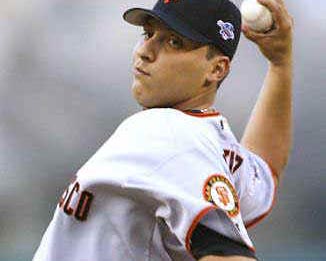
There's
very litte doubt Ortiz was about to issue ball four at
the time of this picture.
5. 
While the top three teams figure
to be immersed wholly in a close divisional race all season long, and Arizona
tries to figure itself out, the Rockies will just be trying to keep their heads
above water. It certainly seems as if this is an organization without any clue
what direction it wants to go in, other than nowhere. There is very little pitching
to speak of, and the lineup still isn’t where it needs to be (or could
be in the future). Although there are a few promising hitters on the roster,
they aren’t good enough to counteract the shortcomings this team will
have to deal with elsewhere.
Despite all their troubles, the Rockies do have a few players worth taking a
look at. At first base, there’s Todd Helton, who you already know as a
very good hitter. Helton’s now 31 years old, but he’s still an absolute
force at home and the road (which is more than you can say for most of the successful
hitters in Rockies history). Helton hits for average, hits for decent power,
and draws a ton of walks. All of this put together makes him a franchise player,
but the Rockies have thus far done little to build around him. This year could
be a step in the right direction (offensively). J.D. Closser, who saw 113 at
bats last season, will step in behind the plate to deliver solid defense and
good hitting. Closser’s just 25, and he’s a definite representation
of what the Rockies should be doing: let talented young players play and let
Vinny Castilla and Jeromy Burnitz get out of town. Twenty-six year-old Clint
Barmes will step in at shortstop, in the process making Colorado wonder exactly
why Royce Clayton started for them last season. Barmes is no star, but he’ll
hit a little and at a low cost. Aaron Miles will likely open the season as the
starter at second despite a pretty poor showing in 2004. Miles really doesn’t
have a lot of potential (he’s now 28) and didn’t even hit well playing
half his games in Coors. Garret Atkins, 25, will play third base and provide
a pretty decent bat and glove for Colorado. Atkins is another inexpensive step
in the right direction.
The Rockies outfield could be a decently productive one. First, there’s
centerfielder Preston Wilson, who missed much of 2004 due to injury. Wilson
is overpaid, but he has some power and is probably as good a middle-of-the-order
threat as the Rockies have. New to the team this year is Dustan Mohr, who’s
29 but has always shown an ability to hit. Mohr hit .274/.394/.437 with the
Giants last season in expansive SBC Park. In Coors, his power could blossom
and he could be extremely productive. Also with some power potential is Matt
Holliday, who’ll start in left field. Holiday hit 14 homers in 400 at
bats last season and is a good bet to hit 20-25 this season as a Rockie. He’s
just 25 and he’ll be a decent option as a corner outfielder for this team.
If you’re merely a casual baseball fan, you may be wondering just why
the Rockies will be so bad if their lineup shows a decent amount of promise.
Well, here’s the answer: they don’t have a real pitching staff.
I’ll begin with the starting rotation, which is horrible (Coors or not).
Jason Jennings is the “number one” here, despite not being all that
good. Jennings would be a decent back-of-the-rotation innings eater for a real
team in a real ballpark, but here he’s an ace with a 5.51 ERA. He’ll
possibly get the ERA a little under 5.00 this year, but that’s all you
can reasonably hope for. Next up is Joe Kennedy, who isn’t a prospect
anymore, but he actually fared well for Colorado in 2004. He finished the season
with a 3.66 ERA in 162 1/3 IP, which is a near miracle for a Rockie pitcher.
He won’t repeat that, but he’ll be a decent pitcher for a while,
especially if he gets out of town. Shawn Chacon is the projected number three,
despite having real difficulties in keeping his ERA under 813.00 last season.
Chacon (7.11 ERA, 12 HR, 52 BB in 63 1/3 IP last season) will get hit hard again
this season, and even harder if he continues to never find the plate. Jeff Francis,
who seriously does have good stuff, is just 24 and could help the Rockies immensely
if he settles in and finds a way to make the effects of Coors milder. Jamey
Wright will plug the other hole in the rotation and probably be his usual self,
which is to say he’ll be a tad below average (which is a plus if you’re
in Colorado).
Chin-Hui Tsao will apparently wind up closing for the Rockies this season, despite
showing enough promise to be a good starter in the past. Tsao is only 24 and
has had good strikeout rates throughout his professional career so far. He’ll
be solid out of the bullpen, but wouldn’t a good starter be better? The
rest of the bullpen may have problems, though. Lefty Javier Lopez (7.52 ERA
in 40 2/3 IP) and righty Brian Fuentes (5.64 ERA in 44 2/3 IP) have shown signs
of success in the past, but were horrible last season. They’ll have to
bounce back for the Rockies’ pen to be effective at all. Even Steve Reed
(age 40) has jumped ship to the Orioles, realizing there was little hope in
Colorado and that he may be the only Rockies reliever to ever have back-to-back
good seasons.
The Rockies are heading in the right direction offensively, starting young and
qualified hitters over advanced-age veterans who would post superficially decent
power numbers. Atkins, Barmes, Mohr, Holliday, and Closser will all provide
respectability to a budding offense. However, some things never change and one
of them is Colorado’s horrendous pitching. Even big-upside guys like Jeff
Francis and Chin-Hui Tsao are dampened by the Rockies organization and the park
they’ll pitch in. As much as things are looking up in Colorado, they can’t
go too far without first figuring out a way to hold teams in the single digits.
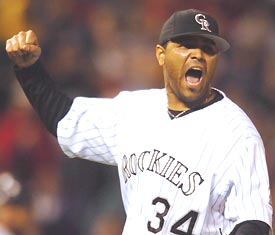
One has
every right to wonder just what it is Shawn
Chacon might have been cheering about.