Previewing the
NL East
Posted
March 1, 2005
1. 
This is both a bold and not so bold pick. It's bold because the Braves always finish first. No matter what kind of roster they have, they always find a way to finish first. It's also not that bold because there are always at least a few people every season who go out on a limb and say that their streak will end this time. If it doesn't happen this year, it very well might never happen, because the Florida Marlins have improved what was already a pretty good team over the off season. It starts with the outfield, where they boast one of the great young sluggers in the game in Miguel Cabrera, one of the game's better lead-off hitters in Juan Pierre, and the always enigmatic but doubtlessly talented Juan Encarnacion (if he isn't dealt first). The infield, after signing free agent Carlos Delgado, is going to cause some problems for other teams as well. First there's Delgado, who has established himself in the past several seasons as one of the best first baseman in the game. Mike Lowell is always productive at third, and Luis Castillo is a perfect fit at the top of the order with Juan Pierre. Alex Gonzalez is certainly not among the best short stops in the game, but he has good power for the position, and helps to form a very good infield defense. Catcher Paul Lo Duca, acquired in a blockbuster trade from the Dodgers last season, is also a solid hitter with better offensive capabilities than many catchers in the game currently.
The starting rotation, even minus Brad Penny and Carl Pavano, is top notch. Despite Al Leiter's advanced age (39), he was a valuable off-season signing, and combined with the promising young trio of Josh Beckett, A.J. Burnett, and Dontrelle Willis, the result is a deep pitching staff most teams would envy greatly. The last spot probably goes to Ismael Valdes, who is still only 31 and made 11 relatively decent starts for Florida last season, en route to coming within one win of his career best (which was 15 in 1996).
Admittedly, the bullpen was dealt a blow when former closer Armando Benitez fled to the other coast to close out games with the Giants. There will be many new faces when it comes to relievers this season, including Antonio Alfonseca (beginning his second stint with the Marlins after a good season with Atlanta), John Riedling (70 appearances in '04 with the Reds), Jim Mecir (spent the last four full seasons throwing his infamous screwball with Oakland), and Todd Jones (former Detroit Tigers closer has 186 career saves). The most likely successor to Benitez would be Guillermo Mota, also involved in the trade that brought them Paul Lo Duca, who has good stuff but struggled in his 26 appearances after becoming a Marlin.
With as well-balanced of a rotation as you'll find, a bullpen full of seasoned veterans, and a lineup that now features Carlos Delgado, Miguel Cabrera, and Mike Lowell in the heart of the order with Juan Pierre and Luis Castillo to get on ahead of them, it's very difficult to see how this team doesn't claim a playoff berth, barring more injuries to Beckett and Burnett, which isn't out of the question. At the very least, you can't blame me for suggesting that the Braves' domination of the NL East has come to an end. I wouldn't be the first to say so and be wrong, though.
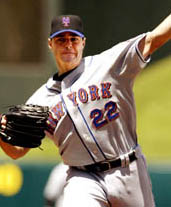
Al Leiter
will do his traditional
delivery battle cry as a Marlin
this season.
2. 
I stand by my decision to put the Marlins first, but even a shaky outfield can't convince me to project the Braves to drop any farther than second. It's true that Brian Jordan and Raul Mondesi have certainly passed their prime, but offensively they can still contribute if placed in the correct spots in the batting order, and defensively their limitations are minimized by the terrific range of Andruw Jones, who is in his prime. Look for Chipper Jones to have a big year; no one with six straight seasons with a .300 or better batting average suddenly becomes a .250 hitter (except for Jason Giambi and Roberto Alomar). Alomar was old, and Giambi was no longer on steroids, so Chipper (Larry) should be cleared to rebound nicely since he's guilty of neither of those things. Marcus Giles and Rafael Furcal are two talented 26-year-olds who most teams would love to have as their double play combination, and first baseman Adam La Roche showed the ability to be a good hitter and play some fine defense as a rookie. Catcher Johnny Estrada really came on with a surprising offensive year as well, although he's anything but a sure bet to repeat his 2004 performance.
Landing Tim Hudson was a great move by GM mastermind John Schuerholz. Suffice it to say he will do a more than adequate job taking over the ace role. I don't think Atlanta fans will be pining for the sight of Russ Ortiz with Hudson on the mound. While Mike Hampton is obviously not the pitcher he was with the Astros and Mets, he is also not the same pitchers he was in Coors (what former Rockie is?), and if John Thomson (another former Rockie) can eat some innings, they will have good depth at the lower end. Left-hander Horacio Ramirez is young with a lot of upside, but must stay healthy and effective. Speaking of health, will John Smoltz's arm hold up over an entire season of starting for the first time since 1999? He still has the stuff to be a quality big league starter, but there are plenty of skeptical baseball minds who do not think he will be able to stay healthy in a 200-inning campaign anymore. If he can, though, then the rotation will be a definite strength.
Lead by newly acquired closer Danny Kolb (3.30 K/9), Atlanta features a bullpen full of finesse pitchers. Kevin Gryboski (4.26 K/9), Tom Martin (5.96 K/9), and Gabe White (6.18 K/9) aren't exactly known for blowing it by anyone. Chris Reitsma returns for his second year of relief work for the Braves as well, leaving them with a few spots to fill before the season starts.
As with most teams, the success of the Braves will depend largely on their starting rotation. Hudson is a lock to deliver, but Hampton's consistency, Thomson's stuff, Smoltz's health, and Ramirez's inexperience are all burdens the team will have to shoulder. Atlanta proved last year the overall quality of the roster is not everything; they will find a way to compete no matter what.
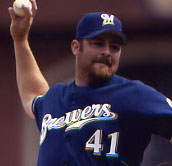
Can Danny
Kolb once again
record nearly twice as many
saves as Ks?
3.
Not even signing Carlos Beltran and Pedro Martinez can persuade me to rank the Mets to take over the East. Let me rephrase. Not even Carlos Beltran, and especially not Pedro Martinez can persuade me. Beltran is doubtlessly one of the best all-around players in the game, and he will upgrade the Mets' stagnant offense, but not everything is in place yet. The outfield is promising, with Beltran now patrolling Shea's ample center field territory, two-time Gold Glove winner Mike Cameron in right (one of the two had to play there), and Cliff Floyd in left. Each of them bring different things to the table, and together make for a very imposing trio, if Floyd is healthy and not traded. Cameron is also a trade possibility.
The infield is where the question marks are. While David Wright appears to be a fixture for years to come at third, new first baseman Doug Mientkiewicz is known mostly for his glove, and Jose Reyes and Kazuo Matsui have much to prove, even with their abundance of potential. Mike Piazza is no longer one of the better hitters in the game, and frankly his defensive abilities behind the plate are horrifying.
How good will Pedro Martinez be? Pretty good, I'm sure. But vintage Pedro good? Pedro circa 1999 good? Not a chance. We'll never see that Pedro again, and that's too bad. In all reality, it is likely his ERA will be somewhere right in between the 3.90 he posted in 2004 and the 2.22 he posted in 2003. That is to say, somewhere in the low to mid 3.00 range. Good? Yes. Is he on the decline? Yes. His stats tell the story quite clearly, from his declining strike outs per nine innings in three successive seasons to his diminishing strike out to walk ratio in four successive seasons. But with a staff that features an aging (but still effective) Tom Glavine, the classic underachiever Kris Benson, perhaps the wildest pitcher in baseball in Carlos Zambrano, and innings eater Steve Trachsel, he is most definitely the ace. He's going to have to pitch like it.
The bullpen is lacking. While Braden Looper has proven he can be a reliable closer, I can't imagine they wouldn't rather upgrade there and use him as a set-up man instead. Aside from him, there isn't a lot of reason to be confident in what might transpire in the late innings of Met games in 2005. Another year of Tyler Yates's heroics (6.36 ERA) will put Big Apple fans in a collective coma. Felix Heredia wasn't exactly effective with the Yankees in '04 either (6.28 ERA), and why should he fare much better with the Mets? The only other recognizable name on their roster for that area is Mike DeJean, who did post a 1.67 ERA in his 17 Met appearances last season, but is generally considered a pretty average big league reliever. This is undoubtedly a problem area.
New GM Omar Minaya did well to land two big-time free agents. He also went after Delgado and Sosa, and might not be done dealing yet. As the roster stands right now, though, it still isn't good enough to make the playoffs. Big splashes in the off-season only go so far towards winning.
4. 
Philadelphia earns this spot in the division because they did nothing to improve in the off-season, aside from a few minor transactions that won't change the overall dynamics of the team. The starting outfield in 2005 will be Pat Burrell (apparently not really the offensive force he was in 2002, but still a decent source of power), Bobby Abreu (one of most complete but also one of the most unknown players in the game), and... Kenny Lofton? Well, that shows you how much Philly thinks of Marlon Byrd these days.
Give credit to Jim Thome for being one of the more valuable one-dimensional sluggers around. He swings with the grace of a lumberjack chopping down the world's biggest tree, but it gets the job done. Granted, he hasn't struck out less than 139 times since 1995, but he's a scary guy that fortifies the less than first-rate Philadelphia lineup. Chase Utley is apparently supposed to be the next big thing, and Placido Polanco agreed to resign with the team, so he'll likely roam all over the infield filling in everywhere. David Bell somehow continues posting solid offensive campaigns at third every now and then, and shortstop Jimmy Rollins is becoming a better hitter every year after taking an initial step back following his strong 2001 rookie season. Catcher Mike Lieberthal continues to put up one quietly productive season after the other.
The departure of Kevin Milwood (to Cleveland) and Eric Milton (to Cincinnati) leaves a void at the top of the rotation. Randy Wolf will likely be expected to take on the ace role, and if he's healthy, he just might be up to it; he has always had good stuff. Vicente Padilla and Brett Myers are young and talented, but maddeningly inconsistent. That duo will need to have career years in 2005. Jon Lieber is yet another respectable starter with health concerns, and one of the few off-season acquisitions. Cory Lidle rounds out the staff as someone who can consistently contribute 200 innings (and 200 hits allowed).
Perhaps the team's biggest strength is the bullpen, which is counting on a healthy Billy Wagner as the closer. Rheal Cormier (yes, he's still around, and he did pretty well in 2004) and newcomer Aaron Fultz will handle the relieving duties from the left side, while Tim Worrell, Amaury Telemaco, Terry Adams, and 24-year-old Ryan Madson (who enjoyed a very good rookie season) will likely get the bulk of the work from the right side. All of these pitchers are dependable and can be counted to provide very effective relief.
This is by no means a bad team; it's just hard to imagine them improving much on their 86-76 record from a year ago without making any significant upgrades. They did add Lieber to the starting rotation, but losing Milwood and Milton offsets that somewhat, and forces some of the underachievers from last season to step up and pitch their absolute best. Whether they can do that will have a profound result on their final record in 2005.
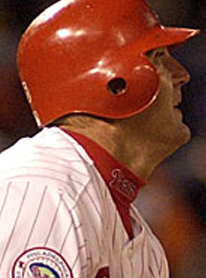
Thome
not only swings like a lumber
jack. He looks like one, too.
5. 
Thank God for the Nationals. Ranking the other four teams was tough work, but I knew all along where I would be putting Washington. Thanks to their clueless GM Jim Bowden, they have actually gotten worse with their off-season transactions, and that's saying something for a team that finished last year 67-95. This team is, for the most part, astoundingly young and unproven. The outfield, for instance, looks like a AAA level club. There's no telling who might wind up as the three starters, but based on 2004, it's looking like Terrmel Sledge, Jose Guillen, and Endy Chavez. Chavez is an okay hitter, and he's fast enough to bat one or two, but he's going to have to draw more than 30 walks to be effective there otherwise. Sledge showed promise as a rookie last season with 15 homers in just under 400 at-bats, but he was an old rookie (27), and it's unlikely he's going to show that much improvement since he's basically in his prime now. Guillen is a good power hitter with a cannon in right field, but he, too, struggles to draw walks and get on base. He also doesn't have the best reputation for being a good teammate.
Someone who does know how to draw a walk is Brad Wilkerson, who might be getting a full season at first base in 2005. However, he has way too much power to be wasted in the leadoff spot, and Washington badly needs someone that actually fits there. Jose Vidro is the team's best hitter when healthy. The left side of the infield is the handy work of Bowden, and it's nothing to be proud of. Vinny Castilla will take over third base, despite never being especially productive outside of Coors Field, and Cristian Guzman, though just 26-years-old, seems to have peaked out in 2001, when he posted the only OPS of his career higher than .693 (it was .814 in '01). Neither Castillo nor Guzman seem to be especially wise investments.
The starting rotation is not a clear strength, but it has the chance to be better than average. While ace Livan Hernandez is always reliable, there aren't many staffs he would be the number one on aside from this one. If Tony Armas can finally be healthy for a whole season and pitch like he's capable of, he could provide Washington with a very good second starter. Esteban Loaiza, another off-season acquisition, will have his work cut out for him in proving 2003 wasn't a ridiculous aberration from his typical 4.70 ERA output. John Patterson will be a serviceable fourth starter, and in all likelihood underrated Zach Day will clinch the fifth spot. Day had a pretty decent 2004, but he was given about as much run support as Randy Johnson (in fact the lowest run support in the majors at 2.47 runs per game).
There are a few good things to say about the bullpen. Firstly I have to mention Chad Cordero, who excelled in his rookie season, and at just 22, has a very bright future. He will be the closer in 2005. Luis Ayala has been nothing short of awesome in his first two seasons in the majors as well. T.J. Tucker did a more than adequate job, as did lefty Joey Eischen (surprisingly), but only in a limited role for the latter. Jon Rauch, who is mostly known for being 6'11" and going AWOL after a game with the White Sox, could develop into a pretty good pitcher as well. And one can't forget Antonio Osuna, acquired from the Padres, who has made a good career of being a set up man. Claudio Vargas figures to get some innings, too.
Washington is certainly a young team, but considering they're just an altered version of the Expos, this is old news. The franchise was effectively a farm system for the rest of the majors to pick from. If the new franchise can actually hold on to the talented young players that make it to the majors, at some point the Nats will be competitive. That point will not be the 2005 season, however.
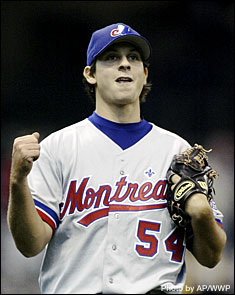
Zach
Day probably didn't look this happy
when the Expos were batting.