Previewing the
AL West
Posted
March 20, 2005
1. 
This may be the obvious
pick in the American League West, but it also looks like the most probable
one. The Angels, no matter what location they may be representing, have the
most talented team in the division and need to capitalize quickly while Oakland
is slightly down. L.A. has a destructive lineup and an amazing bullpen; they
just have to hope the starting pitching is at least mediocre.
Behind the plate we’ll once again see the husky Bengie Molina, a defensive
specialist with a little bit of power. Molina’s 30 now, and he’ll
once again be backed up by his brother Jose. At first will be the always-underwhelming
Darin Erstad, who just isn’t ever going to repeat 2000. Erstad, now
31, has very little power for a first baseman. The Angels would be better
off looking elsewhere (22 year-old Casey Kotchman, if healthy). At second
will be Chone Figgins, whose name is almost as bizarre as the kind of player
he is. Figgins can play just about anywhere, and has blazing speed (17 3B,
34 SB in 2004). He’ll work at the top of the order, especially if he
adds some walks. Dallas McPherson, who destroyed the Pacific Coast League
a year ago (.313/.370/.680, 20 HR in 259 AB) will be starting at third, and
it wouldn’t be surprising to see his power translate at the Major League
level. Orlando Cabrera, fresh off a World Series win with the Red Sox, has
been brought in to play shortstop. Cabrera, who really isn’t quite where
he was a few years ago, was given $32 million over four seasons, and will
likely not earn it. However, he does have quite a few quality hitters surrounding
him, and maybe he’ll get some nice pitches to hit. A few more walks
wouldn’t hurt Cabrera either.
The Angels in the outfield (I’m sorry to conjure up memories of that
Christopher Lloyd movie) are getting a little old, but they do have some ability
left. First of all, there’s Vladimir Guerrero, who isn’t old,
and was the American League MVP in 2004. Guerrero will continue to be MVP-caliber
in 2005 and beyond. Garret Anderson will remain an Angel, but everything’s
beginning to slip a little as he ages. Anderson’s now 33, his power
is tailing off, and his injury frequency is increasing. He’ll still
be solid if he stays breathing. Steve Finley, the other significant Angels
free agent signing (alongside Cabrera), is 40 years old and still useful.
It’s anyone’s guess if he can remain healthy and productive, but
he hit 36 homers last year as a 39 year-old. Hopefully, for the Angels sake,
he can hold it together long enough for the team to make a serious run. He
still plays good defense, but the likelihood of him ever hitting above .275
isn’t very high.
Starting pitching is easily the Angels weakest link. The rotation will be
headed up by Bartolo Colon, whose ERA and weight both exceeded 500 during
the course of 2004. Colon did win 18 games, so I’m sure there are plenty
of people who still think everything’s okay with Bartolo. The problems
are that he walked a few more hitters than usual and just plain got hit hard.
Colon surrendered a career-high 38 homers and surrendered more hits than innings
pitched. Hopefully Colon can right the ship, but it looks like that ridiculous
velocity he used to possess is gone. Jarrod Washburn will be the number two
once again, and he displayed nice command in 2004, but that was about it.
Washburn was also hit hard, failing to strike anyone out along the way. He’d
better hope the defense likes him. Kelvim Escobar was terrific in his first
Angels campaign, posting a 3.93 ERA with 191 strikeouts and 76 walks in 208
1/3 innings. This represents the best season of his career thus far, but Escobar
does have some nasty stuff and is capable of repeating it. John Lackey will
stick around and try to keep the Angels in some games. If he can keep his
ERA in the low 4.00s, and continue to keep his walks down, all will be well.
Paul Byrd is another new addition, and should fit in this rotation quite well
as a placeholder. Byrd had a nice 2004 (3.94 ERA, 79 K, 19 BB in 114 1/3 IP)
for Atlanta, and should be great as a fourth or fifth starter on a team with
this kind of offense.
The bullpen is maybe L.A.’s greatest asset, featuring an array of differently-armed
arms. Francisco Rodriguez will be the full-time closer after a dominant 2004.
Rodriguez had a 1.82 ERA with 123 strikeouts in 84 innings, much better than
Troy Percival could offer. Expect a tremendous 2005. Brendan Donnelly, whose
delivery can only be described as bizarre, will set up K-Rod, and should be
great for the fourth straight year. As if those two weren’t enough,
Scot Shields will return in 2005 as well. Shields was very good a year ago
(3.33 ERA, 109 K in 105 1/3 IP) and will help out again this season.
This is certainly a very good team, and it wouldn’t really be that surprising
to see them make a run in the playoffs, assuming they get there. They have
power and potential on offense, raw quality in the bullpen, and question marks
in the rotation. If the first two can overcome the rest, look out for the
Angels in 2005.
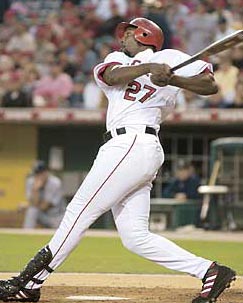
Vladimir
Guerrero has a frightening amount of
talent, and will once again lead Anaheim's high-
powered offense.
2.
It really is pretty
amazing what all the A’s can do and still have a really good team. Perhaps
best-known for having an amazing starting rotation, including “The Big
Three” (Zito, Hudson, Mulder), Oakland general manager Billy Beane did
the unthinkable: he dismantled it. Beane decided to hold on to Zito while
dealing the other two to the National League. Hudson was sent to Atlanta in
exchange for pitchers Juan Cruz and Dan Meyer, as well as outfielder Charles
Thomas. As for Mulder, he was traded to St. Louis for catcher Daric Barton
and pitchers Dan Haren and Kiko Calero. Despite what may seem like unconventional
wisdom by Beane, he traded away expensive stars to get several key players
for both Oakland’s immediate and distant future. This team should be
expected to contend again in 2005, even if they may fall a little short.
At catcher this year will be newly-acquired Jason Kendall, who was picked
up from the Pirates for pitchers Mark Redman and Arthur Rhodes. Kendall is
still a quality player at age 31, and fits right into the A’s offensive
mold (.399 OBP in 2004). Scott Hatteberg will man first base again, and has
been decent as a hitter, although questionable in the field. Keith Ginter,
acquired from the Brewers, offers a little power from second base (19 HR,
.479 SLG in 2004) and will be even better if he learns a little patience.
At third base is Eric Chavez, who may have made some very important strides
in 2004. When healthy, it appeared that Chavez learned to hit lefties, something
that would propel him to the MVP candidate he’s always had the chance
to be. Chavez could very well have his career year in 2005, seeing as he’s
27 and seems to be healthy. He hits, takes walks, and is great with the glove.
At shortstop, the A’s have 25 year-old Bobby Crosby, who was the American
League’s Rookie of the Year last season, and hit 22 homers in the process.
Crosby will likely raise his batting average (.239 in 2004), and he already
plays stellar defense.
The A’s outfield certainly isn’t as strong as their infield, but
they’ll be hoping it gets the job done. Mark Kotsay will return to centerfield,
where he played great defense and regularly got on base as the A’s leadoff
man. He should continue to provide exactly what the A’s want from him.
Eric Byrnes, who hasn’t been stellar but rather acceptable, will apparently
return to left field. Byrnes did show a little more power in 2004, setting
career highs in homers (20) and slugging percentage (.467). Charles Thomas,
who hasn’t really been viewed as a starter by anyone, will start in
right field. Thomas was respectable for the Braves as a reserve in 2004 (.288/.368/.445
in 236 at bats), and the A’s are hoping he’ll offer a surprise
follow-up in 2005.
The starting rotation certainly has endured a lot of changes, but it should
still be good. Barry Zito, surviving member of “The Big Three,”
will start the season as the number one, though he had a lot of trouble at
times in 2004. Zito had what was easily his worst big league campaign, finishing
with a career-high 4.48 ERA. He’ll likely be better in 2005, and he
won’t turn 27 until May. Number two starter Rich Harden is just 23,
and he may wind up being the staff’s ace before long. Harden has amazing
stuff and was very good in 2004 at age 22 (3.99 ERA, 167 strikeouts, 81 walks
in 189 2/3 IP). If he cuts the walks a little and learns the league, Harden
will become dominant. Former Cardinals Dan Haren will fall in as the third
starter after showing promise throughout his minor league career and his brief
major league stints. Haren has good control, and that’ll be enough for
him to have a solid full-season debut. Dan Meyer, another new acquisition,
has a lot of promise as well, and will likely be in the starting rotation.
Meyer has displayed very good minor league numbers and also exhibits exceptional
control at age 23. Another prospect, 24-year-old Joe Blanton, is projected
as the fifth starter. Blanton has also shown good control, and would probably
be a very good number five starter. Somewhere down the road, all of these
guys could win up forming another dominant A’s rotation. As for this
year, they’ll probably still get the job done.
It appears that Octavio Dotel, one of the more confusing relievers in the
game, will be back to close for Oakland. Dotel certainly can be dominant (2002-2003),
but he had his share of struggles last season with the Astros and A’s.
He has great stuff and huge strikeout rates, so he’ll have every opportunity
to be great in 2005. Dotel’s supporting cast should be interesting,
as it will likely include incoming flamethrower Juan Cruz, weird delivery
specialist Chad Bradford, and youngster Justin Duchscherer. This mixed bag
of pitchers indicate exactly what Oakland has always been about: results.
These relievers run the gamut from 80-100 MPH fastballs and each have very
distinct styles. The bottom line is that Billy Beane finds pitchers who get
guys out.
The A’s should be solid again in 2005, but it may be somewhat of a slight
rebuilding season. The funny thing is, this is a team who could make the playoffs
while rebuilding. Chavez, Durazo, and Crosby should anchor a good lineup while
Zito and Harden top a young, promising rotation. Look for 90 or so wins and
a nice run at the Angels.
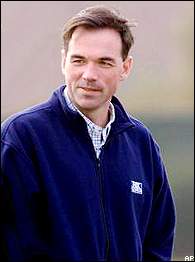
The widely
praised Billy Beane will
have even more supporters if Oakland
is successful in 2005.
3. 
After being perhaps
the single biggest surprise of 2004, the Rangers will hope to contend again
this season. Texas wasn’t supposed to crack the AL West cellar last
year, but their offense was deadly and their pitching wildly exceeded any
possible expectations. They’ll be bringing back their big bats (Teixeira,
Blalock, Soriano), but that pitching staff is still looking very suspect.
But, hey, they had a winning record last season (89-73), and it’s
certainly possible they could build on it and move forward.
Apparently Rod Barajas will be the starting catcher once again in Texas.
Barajas, aside from his 13 home runs, was awful in 2004 (.249/.276/.453).
Texas should be more interested in getting guys on base for the big hitters
in the lineup. Guys like Barajas just aren’t going to do that. At
first is Mark Teixeira, still only 24, and one of the better young hitters
in the game. Teixeira was very good last season (.281/.370/.560 with 38
homers) and will probably be even more powerful this year. He and third
baseman Hank Blalock (24 years old) make up a very dangerous and young middle-of-the-order.
Blalock hit a career-high 32 homers in 2004, and will likely repeat that
for years to come. He has a good, line drive swing and will probably see
his batting average exceed last season’s .276. Alfonso Soriano, who
certainly hasn’t benefited from leaving the Yankees, will play second
and hopefully find some way to rekindle his power. While he still obviously
has some (28 homers in 2004), the Ballpark in Arlington is a hitter’s
park that should’ve yielded better results. Soriano’s slugging
percentages have also gone down each of the last three seasons. His defense
is also quite questionable, as he often looks very out of place and has
trouble with even routine plays. Michael Young will try to follow up a good
2004 (.313/.353/.483, 22 homers) with another solid campaign. Young, Alex
Rodriguez’s replacement, was one of the big reasons why Texas fared
so well a year ago.
The Rangers’ outfield will also feature its fair share of power. Leftfielder
Kevin Mench hit 26 homers last season despite not being a starter for much
of the season. Mench, and his oversized head, will likely continue his power
surge and hit 30-40 home runs in 2005. Richard Hidalgo, who has displayed
seasons of both greatness and utter incompetence, will look to straighten
things out as a Ranger in 2005. He struggled after being dealt from Houston
to the New York Mets last year, hitting .228 after the deal. Hidalgo will
likely show additional power this season thanks to his new home park. Whether
or not the rest of his numbers will be there is the big question. Hidalgo
has shown he can be an MVP-caliber player, and to contend again the Rangers
may need that. Laynce Nix will play center despite a somewhat disappointing
2004. Nix has power, but he’ll need to hit for a higher average and
draw a few more walks. He’s another Ranger who, if successful, could
propel the team to higher ground. Utility special David Dellucci will reportedly
be the DH. Dellucci has never really been healthy, but he showed good power
(17 homers in 331 at bats) in 2004, and will be decent as the Rangers’
DH this year.
Pitching remains a giant chink in Texas’ armor. Although the staff
managed to piece together a surprisingly not-awful 2004, it’s no sure
thing they can do it again. Staff “ace”/chicken expert Kenny
Rogers is 40, and he’ll probably do what he always tends to do (4.50
ERA, no strikeouts, no walks). Considering their offense and home park,
five guys like Rogers would probably give Texas a good chance to win a lot
of games. Ryan Drese will hope to duplicate 2004 (4.20 ERA) despite not
really showing solid numbers anywhere else. Drese pitched 207 2/3 innings
in ’04, and in those innings he only struck out 98, while letting
291 batters reach base. If he doesn’t find a way to be a little more
effective, his ERA could shoot up a run or two in 2005. Chan Ho Park is
32 now, and still owns maybe the Worst Contract Ever. Given a five season,
$65 million deal from Texas in 2001, Park has constantly been hurt and awful.
Odds are he’ll keep giving Texas a big dose of terrible. Juan Dominguez
will try to step into the rotation and have a big rookie season. Dominguez
is 24, has great stuff, and was solid in late-season trail last year (3.91,
14 K/5 BB in 23 IP). Chris Young rounds out the rotation after a decent
rookie season in 2004. Young had a 4.71 ERA with 27 strikeouts in 36 1/3
innings, and he’ll probably be a good fifth starter. He’s still
only 25, so some potential is there.
Francisco Cordero will continue not letting anyone get a hit in 2005. Cordero
has been great as Texas’ closer, and he’ll keep up the good
work. Another sub-3.00 ERA is pretty much a lock for this guy. Twenty-five
year old Frank Francisco will set up Cordero. Francisco has been good, and
he’ll continue to do so if he can cut his walks just a little bit.
Carlos Almanzar had a solid 2004, and he’ll be back to help out in
middle relief. Also back after doing an effective job last year is Erasmo
Ramirez, who has a really cool name. Ramirez (4.29 ERA, 21 K/7 BB in 35
2/3 IP in 2004) is just another reason why Texas hung around last season.
This bullpen is nowhere near as good as the Angels’, but it’s
way better than it gets credit for.
The Rangers probably won’t reach their 89 wins from a year ago, but
they won’t be that bad either. The lineup has power all the way through,
and most of its starts are still very young. If the starting pitching can
keep them in games, and the bullpen can keep shutting teams down at the
end of games, it’s possible Texas could have another improbable run
towards the postseason. Most likely, though, they’ll finish third
behind two superior teams.
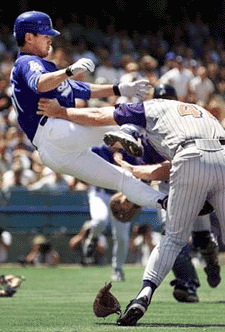
Chan
Ho Park, winner of the WCE award,
would much rather kick Tim Belcher in the
face than pitch well for Texas.
4.

Last season was
quite a struggle for the Mariners, who followed up several nice records
with a dismal 63-99 mark. A lot of things really didn’t work in Seattle.
Bret Boone saw a dramatic drop-off in production, as did the now-retired
Edgar Martinez. As for the pitching staff, it pretty much imploded. Jamie
Moyer finally realized his age, Joel Pineiro couldn’t stay healthy,
and Gil Meche had his share of problems. Mariners’ general manager
Bill Bavasi made big waves in the off-season to try and make Seattle a contender
once again. He brought in two of baseball’s biggest free agents (Adrian
Beltre and Richie Sexson), and now all he needs to do is try and erase some
of the damage done by former GM Pat Gillick, which may not be anything attainable
in the near future.
Former White Sox prospect Miguel Olivo will be the starting catcher for
Seattle this year. Olivo hasn’t really ever delivered on his once-limitless
potential, but he still has a little pop in is bat. He’s still just
26, so there’s hope for him yet. Richie Sexson, given $52 million
over four seasons, will come in to play first and hopefully hit for the
raw power he always has. Sexson is often injured though, and Safeco is a
huge ballpark. If Sexson isn’t fully recovered, this might be his
worst full season in a long time. Bret Boone will be back at second and
still provide value despite his decline. Boone has some power left, but
he might have trouble ever hitting .280 again. More doubles and less homers
is a likely scenario. Ramon Santiago, a good fielder with no hitting abilities
whatsoever, will start at shortstop. Santiago’s only 25, but there
really isn’t much upside here at all. Joining Sexson in having a ridiculously
large contract is Adrian Beltre, who probably could’ve won the National
League MVP award last season (he hit .334 with 48 homers) if Barry Bonds
didn’t exist. Beltre’s only had that one great season, though,
and $65 million over five seasons is a bit excessive (see Chan Ho Park).
Beltre should still be a good hitter, though, and therefore help out last
season’s lowest scoring American League team.
There really isn’t much power to be found in the outfield, but at
least there’s Ichiro, baseball’s new single-season hits champion.
Ichiro’s a solid leadoff hitter (still without a lot of patience)
who’ll get on base at a .400 clip one way or the other. Ichiro’s
a very good defender as well, and he’ll be one of Seattle’s
few highlights again in 2005. Randy Winn will play center field, and hopefully
retain the respectable levels of production he’s started to show.
Winn is likely good for 15 homers and a .340 OBP, which is awfully good
in Seattle. Raul Ibanez, the Mariners’ “huge” off-season
acquistion a year ago, did about what was expected of him. He hit for a
good average while displaying hardly any power. Ibanez will probably do
more of the same in 2005. Look for something like .285 with 15 homers, Randy
Winn style (only for a lot more money). It looks like 29 year-old Bucky
Jacobsen will be the starting DH, and he showed a good amount of power in
his 2004 Edgar-replacement stint. Jacobsen hit 9 homers in 160 at bats,
as well as drawing a respectable amount of walks. If he adds power to this
lineup, he should play.
The starting rotation is an absolute mess. Joel Pineiro, who everyone knows
has good stuff, will try to avoid the injury bug and keep his head on straight.
He’s still just 26 and he’s displayed good control. A bounce
back in 2005 is a very strong possibility. Jamie Moyer, who has to still
be in shock after raising his ERA nearly two full runs (from 3.27 in 2003
to 5.21 in 2004) in a year, is 42 and ready to give it another shot. It’s
unlikely that Moyer can ever really return to form, as he doesn’t
really strike anyone out or have any dominant pitches. He relies on his
command, but that doesn’t matter when you just get hammered if you
throw a strike. Gil Meche had a lot of issues in 2004 as well, but finished
the season strong and showed good control. In 2005, he could be above-average
with a little luck. Bobby Madritsch, a long-time minor leaguer, had a nice
2004 (3.27, 60 K in 88 IP), and will probably be decent in 2005. It wouldn’t
be surprising if he turned in a better season than the rest of this rotation.
Ryan Franklin, who was crushed in 2004, will try to improve in ’05.
He has trouble striking out anyone and he’s already 32. Look for Moyer
and him to share similar fates this season.
Eddie Guardado will return for another season of closing for a bad team.
Guardado was very decent in his first Mariner season (2.78 ERA, 45 K in
45 1/3 IP), but he sustained severe injuries during the duration. If he
comes back healthy, he’ll continue to be a solid closing option. The
rest of the bullpen, which struggled mightily in 2004, will probably shaky
again. Shigetosi Hasegawa was horrible (5.16 ERA, 46 K/ 31 BB in 68 IP in
2004), and he was supposed to be the anchor of the middle/late relief corps.
The rest of them followed suit by pitching poorly as well. Clint Nageotte
was abysmal (7.36 ERA in 36 2/3 IP), while J.J. Putz was merely kind of
bad (4.70 ERA, 47 K in 63 IP). Someone other than Guardado will have to
step up for this bullpen to be any better in 2005.
The Mariners won’t be a whole lot better this season, despite their
Steinbrenner-esque spending. Beltre will hit, and Sexson might, but none
of that will fix a group of pitchers that have the odds stacked incredibly
high against them. Even if a couple of them succeed, the failures of the
rest will likely be too much for the team to overcome. It looks like another
last place finish for the Mariners in 2005.
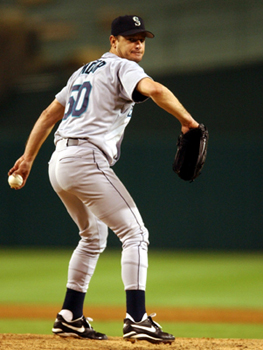
Jamie
Moyer: A poor man's Tom Glavine. Or more
accurately, a bankrupt, on the verge of suicide
man's Tom Glavine.