Previewing the
AL Central
Posted
March 24, 2005
1. 
This is almost becoming
a foregone conclusion. With every other team in the American League Central
either rebuilding (Cleveland), perpetually rebuilding (Kansas City, Detroit),
or busy being the Chicago White Sox, the Twins look poised to capture their
third division title in a row. Even as the gap begins to narrow, it looks
like the Twins will have at least one more year of AL Central dominance. Minnesota
certainly didn’t go out and make any big off-season waves (they never
do), but they have plenty of in-house solutions. With catcher Joe Mauer and
first baseman Justin Morneau now ready, the lineup looks to improve dramatically,
while reigning AL Cy Young award winner Johan Santana should continue to make
hitters cry.
Mauer will hopefully stay healthy this season and show Twins fans why he’s
been so highly touted throughout his young career. In his brief pre-injury
showing last season he hit .308/.369/.570 with six homers in only 107 at bats,
a pretty nice line for anyone, let alone a catcher. Plus, Mauer won’t
even be 22 until after opening day. Justin Morneau, only 23, will start at
first and probably have a huge season. He pounded 19 homers in only 280 at
bats last season, and he looks headed for stardom. He’s the big bat
the Twins really need to have in the middle of their lineup. Luis Rivas, bad,
will probably retain the starting job at second. Rivas hit a gross .256/.283/.432,
and those shiny ten home runs aren’t fooling anyone. He’ll probably
hit ninth and continue to never get on base. Scrappy Nick Punto, who’s
fast and versatile, will play shortstop. He’s no superstar, but he’s
also a cheaper option than the downward-spiraling Christian Guzman, who left
for Washington. Michael Cuddyer will be the third baseman, and he’ll
have a nice 2005. Cuddyer is starting to show streaks of what he’s capable
of, and a .280/20 HR season is probably in line for this year.
Minnesota’s outfield looks much the same as it usually does, featuring
Torii Hunter, Jacque Jones, and Shannon Stewart. Hunter plays a stellar center
field, and has a decent bat as well. He’ll probably continue to put
up numbers in the neighborhood of last season’s, if not a little better.
As for Jacque Jones, he saw his batting average, on-base percentage, and slugging
percentage all decline in 2004. Jones is 30 now, and it’s looking like
he’s headed into decline. Jones circa 2002 is nowhere to be found. Shannon
Stewart will continue to do a nice job leading off and getting on base for
the rest of the lineup, while still doing a little damage on his own. He’s
been great since the Twins acquired him before the trading deadline in 2003.
Lew Ford proved a nice surprise a year ago, and he’ll probably better
those 2004 stats (.299/.381/.446, 15 homers) by a little bit. He’ll
be a good, cheap DH for the Twins, who specialize in good and cheap.
The Twins starting rotation is headed up by the indescribable Johan Santana,
who everyone knew was going to be good, but what he’s done is phenomenal.
Santana captured the AL Cy Young in 2004, going 20-6 with a 2.61 ERA and 265
strikeouts in 228 innings. He’ll be great for years to come. Rotation
mainstay Brad Radke falls in as the number two, and he’ll continue to
use his intelligence and control to keep hitters off balance. Radke had a
great 2004, and he’s got several good seasons left in him. Carlos Silva
looks to be the third starter after a nice 4.21 ERA last season (in 203 IP),
but he’s not likely to be that good again. Silva’s strikeout rates
are frighteningly low, and despite his good control, that will be a problem.
An ERA over 5.00 wouldn’t be shocking in 2005. Kyle Lohse, winner of
baseball’s most ridiculous arbitration salary, will probably do more
of the same. Lohse is good for an ERA around 5.00 and he’ll make all
of his starts. That’s about all you can say for him. It looks as if
Joe Mays, most famous for having one solid season in 2001, may get the fifth
spot. Mays has been pretty terrible since his breakout campaign, and there’s
no viable reason to think he’ll turn it around in 2005. His K/BB ratios
of late have been appalling (88/64 in 225 1/3 IP in 2003/2004). Despite the
weak lower part of the rotation, Santana and Radke should keep the Twins staff
afloat.
Joe Nathan, a failed starter turned dominant reliever, will close for the
Twins again in 2005. Nathan posted a 1.62 ERA in his first full season as
a closer, and he’ll most likely be very good again this year. Juan Rincon,
fresh off a season of awesomeness (2.63 ERA, 106 K in 82 IP), will be setting
up Nathan again, and is sure to do a fine job of it. If Nathan should get
hurt, this is certainly the man to step in. J.C. Romero did a credible job
out of the Twins bullpen last season as well, posting a 3.51 ERA in 74 1/3
innings. He should provide solid support for the lights-out tandem above.
The Twins ‘pen looks good, let’s just hope they neglect to let
Terry Mulholland pitch 123 1/3 innings ever again. He’s 42 and it’s
showing.
All in all, this is another good Twins team that will benefit from a poor
division. The lineup is only getting better as Morneau and Mauer develop,
and the pitching is good enough to get this team into the playoffs. With a
1-2 like Santana and Radke, and a bullpen duo like Nathan and Rincon, the
Twins could be a force in the postseason. It would be something to see if
they run into the Yankees in the October, forcing a Randy Johnson/Johan Santana
duel.
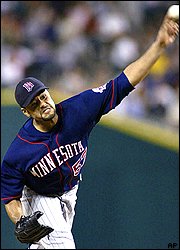
Tom Hanks
is wrong; thanks to
Santana, there is crying in baseball.
2. 
Last season marked
the first in which a young, rebuilding Indians team made a run at decency.
They finished 80-82, which has to be considered progress. Well, this year
may be the first of a few in which they make a semi-serious charge toward
Minnesota. The pitching is improved with the addition of Kevin Millwood, and
the young hitting will only mature further. Bob Wickman makes the bullpen
a bit sketchy (and fat), but that’s nothing they can’t overcome.
Victor Martinez had the first of what will likely be many good seasons in
2004. Martinez showed more power (23 homers, .492 SLG) and will get better
defensively. He’s the right kind of player for the Indians to stake
their promising future on. Ben Broussard will start at first, and he’s
becoming a pretty decent hitter as he approaches 30. Broussard had a good
’04 (.275/.370/.488) and should at least equal that in 2005. Ron Belliard,
eternally disappointing as a Brewer, was solid last season at second base
both offensively and defensively. Third base is a strange situation, as Casey
Blake showed good power (28 HR) last season, but also played poor defense.
Cleveland also acquired Aaron Boone, who’ll probably get at bats somewhere
as well. Jhonny Peralta, only 22, will start at shortstop now that long-time
Indian Omar Vizquel has headed to San Francisco. Peralta had a strong minor
league season at Buffalo last year, and Cleveland is hoping he’s a part
of their future up the middle.
Cleveland’s outfield is interesting, as it features a contingent of
players whose performance might as well be wildly guessed at. Coco Crisp will
start in left, bat leadoff, and run around like he’s got somewhere to
be. Crisp stole 20 bases in '04, but was caught 13 times. He did start hitting
a little more productively (.297/.344/.446, 15 homers), so he may very well
start earning his keep with his abilities, not just his cereal box name. Youngster
Grady Sizemore will start in center, and he’s had good numbers in the
minors. His power hasn’t exactly proven to be prodigious, but he looks
to be a solid hitter. Jody Gerut will probably start again in right, but he
had his share of troubles with the bat in 2004, hitting .252 with 11 homers
in 481 at bats. Given his advanced age, he’ll need to return to 2003
form quick to keep getting playing time. Travis Hafner will return at DH and
continue killing any pitch that might come his way. Hafner’s 27 years
old and coming off a terrific first full season (.311/.410/.583, 28 HR in
482 AB). It wouldn’t be surprising for him to repeat that for a few
more years. He’s the middle-of-the-order threat Cleveland needs.
Comically oversized Carsten Charles Sabathia will be the ace again this year,
and it’s hard to believe he’s only 24 after all of these years.
Sabathia hasn’t really ever struck as many people out as everyone thought
he could, but he’s making thirty starts a year and he’s above
average. Kevin Millwood, who had a rough year as a Philly, should fare better
with the Indians. Hs ERA will likely sink back under 4.00 and he’ll
make a nice number two behind C.C. Jake Westbrook had some success in 2004
(3.38 ERA), but he’ll need his defense to be strong. He still doesn’t
strike very many hitters out, but at least he doesn’t allow too many
fly balls either. An ERA around 4.00 is most likely. Cliff Lee, a lefthander
who’s shown ability from time to time, fell apart at the end of last
season and finished with a 5.43 ERA. He should bounce back to at least some
degree in 2005. Jason Davis looks like the favorite to win the fifth spot
in the rotation, but he’s not really pitched very well as a major leaguer.
He’s 24, though, and if he cuts his walks and gets smarter, he could
improve.
Closer Bob Wickman possesses many interesting traits, such as heftiness, old
age, and fragility. Unfortunately for the Indians, good pitching is not among
them. Wickman is known for his ability to induce ground balls, but he’s
been very subpar since 2001. Rafael Betancourt will be the setup man, and
he’ll be a good one. Betancourt had a good 2004 for the most part, finishing
with a 3.91 ERA and impressive K/BB numbers (76/18 in 66 2/3 IP). If and when
Wickman gets hurt, he should be ready to step in and get the job done just
as adequately. Bobby Howry, who’s found himself in many different bullpens
over the years, had a good 2004, and will come back to the tribe in 2005 with
a reasonable shot at closing given Wickman’s propensity to fall apart.
David Riske, who tried to close a year ago, and Jason Stanford should also
assist in giving Cleveland a decent bullpen.
Things are looking up in Cleveland, and they may just have enough young hitting
and decent pitching to get better now. They’re not quite ready to be
a real threat, but in the American League Central it might not take them very
long. The Indians still aren’t quite the Twins, but the good news is
that they’re not the Royals either.
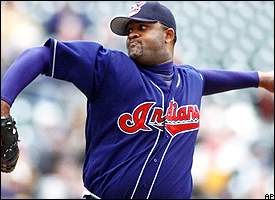
Contrary
to all evidence indicating otherwise, C.C.
does not stand for "cold cut".
3. 
Things aren’t
looking very good in the south side of Chicago. Magglio Ordonez has left for
Detroit, Carlos Lee was mistakenly dealt away for a significantly worse player
(Scott Podsednik), and rotation ace Mark Buehrle will start the season on
the disabled list. The team’s better players are getting older, and
the pitching staff is extremely questionable. The Sox have made a couple of
changes they hope will work, including the acquisitions of Jermaine Dye and
A.J. Pierzynski, but odds are they’ll come up well short of reaching
the postseason.
Former Giant A.J. Pierzynski will be making somewhere in the neighborhood
of $5 million this season to catch for the White Sox, and he’ll be good,
but that’s a little pricy. He’ll probably hit a few more home
runs playing at U.S. Cellular, but that doesn’t quite justify the money.
Either way, he’s an upgrade from last year’s catching situation.
Paul Konerko, who certainly got himself together in 2004 (41 HR, .535 SLG),
will probably keep this added power. He’s not a likely candidate to
hit .300 again, but if he clears 35 homers, the White Sox won’t care.
Willie Harris is really fast, and he’ll start at second base. Harris
can play the outfield as well, and he’s a decent guy to have around.
Joe Crede, an extreme disappointment in 2004, will give it another shot at
third base this year. Crede doesn’t really ever bother walking, or for
that matter getting a hit. He put up a depressing .239/.299/.418 season at
age 26, and there isn’t a whole lot of upside left in him. Juan Uribe
will try and duplicate a nice 2004 (.283, 23 HR), but he doesn’t walk
very much and he strikes out semi-frequently. If he keeps the power, though,
he’s a plus as the Chicago shortstop.
Magglio Ordonez and Carlos Lee, two good-hitting outfield staples in Chicago,
are now gone, and all that’s there to replace them is the scrappy Scott
Podsednik, who’ll start in left field. Podsednik is clearly Lee’s
inferior, but he’s fast, and hopefully he can learn to walk every now
and then. The fact that Chicago traded Lee (.305/.366/.525, 31 HR in 2004)
for a leadoff hitter with no real power and a 2004 OBP of .313 is simply laughable.
Aaron Rowand surprised everyone in 2004 by hitting .310 with 24 homers, and
the White Sox desperately need him to keep making progress as the rest of
team spirals downward. Jermaine Dye is Chicago’s biggest off-season
acquisition, and he’ll bring some power to the lineup. As a White Sock
it wouldn’t be surprising to see him hit 30 homers, albeit with pedestrian
supporting stats. Big Frank Thomas will be the DH again this year, and if
he stays healthy he’ll remain somewhat of an asset. He still has power,
draws walks, and is just plain scary. He’s almost 37 now, though, and
he has a tendency to get hurt.
Mark Buehrle has had a nice career thus far, and he’ll continue to do
so. The problem is that the big lefty will enter 2005 hurt, leaving the Sox
without their ace for about a month. He’ll come back just fine, but
that’s 1/6 of the season the Sox will have to find a pitcher to account
for Buehrle’s spot. Freddy Garcia’s been resigned to be the number
two starter, and he’ll do a nice job of it. Garcia upped his strikeouts
and cut his walks a year ago, and may very well have the best season of anyone
in the rotation. Here’s where it gets ugly: the back end of the rotation
consists of the aging Cuban Jose Contreras, the aging Dominican Orlando Hernandez,
and the really tall and mediocre Jon Garland. Contreras has never really pieced
everything together, and he’s certainly not the pitcher the Yankees
thought they were getting a couple of years ago. Hernandez never stays healthy,
but he’s been pretty good when he is. He’s already 35, though,
and those nagging injuries don’t look to be going away. Garland never
panned out like Chicagoans thought he would, and he’s not likely to
do so at this point. An ERA near 5.00 is likely. Despite the front end of
it, the White Sox will need some luck for their rotation to be worth much.
Thirty-six year old Japanese reliever Shingo Takatsu will close after a good
2004. He posted a 2.31 ERA in 62 1/3 innings of work, and just might be crazy.
He throws an underhanded pitch, among other antics, and just looks like he
might pump out some sort of bizarre, never-before-seen pitch at any moment.
He’ll probably be better than average in 2005, and the Sox will need
it. Damaso Marte has some nasty stuff, and he’ll probably be the setup
man. Marte had a decent ’04 (3.42 ERA, 68 K in 73 2/3 IP), but he walks
too many batters. If he settles down, he could dominate like he did in 2002
and 2003. Cliff Politte will also come back for middle relief help, and he
was at least average in 2004. Considering how poor the rest of the bullpen
could pitch after Takatsu and Marte, Politte will need to be at least respectable
again in 2005.
The White Sox just really aren’t quite there anymore, and they probably
won’t come close to approaching the Twins as they have in past seasons.
If they continue making trades like their biggest one in 2004 (Lee to Milwaukee
for Podsednik) they aren’t headed anywhere positive any time soon. It’s
kind of a shame that the Ordonez/Lee White Sox never really got a chance to
show what they could do in the postseason.
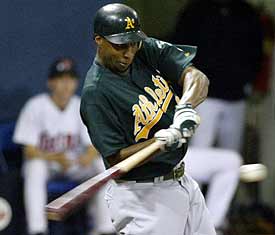
After
a mediocre stint with Oakland, Dye will be
counted on to help Sox fans forget Lee and Ordonez.
4. 
Well, 2004 wasn’t
great for the Tigers, but it sure was better than 2003. Coming off one of
the worst overall seasons a baseball team has had in history, the Tigers made
a few changes, finished 72-90, and got themselves out of the basement. They’re
still getting better and they’ll look to make additional progress this
season. They’ve brought in a big bat (Magglio Ordonez) and a big-name
reliever (Troy Percival), which shows they’re at least kind of serious
about moving forward some more, even if these weren’t the most intelligent
moves. Just remember, the Tigers have inked worse contracts (Dean Palmer,
Juan Gonzalez, Damion Easley).
Ivan Rodriguez, now 33, returns for what he hopes will be s successful sophomore
season with the Tigers. Rodriguez was great in his first, hitting .334 with
19 homers and a Gold Glove. He’ll be good again, but it will be hard
for even Pudge to duplicate his stellar 2004. Carlos Pena, once a can’t-miss
prospect, will be the starter at first. Pena does have power (27 homers in
’04) and a little bit of patience (70 BB in ’04), but he hasn’t
shown any sort of ability to hit for average in his major league career. It’s
unlikely that will change now. Omar Infante, just 23, had a decent season
last year, and has the potential to get better. Infante offered 16 homers
and 13 steals to the Tigers in 2004, but also didn’t walk much or hit
for average. Hopefully he’ll continue to develop and give Detroit a
valuable player. Brandon Inge, he of many positions, will start at third this
year despite not having much of a bat. Inge is getting better as a hitter,
though, and might be able to have a few .280/15 homer seasons. Carlos Guillen
is the starter at shortstop, and he’s on the heels of a monster 2004.
Guillen wholly delivered on his former prospect potential, hitting .318/.379/.542
with 20 homers and 12 steals in 522 at bats. He’s 29 now, but he should
still be very good at short for Detroit.
Magglio Ordonez is the big news for Detroit’s outfield, and he has certainly
been great at times in his career. Ordonez was hurt for much of last season,
but a return to previous heights isn’t out of the question completely.
Comerica Park will probably dim his numbers a bit, but he’ll be good.
Rondell White will be the leftfielder, and offer the same thing he always
does: mediocre offense for an outfielder. Hey, it could be worse (see 2003).
Alex Sanchez, who’s fast and otherwise terrible, will start in center.
Sanchez NEVER walks, and managed to hit .322 last season despite only having
a .335 on-base percentage. He doesn’t have any power to speak of, either,
and the Tigers really need to find another option in the outfield. Dmitri
Young, usually the Tigers obligatory All-Star, broke his leg and missed a
lot of time in 2004. Young is probably good for a couple more .290-20-90 seasons
before he declines heavily.
Considering that the Tigers play in a pitcher’s park, it would be helpful
to, um, have some pitching. They don’t, however, and it’s hurting
them. Jeremy Bonderman is still just 22, and he showed a few signs of coming
around in 2004. His ERA was still high (4.89), but his strikeout rate was
much higher (168 in 184 IP). It certainly wouldn’t be too surprising
to see Bonderman keep maturing and have a solid 2005. Nate Robertson really
wasn’t that bad for a Tigers starter, and he’ll be the number
two in 2005. Robertson had a 4.90 ERA and struck out 155 in 196 2/3 innings
of work. He’ll continue to improve as well. Mike Maroth, most notably
the last pitcher to lose 20 games, will be the third starter, and he’ll
be a poor one. Maroth’s control is decent, but he doesn’t strike
anyone out and he gets hit pretty hard. Jason Johnson isn’t very good,
and he’ll be near the back of the rotation. Johnson should be counted
on for an ERA a little under 5.00 and not very many strikeouts. Whoever fills
out the fifth spot in the rotation, God help them. If it’s Gary Knotts
again, the Tigers are in trouble. Hopefully the Tigers can find someone to
step in and be…not too bad.
Troy Percival will be heavily paid to close/get hurt for the Tigers in 2005.
Percival was pretty good in 2004, as he generally is, but his constant injuries
and increasing age are going to be an even bigger problem soon. The Tigers
also have Ugueth Urbina around, despite whatever crazy hostage situation-related
family problems he may have. Urbina’s a decent, aging reliever as well,
and he’ll compliment Percival well. Giant, imposing reliever Franklyn
German was once very highly regarded for his deadly fastball, but now it looks
like he may never learn to throw a strike. The Tigers had better hope he does,
because they need some sort of quality reliever pretty bad. Wil Ledezma may
wind up being okay, but guys like Gary Knotts and the incredibly wild Matt
Anderson don’t lend much hope. Anderson may be the worst pitcher ever
to throw a baseball 100 miles-per-hour.
The Tigers are headed in a positive direction, but they’re just not
quite there yet. They need to save their money when it comes to closers and
concentrate on more prevalent things like starters and hitters. This team
definitely needs a little more hitting and a lot more pitching, but it’s
on its way. At least 2003 won’t happen ever again for this organization.
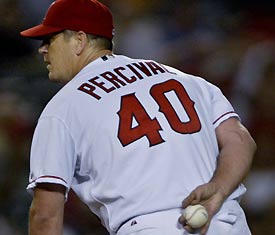
Newly
acquired Troy Percival isn't worth the money
unless he saves the number of games on his uniform.
5. 
What’s funny
about the Royals is that they seem to have been rebuilding for over a decade.
Oh wait, they have. So many players have been on their way to save this franchise.
Johnny Damon, Jermaine Dye, Carlos and Carlos (Beltran and the incomparably
bad Febles), and now Zack Greinke, just to name a few. The problem is that
there just isn’t ever a strong supporting cast, even when these players
do pan out. The Royals don’t have much money, and sometimes they don’t
wisely spend what they do have. Under GM Allard Baird, they have been more
successful in not looking stupid than previously, but only in 2003 did they
find themselves anywhere near contention. 2005 won’t be any different
unless something really bizarre happens (and it’s going to have to involve
Bob Hamelin).
John Buck, a former
Astros prospect, will start at catcher for the Royals this season. Buck has
shown a lot of power, hitting 12 homers in a brief call-up at the end of last
season. Buck should be a better catching option than most anyone the Royals
have tried in a while. But lest we forget, Sal Fasano was quite the defender.
First base is slightly open, although Ken Harvey, 27, is likely to be the
starter. Harvey doesn’t walk much and offers little power for a first
baseman, let alone one of his size. Mammoth Calvin Pickering is challenging
him for the job in spring training, but isn’t doing much to unseat Harvey.
Twenty-two year old Ruben Gotay will be the second baseman, and he’s
a step in the right direction. Gotay has shown decent offensive ability, and
that’s something the Royals need. Third base is a little bit questionable
as well, with youngster Mark Teahen, veteran wanderer Chris Truby, and utility
man Tony Graffanino all battling it out in a steel cage death match. Okay,
that last part was made up. Teahen has shown the ability to hit, and hit for
some power, and with the credibility of his third base rivals, he may win
the job out of spring training. Angel Berroa will once again be the starting
shortstop, and hopefully he’ll do at least somewhat of an about-face
from 2004’s sophomore disaster. Berroa followed up his Rookie of the
Year campaign by hitting .262/.308/.385 in 512 at bats, showing virtually
none of the abilities he displayed the season before. He’ll rebound
at least a little bit; he couldn’t be much worse.
Terrence Long will
be the leftfielder, and somehow there are always teams who don’t see
how bad he really is. Long was, for whatever the reason, once regarded fairly
highly as an Oakland A, and the label has followed him and his awful statistics.
He’ll be bad again as a Royal. David DeJesus will play center after
a pretty solid rookie effort in 2004. DeJesus hit .287/.360/.402 in 363 at
bats and will probably hit leadoff. He draws some walks and has a little power,
so he’s useful. It looks like Matt Stairs will hulk around right field
and hit a few home runs again in 2005, but at 37 he’s starting to become
a tad useless. The Royals don’t really need to have guys this old around;
they need to be moving forward. Mike Sweeney will DH and play a little first
base. Sweeney will still hit if he stays healthy, which isn’t at all
likely. If he manages to, he’ll probably hit .300 with 20 or 25 homers.
Kansas City’s
rotation is interesting to say the least. Zack Greinke, 21, will be the staff
ace, and has shown the ability to step right into that role. He’s well
known for changing speeds frequently and being terrific at every level he’s
seen. That continued in Kansas City last year, as he finished with a 3.97
ERA, 100 strikeouts, and only 26 walks in 145 innings last season. If he cuts
the home runs a little (he allowed 26 in ’04), and he probably will,
he’ll be even better. After Greinke is 23 year old Jimmy Gobble, who
showed good control (43 walks in 148 IP) last season, but also showed an inability
to strike anyone out (49 K). He’ll better 2004’s 5.35 ERA, but
it probably won’t be by too much. Unfortunately, it appears that it’s
once again Lima Time in Kansas City, a sight most Royals fans (at least the
sober ones) probably don’t want to see. Lima’s control isn’t
a problem, but hitters destroying him is. He allowed 33 homers last season,
and he’s a good bet to top that if he stays in the rotation this season.
At least it’ll give him something to voraciously rant about in post-game
interviews. Brian Anderson isn’t very good, and he’ll be in the
rotation again. Anderson also surrendered 33 homers, and he’ll likely
repeat that as well. He’s another pitcher who really has no means of
recording a strikeout. Runelvys Hernandez, back from Tommy John surgery, is
expected to fill out the rotation and pick up somewhere near where he left
off a couple of years ago. He’s a decent bet to be among the better
half of this rotation. But then again, this rotation includes Jose Lima and
Brian Anderson.
The bullpen is just
about as crazy as the rotation. Jeremy Affeldt, once thought to be a dominant
starter in the making, will likely be the closer. Affeldt does have great
stuff; it’s just questionable if he’ll ever effectively use it
again. Then there’s Mike MacDougal, who’s also talented, but ten
times more questionable than Jeremy Affeldt ever thought about being. MacDougal
can throw a baseball 100 miles-per-hour, but he has no clue where it’s
going. Everything he throws has disgusting movement, and he’s a good
candidate to strike people out…if he ever threw strikes. He’s
28 now, and there’s no telling how he’ll turn out. Shawn Camp
was very good out of the ‘pen for the ’04 Royals, and he’ll
likely be okay this season as well. Camp posted a 3.91 ERA and struck out
51 (with only 16 walks) in 66 2/3 innings. D.J. Carrasco was mediocre, and
he’ll likely be stuck in low leverage situations. Jamie Cerda was a
pretty effective lefty last season, but he can’t surrender that many
walks again. Then there’s Chris George, who really has little hope for
being anywhere near this pitching staff ever again, but I just wanted to take
some time out of my day to bring just how bad he’s been to your attention.
I think 2004’s line sums it up pretty well: 7.23 ERA, 15 K, 25 BB, 60
H in 42 1/3 IP.
The Royals aren’t going anywhere anytime soon, but there are rays of hope just as bright as Damon and Beltran were all those years ago. Even if this team loses 100 games again, which almost has to be considered likely, at least maybe Greinke will give everyone in Kansas City something positive to watch. God knows Jose Lima won’t.
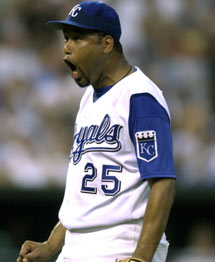
Few players
get as excited about being
terrible as Jose Lima does.