
Why T did T Melon T miss T this T shot ? T
US Dream Team in the Olympic games - Barcelona 92
Melon ( the Mailman ) is on the foul line .
Why did he miss even though he had such an high percentage scores ?
Click on the image below to see the video
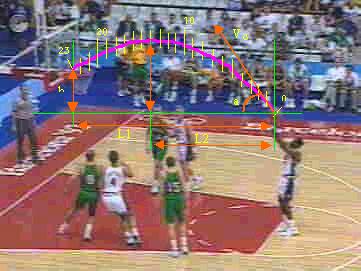
The VIOLET line shows the trace of the ball from Melon hand to the ring.
The YELLOW vertical lines mark the ball locations in the succesive frames.
The TIME distance between 2 succesive frames is 40 milisecond (0.040 second).
(It was samples from the European PAL standard with 25 frames per second )
In the following computations: ( See the marked notations on the above image)
g --> The gravitation accelaration is 9.8 m/sec2
V0 --> The initial velocity of the ball after leaving Melon's hand.
a --> The initial angel of the ball after leaving Melon's hand.
tp --> The time between the ball leaving Melon's hand up to its highest point.
It's easy to compute it by counting the number of frames :
tp = 0.56 second ( 14 frames * 0.040 sec/frame )
It's known from mechanics that : . . . V0 * SIN(a) = g * tp
By substituting the known value for g (9.8) and tp (0.56) we get :
(1) . . . V0 * SIN(a) = 9.8*0.56 = 5.48 m/sec
h --> The vertical height between the final point (entering the ring) and the point of the ball leaving Melon's hand.
tf --> The ball time between leaving Melon's hand up to its final point - the ring.
It's easy to compute it by counting the number of frames :
(2) . . . tf = 0.92 second ( 23 frames * 0.040 sec/frame )
It's known from mechanics that : . . . h = V0*SIN(a)*tf - (g/2)*tf2
By substituting the known value from (1) for V0 * SIN(a) and tf (0.92) we get :
(3) . . . h = 5.48*0.92 - (9.8/2)*0.922 = 0.89 m
L1 --> The horizontal distance between the foul line and the ring center.
By measuring on the image above (with ruler) the lengths of h and L1 , we get :
(4) . . . h/L1 = 6/31 (1.5/7.75) ---------> L1 = (31/6)*h
By substituting in (4) h=0.89 (from (3)) , we get :
(5) . . . L1 = (31/6)*0.89 = 4.59 m .
It's known from mechanics that :
(6) . . . L1 = V0*COS(a)*tf
By substituting L1=4.59 from (5) and tf = 0.92 from (2) into (6) we get :
(7) . . . V0*COS(a) = 4.59/0.92 = 4.98 m/sec
Now we have two trigonometric equations (1) and (7) with two unkown parameters :
the angel a and the initial velocity V0
Dividing (1) by (7) gives : . . .(8) . . . TAN(a) = 5.48/4.98 = 1.1
Computing angel a from (8) gives . . .(9) . . . a = 47.7 0
By substituting angle a=47.70 into (1) or (7) we get : . . .(10) . . .V0 = 7.4 m/sec
Thus, we know that :
a --> The initial angle of the ball after leaving Melon's hand is 47.7 degrees
V0 --> The initial velocity of the ball after leaving Melon's hand is 7.4 m/sec.
This initial velocity (7.4 m/sec) is quite close to the optimal , but the angle 47.7 is too low comparing to the optimal angle by about 4.5 degrees !
This shift of 4.50 means horizontal shift from the center of the ring by about 35 cm , which means a miss !
And now back to the main question :
Why did Melon miss this time from the foul line ?
The answer is that the angle of the shot (47.70 ) was TOO LOW !
It's too low by about 4.50 (comparing to the OPTIMAL ANGLE).
This means horizontal shift from the center of the ring of about 35 cm !
The meaning of OPTIMAL ANGLE is the angle in which a certain shift in the angle causes the smallest shift of the ball reaching the ring
The ball's diameter is about 24 cm and the ring diameter is about 45 cm , so there is a spare of 10 cm from the ring center (plus additional 5-10 cm for succesful shots which hit the ring).
The computations of the distance of the miss of about 35 cm from the ring center are quite simple :
According to (6) . . . L1 =V0*COS(a)*tf = 7.4*cos(47.7)*0.93= 4.58 m
The distance of the ring center is about 4.23 m , and the difference is 35 cm (4.58-4.23) which is more than 10 cm out of the ring !
For a detailed explanation about the OPTIMAL ANGLE and how it is computed ,
choose BASKETBALL and CALCULUS !
See also on BASKETBALL and TRIGONOMETRY :
Why did Melon score in most of his foul shots ? !