
Is T Melon's T shot T optimal T ?
US Dream Team in the Olympic games - Barcelona 92
Melon ( the Mailman ) is on the foul line .
Does he score so well because his shot's angle is optimal ?
Click on the image below to see the video
(By the way , in the image there are 2 very famous NBA stars (beside Melon).
WHO are they ?
(The answer is on the bottom of the page ! )
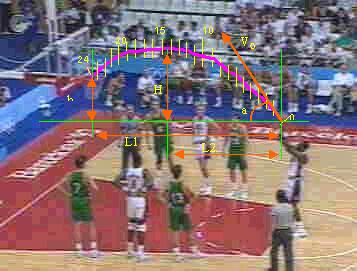
The VIOLET line shows the trace of the ball from Melon hand to the ring.
The YELLOW vertical lines mark the ball locations in the succesive frames.
The TIME distance between 2 succesive frames is 40 milisecond (0.040 second).
(It was samples from the European PAL standard with 25 frames per second )
The meaning of OPTIMAL ANGLE is the angle in which a certain shift in the angle causes the smallest horizontal shift of the ball when reaching the ring
In the following, we compute the value of this optimal angle , and check how close is Melon's foul shot to this optimal angle.
If his shot angle is around this value , it means that even if his palm angle will not be perfect, he will not miss !
In Trigonometry & Basketball : "Why does Melon Score ? " there is full computation of the ball initial angle 'a', and the ball initial velocity ' V0 ', when it leaves Melon's hand .
As you can see there the ball's initial angle in the above successful shot is about 52.2o ,
(1) . . . . . a = 52.2 o
and the ball's initial velocity in the above successful shot is about 7.2 m/sec .
(2) . . . . . Vo = 7.2 m/sec
Is this angle optimal for this shot ?
( For this initial velocity )
In the following computations: ( See the marked notations on the above image)
g --> The gravitation accelaration is 9.8 m/sec2
V0 --> The initial velocity of the ball after leaving Melon's hand.
a --> The initial angel of the ball after leaving Melon's hand.
h --> The vertical height between the final point (entering the ring) and the point of the ball leaving Melon's hand.
tf --> The ball time between leaving Melon's hand up to its final point - the ring.
L1 --> The HORIZONTAL distance between the foul line and the ball location when reaching the ring height.
It's known from the basketball court geometry that the ring height is 3.05 m .
Thus , if the ball leaves above Melon's head - asuming 2.1 m , we get :
(3) . . . h = 0.95 m ( 3.05 - 2.10 )
As we explained above, the meaning of OPTIMAL ANGLE is the angle in which a certain shift in the angle (da) causes the smallest horizontal shift of the ball when reaching the ring (dL1)
Thus, we have to find the angle 'a' around which we get the minimum absolute value for dL1/da. ( and the best is |dL1/da| = 0 ).
First, we'll find L1 as a function of 'a' , then we'll compute dL1/da and find the angle 'a' which gives dL1/da = 0 .
The angle which gives dL1/da = 0 is the optimal angle !
It's known from mechanics that : . . . (4) . . . h = V0*SIN(a)*tf - (g/2)*tf2
It's also known from mechanics : . . . (5) . . . L1 = V0*COS(a)*tf
h and V0 are known from (2) and (3).
Thus, from (4) we can get tf as a function of 'a' .
( It's a quadratic equation but we take only the larger solution, which fits the ball distance after the peak , when it goes down to the ring )
(6) . . . tf = (1/(2*(g/2))* (V0*SIN(a) +square root of [ V02*SIN2(a) - 4*(g/2)*h ) ]
As we want to find L1 as a function of a , we substitute (6) into (5) and get :
(7) . . . L1(a) = V0*COS(a)*(1/(2*(g/2))* (V0*SIN(a) +square root of ( V02*SIN2(a) - 4*(g/2)*h ) )
In order to find the value of 'a' which gives dL1/da = 0, we have to compute dL1/da .
First, we find the derivative of the first part of (7) : (It's sum of 2 expressions )
The first part = (1/g)*V02*COS(a)*SIN(a)
and using the identity : . . . 2*COS(a)*SIN(a) = SIN(2*a) . . . we get:
(8) . . . (1/g)*V02*(1/2)*SIN(2*a)
The derivative of (8) is :
(9) . . .(1/g)*V02*(1/2)*2*COS(2*a)
Now, we find the derivative of the second part:
(1/g)*V0*COS(a)*square root of [ V02*SIN2(a) - 4*(g/2)*h ) ]
This derivative is computed as multiplication of functions of 'a' , and we get :
(10) . . . (1/g)*V0* [ (-SIN(a)*square root of [ V02*SIN(a)2 - 4*(g/2)*h ] +
(1/2)COS(a)*{1/square root of (V02*SIN2(a) - 4*(g/2)*h]} *V02*2*SIN(a)*COS(a)
Then, summing the two parts in (10) with the common denominator square root of [ V02*SIN2(a) - 4*(g/2)*h ]
and using the identity . . . COS2(a) - SIN2(a) = COS(2*a) . . . we get the derivative of the second part :
(11) . . . (1/g)*V03*SIN(a)*[COS(2*a) + 2*g*h ] * {1/square root of [ V02*SIN2(a) - 4*(g/2)*h ]}
The derivative dL1/da is the sum of (11) and (9) :
(12) . . . dL1/da = (1/g)*V02*(1/2)*2*COS(2*a) + (1/g)*V03*SIN(a)*[COS(2*a) + 2*g*h ] * {1/square root of [ V02*SIN2(a) - 4*(g/2)*h ] }
Substituting in (12) the known values of g , V0 (2) and h (3) gives the required function dL1/da as a function only of 'a'
Now, we find which 'a' gives dL1/da = 0
It's not an easy task to find an analytical solution , but it's very easy to solve it by plotting the graph of dL1/da as a function of 'a' , and looking for which 'a' we get the minimum absolute value of dL1/da. ( Zero is the best).
( This can be done easily by some of the math tools like MATHLAB )
So, all we have to do is to plot dL1/da ( the blue graph ) as a function of 'a' and to check for which 'a' the graph cross the zero line :
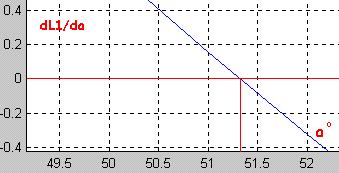
As we can see from the graph above , dL1/da = 0 for a = 51.3 o
This means that the optimal ball's initial angle is 51.3 o.
( for this initial velocity of 7.2 m/sec )
Around this angle a certain amount of error in Melon's palm angle ( which is da ) has the LEAST influence on the horizontal shift (dL1) of the ball reaching the ring .
( We are interested only in the absolute value of the shift because it does not matter if there is a short or long miss )
As was explained above, the meaning of OPTIMAL ANGLE is the angle in which a certain shift in the angle causes the smallest horizontal shift of the ball when reaching the ring.
As we mentioned in (1) Melon's initial angle is 52.2 o which is less than 1 o difference from the optimal angle 51.3 o .
Accuracy of 1 deg means accuracy of the shift of the fingers by about 0.5 cm !
( Assuming hand palm of 30 cm , 30*tan(1) = 0.5 cm )
In order to check the meaning of an angle shift of about 1 o we have to look on the graph of L1 as a function of 'a' , and to see what is dL1 for da=1 o
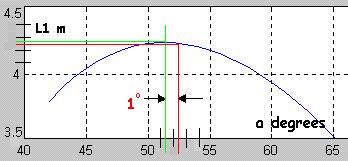
As we can see on the above blue graph, Melon's shift of 1 o from the optimal angle caused a ball shift of about 1 cm aside on reaching the ring.
As we can see on the above blue graph, a shift of 1 o around 45 o causes a ball shift of more than 10 cm aside on reaching the ring . Such a shift means a MISS !
The ball's diameter is about 24 cm and the ring diameter is about 45 cm , so there is a spare of 10 cm on each side of the ball.
The above computation explains why Melon scores so well from the foul line !
His shot angle is around the optimal, best possible, angle , and thus even angle's inaccuracy does not cause a miss !
See also on BASKETBALL and TRIGONOMETRY :
Why did Melon score in most of his foul shots ? !
and
Why did Melon miss the foul shot ? !
(The 2 very famous NBA stars (beside Melon) are: Bird (white shirt,face) and Uing (white shirt,back).