Fan
Noli
(1882-
1965)
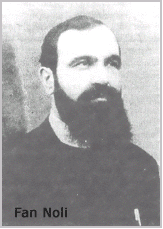
Fan Noli, also known
as Theophan Stylian Noli, was not only an outstanding leader of
the Albanian-American community, but also a pre-eminent and multi-talented
figure of Albanian literature, culture, religious life and politics.
Noli was born in the village of Ibrik Tepe (Alb. Qyteza), south
of Edirne (Adrianopole) in European Turkey on 6 January 1882.
His father Stylian Noli had been a noted cantor in the Orthodox
church and had instilled in his son a love for Orthodox music
and Byzantine tradition. Fan Noli attended the Greek secondary
school in Edirne, and in 1900, after a short stay in Constantinople,
settled in Athens where he managed to find occasional and badly-paying
jobs as a copyist, prompter and actor. It was with one such itinerant
theatre company touring Greek-speaking settlements in the eastern
Mediterranean that Noli first arrived in Egypt. Abandoning the
company in Alexandria, he found work from March 1903 to March
1905 as a Greek teacher and as a church cantor in Shibîn el Khôm
and from March 1905 to April 1906 in El Faiyûm where a small Albanian
colony had settled. Here he wrote a number of articles in Greek
and translated Sami Frashëri’s 'Shqipëria - Ç’ka qënë, ç’është
e ç’do të bëhetë'? (Albanian - what was it, what is it and what
will become of it?) into Greek, works which were published
at the Albanian press in Sofia.
In Egypt, Noli learned
more about the traditions of Byzantine music which so fascinated
him from his teacher, the monk Nilos, and resolved to become an
Orthodox priest himself. He also came into contact with the nationalist
leaders of the Albanian community such as Spiro Dine (1846?-1922),
Jani Vruho (1863-1931) and Athanas Tashko (1863-1915) who encouraged
him to emigrate to America where he could make better use of his
talents. The young Noli agreed.
In April 1906, with
a second-class steamer ticket which was paid for by Spiro Dine,
Fan Noli set off via Naples for the New World and arrived in New
York on May 10. After three months in Buffalo where he worked
in a lumber mill, Noli arrived in Boston. There publisher Sotir
Peci (1873-1932) gave him a job at a minimal salary as deputy
editor of the Boston newspaper Kombi (The nation), where
he worked until May 1907 and in which he published articles and
editorials under the pseudonym Ali Baba Qyteza. These were financially
and personally difficult months for Noli, who did not feel at
home in America at all and seriously considered emigrating to
Bucharest. Gradually, however, he found his roots in the Albanian
community and on 6 January 1907 co-founded the Besa-Besën (The
Pledge) society in Boston.
In this period, Orthodox
Albanians in America were growing increasingly impatient with
Greek control of the church. Tension reached its climax in 1907
when a Greek Orthodox priest refused to officiate at the burial
of an Albanian in Hudson, Massachusetts on the grounds that, as
a nationalist, the deceased was automatically excommunicated.
Noli saw his calling and convoked a meeting of Orthodox Albanians
from throughout New England at which delegates resolved to set
up an autocephalic, i.e. autonomous, Albanian Orthodox Church
with Noli as its first clergyman.
On 9 February 1908
at the age of twenty-six, Fan Noli was made a deacon in Brooklyn
and on 8 March 1908 Platon, the Russian Orthodox Archbishop of
New York, ordained him as an Orthodox priest. A mere two weeks
later, on 22 March 1908, the young Noli proudly celebrated the
liturgy in Albanian for the first time at the Knights of Honor
Hall in Boston. This act constituted the first step towards the
official organization and recognition of an Albanian Autocephalic
Orthodox Church.
From February 1909
to July 1911, Noli edited the newspaper Dielli (The Sun),
mouthpiece of the Albanian community in Boston.
On 10 August 1911,
he set off for Europe for four months where he held church services
in Albanian for the colonies in Kishinev, Odessa, Bucharest and
Sofia. Together with Faik bey Konitza who had arrived in the United
States in 1909, he founded the Pan-Albanian Vatra (The Hearth)
Federation of America on 28 April 1912, which was soon destined
to become the most powerful and significant Albanian organization
in America. Fan Noli had now become the recognized leader of the
Albanian Orthodox community and was an established writer and
journalist of the nationalist movement.
In November 1912,
Albania was declared independent, and the thirty-year-old Noli,
having graduated with a B.A. from Harvard University, hurriedly
returned to Europe.
In March 1913, among
other activities, he attended the Albanian Congress of Trieste
which was organized by his friend and rival Faik bey Konitza.
In July 1913 Fan
Noli visited Albania for the first time, and there, on 10 March
1914, he held the country’s first Orthodox church service in Albanian
in the presence of Prince Wilhelm zu Wied who had arrived in Durrës
only three days earlier aboard an Austro-Hungarian vessel.
In August of 1914
Noli was in Vienna for a time, but as the clouds of war darkened,
he returned in May 1915 to the United States.
From 21 December
1915 to 6 July 1916 he was again editor-in-chief of the Boston
Dielli (The Sun), now a daily newspaper.
In July 1917 he
once more became president of the Vatra federation which,
in view of the chaotic situation and political vacuum in Albania,
now regarded itself as a sort of Albanian government in exile.
In September 1918
Noli founded the English-language monthly Adriatic Review which
was financed by the federation to spread information about Albania
and its cause. Noli edited the journal for the first six months
and was succeeded in 1919 by Constantine Chekrezi (1892-1959).
With Vatra funds collected under Noli’s direction, Albanian-American
delegates were sent to Paris, London and Washington to promote
international recognition of Albanian independence.
On 24 March 1918,
Noli was appointed administrator of the Albanian Orthodox Church
in the United States and in early July of that year attended a
conference on oppressed peoples in Mount Vernon, Virginia, where
he met President Woodrow Wilson (1856-1924), champion of minority
rights in Europe.
On 27 July 1919,
Noli was appointed Bishop of the Albanian Orthodox Church in America,
now finally an independent diocese. In the following year, in
view of his growing stature as a political and religious leader
of the Albanian community and as a talented writer, orator and
political commentator, it was only fitting that he be selected
to head an Albanian delegation to the League of Nations in Geneva
where he was successful in having Albania admitted on 17 December
1920. Noli rightly regarded Albania’s admission to the League
of Nations as his greatest political achievement. Membership in
that body gave Albania worldwide recognition for the first time
and was in retrospect no doubt more important than Ismail Qemal
bey Vlora’s declaration of independence in 1912.
In a commentary on
23 July 1924, the Manchester Guardian described Fan Noli as a
"man who would have been remarkable in any country. An accomplished
diplomat, an expert in international politics, a skilful debater,
from the outset he made a deep impression in Geneva. He knocked
down his Balkan opponents in a masterly fashion, but always with
a broad smile. He is a man of vast culture who has read everything
worth reading in English and French." Noli’s success at the
League of Nations established him as the leading figure in Albanian
political life.
From Geneva, he returned
to Albania and from 1921 to 1922 represented the Vatra Federation
in the Albanian parliament there. In 1922, he was appointed foreign
minister in the government of Xhafer bey Ypi (1880-1940) but resigned
several months later.
On 21 November 1923,
Noli was consecrated Bishop of Korça and Metropolitan of Durrës.
He was now both head of the Orthodox Church in Albania and leader
of a liberal political party, the main opposition to the conservative
forces of Ahmet Zogu (1895-1961), who were supported primarily
by the feudal landowners and the middle class.
On 23 February 1924
an attempt was made in parliament on the life of Ahmet Zogu and
two months later, on 22 April 1924, nationalist figure and deputy
Avni Rustemi (1895-1924) was assassinated, allegedly by Zogist
forces. At Rustemi’s funeral, Fan Noli gave a fiery oration which
provoked the liberal opposition into such a fury that Zogu was
obliged to flee to Yugoslavia in the so-called June Revolution.
On 17 July 1924,
Fan Noli was officially proclaimed prime minister and shortly
afterwards Regent of Albania. For six months, he led a democratic
government which tried desperately to cope with the catastrophic
economic and political problems facing the young Albanian state.
His twenty-point programme for the modernization and democratization
of Albania, including agrarian reform, proved however to be too
rash and too idealistic for a backward country with no parliamentary
traditions. In a letter to an English friend, he was later to
note the reasons for his failure: "By insisting on the agrarian
reforms I aroused the wrath of the landed aristocracy; by failing
to carry them out I lost the support of the peasant masses."
With the overthrow of his government by Zogist forces on Christmas
Eve 1924, Noli left Albania for good and spent several months
in Italy at the invitation of Benito Mussolini (1883-1945). When
the Duce finally reached agreement with Zogu on oil concessions
in Albania, Noli and his followers were given to understand that
their presence in Italy was no longer desired. Noli subsequently
spent several years in northern Europe, primarily in Germany and
Austria.
In November 1927
he visited Russia as a Balkan delegate to a congress of ‘Friends
of the Soviet Union’ marking the tenth anniversary of the
October Revolution, and in 1930, having obtained a six-month visa,
he returned to the United States. Back in Boston, Noli founded
the weekly periodical Republika (The republic), the name
of which alone was in open defiance of Ahmet Zogu who on 1 September
1928 had proclaimed himself Zog I, King of the Albanians. Republika
was also published in opposition to Dielli (The Sun), now
under the control of Faik Konitza who had come to terms with King
Zog and become Albanian minister plenipotentiary in Washington.
After six months, Noli was forced to return to Europe when his
visa expired and his Republika was taken over by Anastas Tashko
until it ceased publication in 1932. With the help of his followers,
he was able to return from Germany to the United States in 1932
and was granted permanent resident status.He
withdrew from political life and henceforth resumed his duties
as head of the Albanian Autocephalic Orthodox Church.
In December 1933,
Noli fell seriously ill and was unable to pay for the medical
treatment he so desperately needed until he received a gift of
3,000 gold franks from Albania, which was ironically enough from
his archenemy Ahmet Zogu. This gesture, as intended, led to a
certain reconciliation between Noli and Zogu and pacified Noli’s
now often tenuous relations with Faik Konitza.
In 1935, he returned
to one of his earlier passions - music - and, at the age of fifty-three,
registered at the New England Conservatory of Music in Boston,
from which he graduated in 1938 with a Bachelor of Music.
On 12 April 1937,
Noli’s great dream of an Albanian national church was fulfilled
when the Patriarch of Constantinople officially recognized the
Albanian Autocephalic Orthodox Church. Not satisfied with ecclesiastical
duties alone, Noli turned to post-graduate studies at Boston University,
finishing a doctorate there in 1945 with a dissertation on Scanderbeg.
In the early years following the Second World War, Noli maintained
reasonably good relations with the new communist regime in Tirana
and used his influence to try to persuade the American government
to recognize the latter. His reputation as the ‘red bishop’ indeed
caused a good deal of enmity and
polarization in emigré circles in America.
In 1953, at the
age of seventy-one, Fan Noli was presented with the sum of $20,000
from the Vatra Federation, with which he bought a house in Fort
Lauderdale, Florida, where he died on 13 March 1965 at the age
of eighty-three.
Politics and religion
were not the only fields in which Fan Noli made a name for himself.
He was also a dramatist, poet, historian, musicologist and in
particular an excellent translator who made a significant contribution
to the development of the Albanian literary language. Noli’s first
literary work was a three-act drama entitled Izrailitë dhe
Filistinë, Boston 1907 (Israelites and Philistines).
This forty-eight page tragedy written in 1902 is based on the
Book of Judges 13-16 in the Old Testament, the famous story of
Samson and Delilah. Published at a time when Albanian theatre
was in its infancy, it is one of the rare Albanian plays of the
period not gushing with sentimentality before reaching a superficial
melodramatic conclusion. Such were the tastes of the period, however,
and Noli’s play found little favour with the public. Not only
was the subject matter too distant and philosophical, but his
language was too archaic or dialectal for the public to enjoy.
On his ordainment as an Orthodox priest and his celebration of
the first Orthodox liturgy in Albanian in 1908, Noli recognized
the need for liturgical texts in Albanian and set about translating
Orthodox rituals and liturgies, which were published in two volumes:
Libri ishërbesave të shëjnta të kishës orthodoxe, Boston
1909 (Book of holy services of the Orthodox Church), and
the 315-page Libre é te krémtevé te medha te kishes orthodoxe,
Boston 1911 (Book of great ceremonies of the Orthodox Church).
Other religious translations followed, in an elegant and solemn
language befitting such venerable Byzantine traditions. Noli indeed
considered these translations to be his most rewarding achievement.
Fan Noli’s most popular work today is a scholarly history of the
life and times of the Albanian national hero Scanderbeg. A 285-page
Albanian version was published as Historia e Skënderbeut (Gjerq
Kastriotit), mbretit të Shqipërisë 1412-1468, Boston 1921
(The history of Scanderbeg (George Castrioti), king of
Albania 1412-1468), and an English version, the fruits of his
doctoral dissertation at Boston University in 1945, as George
Castrioti Scanderbeg (1405-1468), New York 1947. Another scholarly
work in English which mirrors both his fascination with great
figures of the past (Jesus, Julius Caesar, Scanderbeg and Napoleon)
and his love of music is the 117-page Beethoven and the French
revolution, New York 1947. Noli has not been forgotten as a poet
though his powerful declamatory verse is far from prolific. It
was collected in a volume with the simple title Albumi,
Boston 1948 (The album), which he published on the occasion
of his forty years of residence in the United States. Albumi contains
primarily political verse reflecting his abiding nationalist aspirations
and the social and political passions of the twenties and thirties.
Fan Noli’s main contribution to Albanian literature, however,
was as a stylist, as seen especially in his translations. Together
with Faik bey Konitza, Noli may indeed be regarded as one of the
greatest stylists in the Tosk dialect of the Albanian language.
His experience as an actor and orator, and his familiarity with
other great languages of culture, Greek, English and French in
particular, enabled him to develop Albanian into a language of
refinement and flowing elegance. Noli translated poetry of various
nineteenth-century European and American authors, and most often
managed, with the ear of the musician he was, to reflect the style,
taste and rhythmical nuances of the originals. Though he wrote
comparatively little in the way of literature per se, Fan Noli
remains nonetheless a literary giant. He was instrumental in helping
the Albanian language reach its full literary and creative potential.
HYMNI
I FLAMURIT
O Flamur gjak,
o flamur shkabë,
O vënd e vatr' o nën' e babë,
Lagur me lot, djegur me flagë,
Flamur i kuq, flamur i zi.
Fortesë shkëmbi
tmerr tirani,
S'të trëmp Romani, as Venecjani,
As Sërp Dushani, as Turk Sulltani,
Flamur i math për Vegjëli.
Flamur që lint
Shën Kostandinin,
Pajton Islamn' e Krishtërimin,
Çpall midis feve vllazërimin,
Flamur bujar për Njerëzi.
Me Skënderben'
u-lavdërove
Dhe në furtun' i funtmi u-shove,
Me Malon prapë lart vrapove,
Yll i pavdekur për Liri.
Sa shpesh pastaj
për-dhe u-shtrive
Me zjarr e zi u-ndeze u-nxive,
Po çdo mizor me shpat' e grive,
O fushë-kuq, o shkabë-zi.
Përpjetë pri-e
Shqipërinë,
Përlintj'a shpirtin dhe fuqinë,
Diell për vllanë, yrnek për fqinë
P ër botën ëndr' e qjell i ri.
SYRGJYN
-VDEKUR
(Elegji për Luigj Gurakuqin)
Nëno moj, mbaj
zi për vllanë,
Me tre plumba na i ranë,
Na e vran' e na e shanë,
Na i thanë trathëtor.
Se të deshte dhe
s'të deshnin,
Se të qante kur të qeshnin,
Se të veshte kur të çveshnin,
Nëno moj, të ra dëshmor.
Nëno moj, vajto,
merr malin,
Larot t'a përmbysnë djalin
Që me Ismail Qemalin
Ngriti flamur trimëror.
Nëno moj, m'a qaj
në Vlorë
Ku të dha liri, kurorë,
Shpirt i bardhë si dëborë;
Ti s'i dhe as varr për hor.
Nëno moj, ç'është
përpjekur
Gojë-mjalt' e zëmër-hekur,
Syrgjyn-gjall' e syrgjyn-vdekur,
Ky Vigan Liberator.
SHPELL
E DRAGOBISE
(Elegji për Bajram Currin)
Kur tufani e çthuri
fenë,
Kur tirani e krrusi atdhenë,
Mi një brek të Dragobisë
Priret Flamur' i lirisë.
Atje nisi, atje
mbaroj,
Atje krisi, atje pushoj,
Rrufe-shkab' e Malësisë,
Në një shkëmb të Dragobisë.
Vendi dridhej,
ay mbeti,
Se s'tronditej nga tërrmeti,
Dif drangoj i Dragobisë,
Trim tribun i Vegjëlisë.
0 Bajram, bajrak
i gjallë,
More nam me gjak në ballë,
Te një shpell' e Dragobisë,
Yll i rrall' i burrërisë.
Thon' u-shtri e
thon' u-vra,
Po ti s'vdiqe, or Baba,
As te shkëmb' i Dragobisë,
As te zëmr' e Djalërisë.
As je vrar' e as
po vritesh
Legjendar Ante po rritesh.
Dithiramb i Dragobisë,
Tmerr, panik i mizorisë.
Me Zjarr Shenjt
u-ndrit kjo shpellë,
Gjer në qjell u-ngrit Kështjellë,
Për çlirimn' e Shqipërisë,
Katakomb' e Dragobisë.
RENT,
OR MARATHONOMAK
Rent, or rent,
rent e u thuaj
Se u çthur ordi e huaj,
Se betejën e fituam
Dhe qytetin e shpëtuam!
Rent, or rent, Rent,
or Marathonomak!
Kap një degë prej
dafine
Dhe vërtitesh ndaj Athine,
Nëpër fush' e brek mi brek
Këmba tokën as t'a prek,
Hip' e zbrit,
Petrit, Marathonomak!
Ke një plagë, po
s'e the,
Djers' e gjak pikon për-dhe;
Do që ti të jesh i pari,
Për triumfin lajmëtari
Flamur-gjak,
Kuqo, Marathonomak!
T'u tha gryka,
po s'të pihet,
T'u mpi këmba, po s'të rrihet,
Se mileti po të pret,
Ankthi zëmrat ua vret,
Vrer e tmerr,
Shpejt, or Marathonomak!
Kurrë kaqë s'dogji djelli
Dhe si plumb s'rëndovi qjelli,
Kurr' aq ëmbël' e bukur s'ftoj
Hij' e lisit edhe kroj;
Turru tej,
Tutje, or Marathonomak!
Vapa mbyt e pluhri
nxin
Ferra çjerr e guri grin
Afsha gjoksin përvëlon
Syrin avulli verbon;
Ur' e prush,
Furr', or Marathonomak!
Gryka si gjyryk të çfryn
Prej Vullkani flag' e tym
Se ç'vëngon e se ç'gulçon,
Zëmra brinjët t'i çkallmon
Me tokmak,
Mbahu, or Marathonomak!
Nëna, motra, nusja
dalin,
Ngrehin krahët të të ndalin,
Mos, se s'janë veç
Najada Magjistrica dhe Driada;
Lark, or lark,
Lark, or Marathonomak!
Hajde, ja Akropolia,
Ja qyteti e njerëzia
Që të pan' e që të çquan
Dhe fuqinë t'a rishtuan
Ha dhe pak,
Hajde, or Marathonomak!
Ja, arrive, ua the:
Ç'gas e ç'helm qe kjo myzhde!
"E fituam!", brohorite
Dhe për tok' u-përpëlite;
Vdiq, or vdiq!
Vdiqe, or Marathonomak!
Rent kudo, dyke bërtitur,
Nëpër shekuj faqe-ndritur,
Se i vogli shtrin viganin
Dhe i shtypuri tiranin,
Veç e tok,
Tok, or Marathonomak!
(Prill, 1930)
ANES
LUMEJNVE
Arratisur, syrgjynosur,
Raskapitur dhe katosur
Po vajtonj pa funt, pa shpresë,
Anës Elbës, anës Spree-së.
Ku e lam' e ku
na mbeti
Vaj-vatani e mjer-mileti
Anës detit i palarë,
Anës dritës i paparë,
Pranë sofrës i pangrënë,
Pranë dijes i panxënë,
Lakuriq dhe i dregosur,
Trup e shpirt i sakatosur?
Se ç'e shëmpnë
derbederët,
Mercenarët dhe Bejlerët,
Se ç'e shtypnë jabanxhinjtë
Se ç'e shtrythnë fajdexhinjtë,
Se ç'e pren' e se ç'e vranë,
Ç'e shkretuan anembanë,
Nënë thundrën e përdhunës
Anës Vjosës, anës Bunës!
Çirem, digjem i
vrerosur,
Sakatosur, çarmatosur,
As i gjall' as i varrosur,
Pres një shenj' e pres një dritë,
Pres me vjet' e pres me ditë,
Se ç'u tera, se ç' u-mpaka,
Se ç' u-çora, se ç' u-mplaka,
Lark prej vatrës dhe prej punës,
Anës Rinit, anës Tunës.
Çakërdisur, batërdisur,
Përpëlitur dhe zalisur,
Endërronj pa funt, pa shpresë
Anës Elbës, anës Spree-së.
Dhe një zë vëngon
nga lumi,
Më buçet, më zgjon nga gjumi,
Se mileti po gatitet,
Se tirani lebetitet,
Se pëlcet, kërcet furtuna,
Fryhet Vjosa, derdhet Buna,
Skuqet Semani dhe Drini,
Dridhet Beu dhe zengjini,
Se pas vdekjes ndriti jeta,
Dhe kudo gjëmon trumbeta:
Ngrehuni dhe bjeruni,
Korrini dhe shtypini,
Katundar' e punëtorë,
Që nga Shkodra gjer në Vlorë!
Ky ilaç e ky kushtrim
Më bën djal' e më bën trim,
Më jep forc' e më jep shpresë,
Anës Elbë-s, anës Spree-së.
Se pas dimrit vjen një verë
Që do kthehemi një herë
Pranë vatrës, pranë punës,
Anës Vjosës, anës Bunës.
Arratisur, syrgjynosur,
Raskapitur e katosur
Brohorit me bes' e shpresë
Anës Elbës, anës Spree-së.
(Hamburg, Maj, 1930.)
FRYN
MOJ ERE
-Ngaj po na vjen,
moj erë e rreptë?
Pse vërshëllen me aq mallëngjim?
-Vij drejt nga malet e Shqipërisë,
për të përhapur zi e vajtim.
Fryn, moj erë, moj erë e shkretë fryn,
drejt më zëmër, më zëmër time hyn.
-Nga ata male, moj erë trime,
ç'lajme të reja po na ke siell?
Pse je e vrerët dhe e helmuar?
qiellë me zi përse na e mbiell?
Fryn, moj erë, etj.
Pse e ke synë të trubulluar
e rent kaluar mi t'zeza re?
Pse të pikojnë lottë të zeza,
lottë të zeza posi rrëke?
Fryn, moj erë, etj.
Syri m'u err nga ato që pashë
Ah! nukë mbahem, nuk duroj dot.
Pashë një gjëmë, gjëm të tmeruar,
rent ta haroj, po rentkam më kot.
Fryn, moj erë, etj.
Atje tek losnja në fush' të Korçës,
duke u hedhur lis më lis,
një qivur pashë me nj'çup' të virgjër,
ma vrau shpirtin ay filis.
Fryn, moj erë, etj.
Tokat pushonin, prift nukë dukej,
e pakënduar na u varros;
mihnë dëborën, i bënë varrë,
shpirt nuk më mbeti, forca m'u sos.
Fryn, moj erë, etj.
Atje mi varrë qante një grua,
një grua qyqe me mallëngjim;
burrën të qante më par'a çupën,
për kë të bënte më par'vajtim?
Fryn, moj erë, etj.
Renda e ika e fluturova,
po dhëmbjen time ku do ta fsheh?
Çava oqeane, dete dhe male,
po vajtoj edhe sikundër sheh.
Fryn, moj erë, etj.
-Moj er'e rreptë, erë malsore,
shpirti m'u ndes, zëmra më shkriu;
sytë m'u errë si ty dhe mua,
mëndja në kokë më bubullin.
Fryn, moj erë, etj.
Qëndro të lutem, të kam për t'dhënë
dhe un'i varfri një porosi:
një re të madhe dërgo të zbresë
e ta ngarkojmë me lott'e mi.
Fryn, moj erë, etj.
E kur të kthehesh
nga Shqipëria,
Atje në kopshtin, atje t'qëndrosh,
dhe lott'e mia si vesë qjelli
dalë nga dalë do t'i pikosh.
Qaj, moj erë, moj er'e shkretë qaj,
derthmi lottë atje mi varr'e saj.
(25 Janar 1907)

 page
page 
