How Do Social Networks Earn?
In this article we are going to discuss that how is money made by social networking sites.
Social networking sites seem to dominate the Web. How often do we find ourselves updating our status on Facebook, sending out a tweet on Twitter or adding new images to our MySpace page? Many social networking sites allow users to create profiles for free. But have we ever wondered how these sites made enough money to support millions of users?
One way social networking sites manage to make money is through investments from business enterprise capitalists. These investors are essentially making a bet that the site they're investing in will become popular and will eventually find a way to monetize that success. Getting in early can mean a huge payoff down the road. There are several examples of large corporations buying out Internet startup companies for millions or even billions of dollars.
The problem with depending upon venture capitalists is that as time goes on, we have to find ways to raise more capital. There's no steady stream of revenue coming in to fuel the company. We may raise millions of dollars during each round of financing, but that money eventually runs out. Oddly enough, it runs out even faster as demand increases and our service or site becomes more popular.
Eventually, social networking sites have to hope for one of two outcomes:
They have to find a way to make money or convince a larger company to buy their site. Assuming the social networking site's founders want to maintain control over their creation, the only real choice is to find a way to make money.
- -->One way that Twitter makes money is through selling an exclusive live stream, often referred to as "the fire hose" to search companies such as Google and Bing for real-time Twitter search results. This is different from the UserStream API, which is restricted to the current surrounding network of the user.
-->Advertising and Fees
The most common way for Web sites to generate revenue is to allow companies to advertise on their sites. It may be hard to believe, but Web advertising is still an emerging market. Marketing experts are continuously trying to find the best way to insert advertising into the Web experience without impacting users in a negative way.
In general, the more popular the Web site, the more money it will be able to generate through advertising. A social networking site like Facebook has millions of active users. Access to that enormous user base is a valuable commodity. For that reason, advertisers might be willing to pay more for an ad on Facebook than for a comparable ad on a smaller social networking site.
Another tactic is to charge a membership fee to users. While most social networking sites avoid this strategy, a few have been able to use it effectively. Many online sites withhold key features from users until they choose to upgrade to a premium account. For example, you might be allowed to download a file by a direct link by taking approximately 45 seconds to wait but on the other hand if we upgrade to premium, we may get higher speed downloads without any time limit.
Eg:-
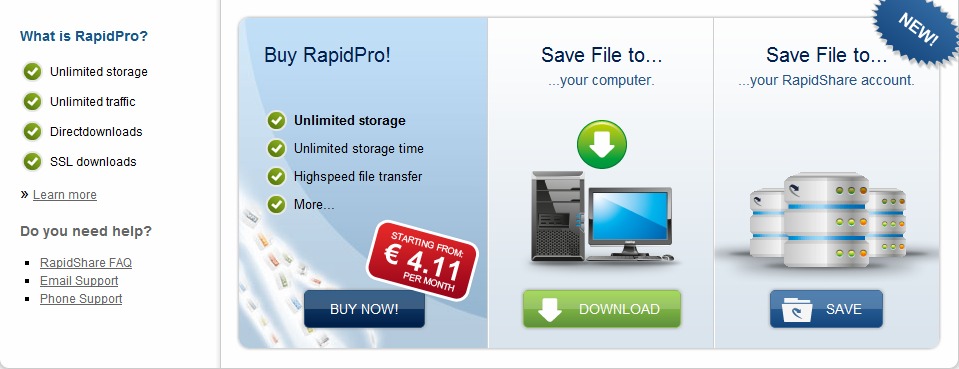
While some social networks are completely free, others might offer a premium option to its users in an attempt to earn some money. LinkedIn, for example, has a premium package for job seekers. All your networking options are free with LinkedIn, but if you want special privileges you have to sign up for one of their premium options.-->Application Development
For social networking sites that incorporate applications and services into the community, a developer fee can help generate revenue. While Facebook allows developers to create applications and incorporate them into Facebook for free, the site has an optional verification program that requires developers to pay a fee to participate. For $375, Facebook will evaluate a developer's application. If the application meets Facebook's standards, Facebook will list it as a verified application. This means Facebook will feature the application prominently over apps that haven't been verified.
We may see other business models emerge as social networking sites continue to grow and become more integral to the average user's Web experience. Other strategies could include, for example, special premium accounts for businesses. The businesses could then leverage the social networking site as an advertising platform. In fact, the founders of Twitter have discussed a business model that would require companies to pay a verification fee to have an official company Twitter account. But whether these strategies will pan out or not remains to be seen.
-->Creative Products & Promotions
-->Monetizing Our Data
Ways in which they can make money is:-
Because of the difficulty of monetizing a social network, websites are forced to come up with creative ways to earn revenue. The best example of this is Facebook Gifts.
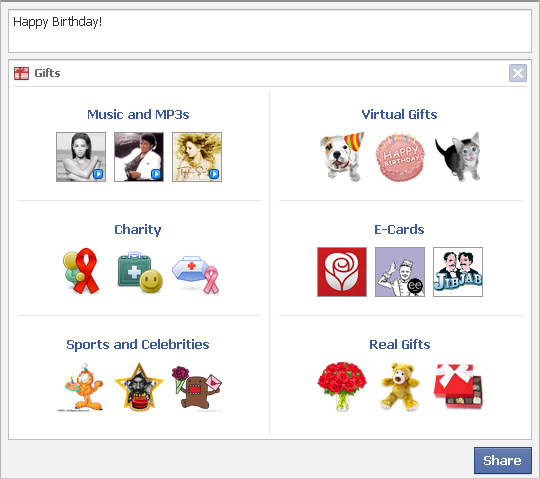
Facebook Gifts allows users to send virtual (as in not real) gifts to their friends that appear on the recipient's profile. The cost of a gift is $1.00 and you can add a personalized message to it.
"Data is just as likely to be as big a piece of the business equation as advertising. Facebook, LinkedIn, MySpace and Twitter already possess billions of pieces of useful data that can infer so much about what's happening -and what's going to happen - in consumer society." ~ Forbes
The data that social networks have accumulated is potentially very valuable. By aggregating this relationship data and making it anonymous, communities can find third-parties willing to pay for it. Take Facebook for example. There is the idea of "like". Someone who likes something is generally showing interest in what the specific post is about (unless they want to play a prank on someone or something).Now imagine you have a large group of college students "like" posts about a particular movie. The production studio of the movie asks Facebook "what kind of people like this movie?" Now, assuming the privacy policy permits, Facebook could, for a cost, provide this data (most likely in some anonymous form) to the studio. Now the production studio has the data they need to increase marketing to college students, instead of fishing around trying to figure out what their target market is.
It will be important that the sold information doesn't invade anyone's privacy, but that's an entirely different issue. So long as the data contains our wants, needs, likes, dislikes, and interests, its value cannot yet be measured. The sky is the limit!
It seems clear that social networking sites are here to stay. Millions of people use them, and developers create applications that depend upon these sites. But ultimately they'll need to generate revenue if they're going to stick around.