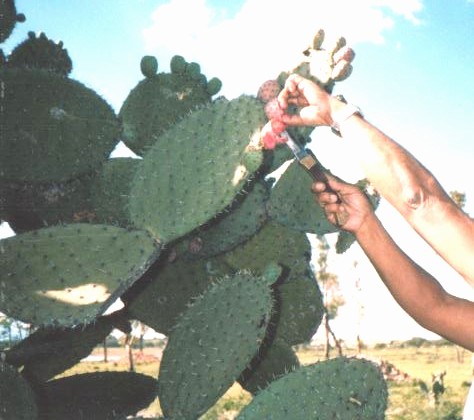
El nopal, o nopalli, es muy apreciado en Mexico,como alimento. Es una planta fibrosa de la familia del cactus. Sus hojas o pencas, especialmente tiernas, son un exqusito manjar. Las pencas son altamente apreciadas por sus propiedades medicinales, y se le reconoce util en el tratamiento de diabetes y alta presion arterial, y por su alto contenido en fibra, es muy requerido por deportistas. Tanto sus pencas, como su fruto, la tuna, est�n cubiertos por espinas que no son problema cuando uno sabe c�mo manejarlas. Se presentan diversas variedades de tuna,siendo considerada la blanca, como la de mayor consumo comercial. Tambien hay tuna roja, naranja y morada. La blanca, sin embargo, ha sido cultivada para ser m�s dulce y jugosa. Existe un bicho, llamado Cochinilla, que se utiliza para obtener un tinte rojo purpura. Se han encontrado tapetes te�idos de esta forma de cientos de a�os de antiguedad. |
The nopal, or nopalli, is very appreciated in Mexico, as food. It is a fibrous plant of the cactus family. Their leaves or pencas, specially when they are very tender, are an exquisit dish. The pencas are highly in demand due to their medicine properties, and its usefulness has been accepted in diabetes treatment and blood pressure problems. By its high fiber content it is used a lot among sport men and women. The leaves, as its fruit the tuna, are covered by thorns but they are not a problem when one knows how to handle them. There are several tuna varieties, being the white the one of greater commercial consumption. There are also red, orange and purple tunas. The white, nevertheless, has been cultivated to be sweet and more juicy. There is a tiny nopal bug, called Cochinilla, which is used to obtain a red/purple dye. Tapestries and rugs of hundreds of years old dyed with this process have been found and their purple color remains as bright as if newly dyed. |

