Religion
Throughout central Burma and among 85 percent of the Burmese people, the teachings of the Buddha are thoroughly interwoven into the fabric of everyday Burmese life. Buddhism has dramatically shaped Burmese culture and civilization. An appreciation of Buddhism and its history in Myanmar is crucial to outsiders wanting to understand the Burmese mind. Within Myanmar's several thousand monasteries reside approximately 800,000 monks, novices, and nuns, and most villages are centered around at least one monastery. No Burmese Buddhist household is complete without a small Buddhist shrine, which occupies a prominent place in the home.
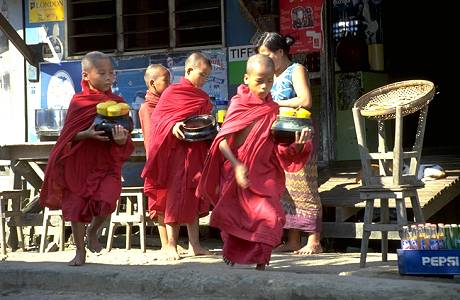
Monks collecting food early in the morning.
The Burmese practice Theravada Buddhism, an ancient sect that adheres most closely to the original teachings of the Buddha spanning 2,500 years. The Mon were the first people in Myanmar to practice Theravada Buddhism, also called the Southern School since it took the southern route from India, its place of origins during the third century BC when the great Buddhist missionary King Ashoka sent missions to Indochina. A second wave is thought to arrived in Southeast Asia via Sinhalese missionaries from present-day Sri Lanka, sometime between the 6th and 10th centuries.
The early Pyu people of Myanmar practised a mixed form of Theravada and Mahayana (the other major school of Buddhism) Buddhism. During the reign of King Anawrahta of Bagan, he successfully propagated Theravada Buddhism to the whole of Myanmar, and it remains today as the dominant school of Buddhism in Myanmar.
Burmese Buddhists believe strongly in the doctrine of karma: the law of cause and effect, which holds that each rebirth is the result of the actions of a previous life. Calling into question whether Buddhism is actually a 'religion', it does not teach belief in a god or supreme being; one is fully responsible for one's own actions. The Burmese are a generous people, partly due to their desire to earn merit toward their next life through present good deeds.
Almost every Burmese man enters the monastery at least three times during his lifetime - once for his boyhood initiation (shhin-pyu) and two more times as an adult. Monks (pongyi) are required to abide by the strictest code of discipline, which includes celibacy, the renunciation of possessions, no solid food after twelve noon until the following morning at sunrise, and a vow not to injure any living thing, even insects. The pongyi sets out every dawn with his alms bowl to beg for food. A donor is grateful for the opportunity to earn merit by providing sustenance for one in service to the Dharma, teachings of the Buddha.