23 June
A Spiritual Sojourn
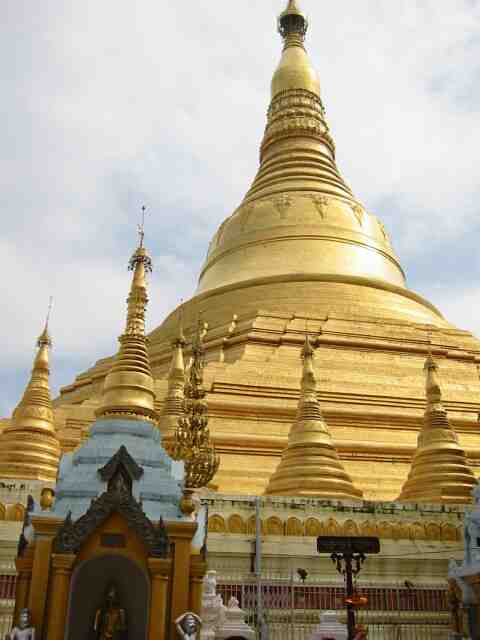
My heart stirs as the golden dagon looms slowly towards me, its spiritual radiance illuminating the path ahead, my breath and footsteps merging into one. The Shwedagon has never failed to inspire me, be it from photographs, the window of my room or simply being in its glorious presence. The Shwedagon is one of the wonders of the world, the national treasure and pride of Myanmar. According to the Burmese chronicles, two Burmese merchants by the name of Bhallika and Tapussa ventured to India on a business trip and met the Lord Buddha on the first day after he attained Enlightenment. Being over-awed by the immaculate radiance emanating from the Lord Buddha's body, they prostrate in front of him and requested an item of memorandum from the Lord who obliged by giving them 8 strands of his hair. The two merchants returned to Myanmar and built a stupa to enshrine the hairs. Generations after generations of devotees flocked to the stupa and adorned it with stacks of pure gold, building it to the present-day spectacular sight.
The towering golden spiral of the Shwedagon, the holiest shrine in Myanmar.
As I ascended the covered stairways leading to the Shwedagon, the gigantic frescos hanging from the ceiling depicting the life story of the Buddha again captured my fascination as it did last year. The Buddha was born as Prince Siddharta of the aristocratic Sakya clan which holds dominion over the river banks of the Ganges and Brahmaputra. At the age of 29, with limitless wealth, power and glory awaiting me, he chose to give everything up to pursue a path to the Truth of life. After a 6-year try filled with trials and tribulations, he finally realize the Truth at 35 years old, after which he spent the rest of his life spreading his teachings to those who have the wisdom to listen, learn and follow. The Buddha attained paranibbana at 80 years old, leaving behind the supreme unrivalled Dharma to future generations. The story behind every lively picture is read out loud in my heart, as so many times in the past. I am ashamed to admit that I have been grossly derailed in my spiritual path so much so that I am not even trying to find my way back though I know I am now trapped in a no-man's land. An occasional inspiration like this serves to remind me where I truly and will eventually belongs to. I am not doing what I ought to be doing. There is something more noble than doing all the humanitarian work in the world for countless are there people to be helped, but only by realizing the Truth that will one be able to end the suffering of others.
It was drizzling but otherwise the weather is cool and pleasant. That did not deter the devotees armed with umbrellas flocking here early in the morning to offer their prayers. Such is the deep faith and devotion the Burmese have in Buddhism. There was a sense of peace and quietude about the place in spite of the crowd and occasional dongs made by the bells. As I circum-ambulate the zedi clockwise, I was suddenly effused with an unbearable lightness of being. For a while, my mind is not clouded by the worries and troubles of the mundane world. It is free to dwell alone in its pristine resting state. I continued walking in the rain, oblivious to my companions, the surroundings and everything else. Why should I care so much? Lay life is full of dust and instead of ridding myself of it, I'm accumulating more and more each day till I can no longer see myself clearly. Am I seeking refuge in the right place? There is silence, all that it offers for my efforts. Silence. I was stuck in that silence, not knowing how many rounds I have gone, just like the endless rounds of wheel of life, it goes on and on. Upon attaining the Supreme Enlightenment, the Lord Buddha declared to the world: "Today, I have made an end to suffering. Done is what is to be done, there is nothing more to be done. Destroyed is birth, destroyed is the state of becoming, destroyed is old age, suffering and death. There is no more coming to this state." Where did I come from? Where am I heading to?
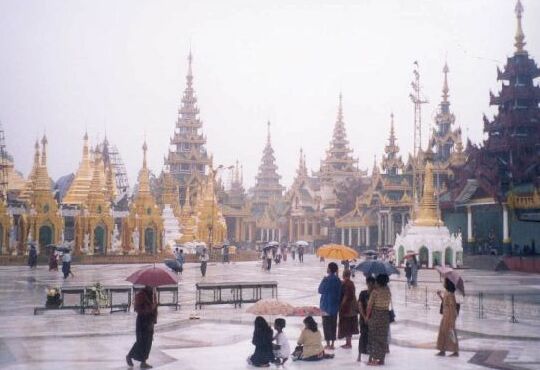
Rains over the Shwedagon
The girl selling coconut flowers
Hawkers prying their trade amongst the tourists lined the stairways leading to the exit of the Shwedagon. It was still raining and they knew we would remain there for quite a while. A girl roughly five years old of age approached me with her basket of flowers and asked me politely whether I would want to buy one. Only 200 kyats, she said, staring straight into my eyes, as if begging me to buy.
I sat down at her stall and inspect her goods. They were made of coconut leaves. The girl can speak pretty good English. She never attended school and learnt it from the tourists. She needs to pick up the language fast in order to make a living. Her name is Ma Aung Kyint and she recently passed her 6th birthday. She will be here at the same spot every day without fail with her basket of flowers which she made herself. She was from Toungoo in Upper Myanmar and her family moved to Yangon when she was 3 in search of a better life. That never materializes and her father returned to the village where they hailed from, leaving her mother and siblings to fend for themselves. She never knew why her parents are separated. She was the 2nd child of the family. She had one older brother at 8 and two younger sisters. They lived in a make-shift hut at the outskirts of the city near the port. Her mother sells vegetables and eggs at the market. Her income is to meagre to feed the family and there are days when they have no food at all, let alone send the children to school. Her elder brother is learning how to mend shoes from the street cobbler while her two sisters accompanied her mother to the market.
She doesn't want to go to school even if her mother can afford to do so. She only wants to earn enough money so that her sisters don't have to starve and have enough clothes to wear and she does not see how an education in school, other than depriving her an opportunity to make money, is able to help her family. However, her mother insists she learn to write and read in Burmese. She spends 100 kyats on transport daily. On a good day, she can earn almost 2,000 kyats while on some days, she was not able to sell anything at all. She hopes to venture into other trades one day such as selling of postcards and newspapers when she has enough capital. She wants to make enough money to buy her family a home to stay. She has little idea of whether she will meet her father again or how long they will live in Yangon. She doesn't like to answer questions. Maybe she didn't quite understand or because she finds them too intrusive. She knows about Singapore as there are many Singapore tourists around. She thinks Singapore is a very developed country and the people are rich.
In the end, I didn't buy a flower from her, but still gave her 200 kyats. It may only be 50 Singapore cents, but it should suffice to buy her family meals for a day so that they won't have to go hungry. There are many such stories like her around. What we can do is so little, yet it means a lot to them.
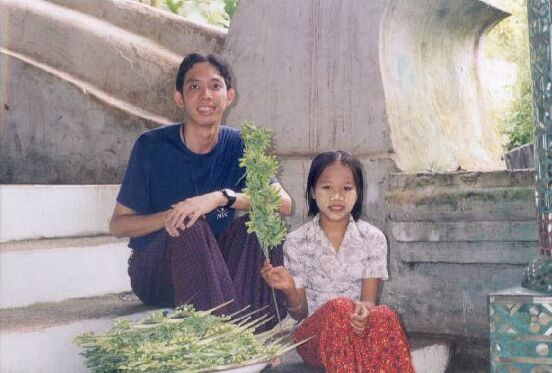
Ma Aung Kyint and her flowers
Picking Shan tea leaves at the Karaweik
After a session of the all-time favourite past-time of Singaporeans, which many in the team lamented of the shortage of time, we proceeded to the Karaweik restaurant for a farewell dinner sponsored by our hosts. It was similar to what we had last year, a ceremony where formalities are exchanged, a buffet dinner and a traditional Burmese cultural performance.
I was particularly attracted by the Shan dance which depicts Shan girls picking tea-leaves at the hills, not by the the elegance and beauty of the girls, but there is a rustic charm about it which brings out the simple and undisturbed lifestyle of the indigenous Shan people. Shan state occupied almost a quarter of Myanmar's land. Tucked neatly between Thailand and China's Yunnan province, the Shan is inhabited by a large variety of ethnic minorities, the Shans, Wa, Padaungs, Pa-Os and the Chinese, descendents of 44th Battalion of the KMT stranded there at the end of the Chinese civil war.
Though little known and secluded from the rest of the world, Shan state is a focus of attention by the CIA as it is the largest producer of drugs in the world - heroin, opium, amphemethamine. The Shan is a volatile hotspot of Myanmar, large swathes of it still being over-run by petty Shan chieftains, drug lords, and local militias. Mong la, the border town recently featured in Times magazine, was notoriously built entirely on drug money. The government army is now bogged now in a guerilla war with the Shan rebels along the Thai-Myanmar border. A ceasefire seems unlikely with both sides determined to eradicate each other's presence from the region. The horror of it all is, nobody knows what is going on there. After having witnessing for myself the hardships of the people in Yangon, I cannot imagine the situation of the people there.
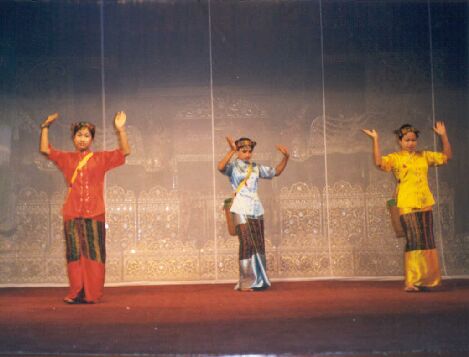
The Shan dance
Beyond self
We ended the last night in Myanmar with a karaoke session. I was pleasantly surprised that it offered Beyond's songs and as I sang "Sea and Sky", I almost choked with emotions, the lyrics resonating in my ears the journey I have traversed over the past one year.....
Today, as I cast a furtive glance at the falling snow-flakes outside,
Bitterness in my heart as I scan the horizons
Endless pursuit amidst the vagaries of life, I lost sense of my direction
The Sea and the Sky, You and Me, who ever change?
Countless times, faced with sneers and criticism
Never give up my lifelong dreams
In an instance the feeling surged
But gradually it subsides, my heart's eternal pain
Forgive me for my un-restraint and love for freedom
I fear too that one day I will fall
Anyone else can betray their ideals
One day, there is only You and Me
I shall continue on my own
Singing my song to the heavens
Traversing thousands of miles....