Biography
WHATEVER adjective you wish to apply to Blink-182 crass, juvenile, obnoxious, scatological no
one can claim the band isn't market savvy. Slashing and burning through trails first laid out
by California punk bands such as Green Day and Pennywise, the San Diego-based group has
managed to forge a musical identity that's easily packaged and intellectually undemanding.
Moreover, the group has elevated the notion of corporate sponsorship to a near art-form.
Defying the long-held punk ethic that frowns on easy alliances between music and merchandise,
the members of Blink-182 (when they aren't naked) are often walking billboards for companies
that furnish the band with sneakers, sunglasses, and other apparel.
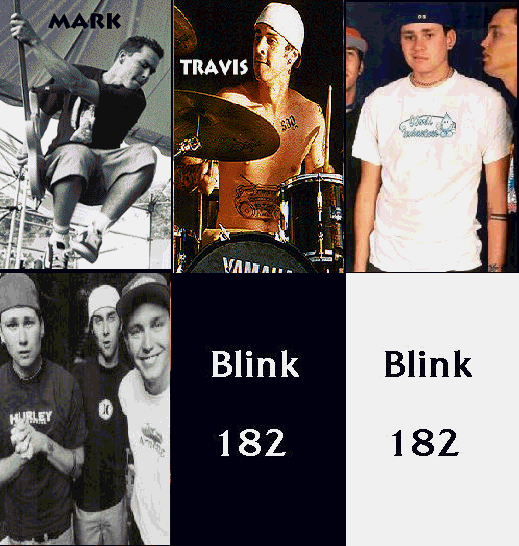
Blink-182's beginnings can be traced to the fall of 1991, when the sister of Mark Hoppus
(bass, vocals) introduced him to then-14-year-old Tom DeLonge (guitar, vocals). The son of
hightech weapons engineer, Hoppus had an early childhood characterized by constant
relocation and world travel necessitated by his father's occupation. By the late '80s, the
family had settled in San Diego, where Hoppus then in his midteens bought a bass guitar and
began emulating songs by the Cure and the Descendents. At the time he met DeLonge, he had
just dropped out of college.
Raised in an upper-middle class home just outside San Diego, DeLonge worked a job lifting
and loading concrete bags at construction sites prior to meeting Hoppus. With the addition of
aspiring drummer Scott Raynor, the first incarnation of Blink-182 then known as Blink began
playing clubs in and around San Diego. Presaging themes that would later surface in its
songs, the group's early shows featured mildly risqu� audience-participation routines such
as wet T-shirt and wet pants contests. Meanwhile, Hoppus and DeLonge befriended the Orange
County punk rock group the Vandals, whose tiny label, Kung Fu, released Blink's
cassette-only debut recording (titled Buddha) in 1994.
Less than a year later, Blink came to the attention of Cargo Records, who signed the band to
a one-album deal. The group's 1995 effort for the label, Cheshire Cat, was pedestrian at
best, but there was no denying the band's growing popularity as a live act. Impressed by
Blink's rabid following in Australia, MCA signed the group in 1996. After a slight
modification to its band name (a nondescript Irish band already had dibs on "Blink," and it
threatened to sue), the newly christened Blink-182 released its major label debut,
Dude Ranch, the following year. The album quickly achieved platinum sales in Australia, while
reaching gold status in Canada and the U.S.
On the strength of heavy radio play and incessant touring, Blink-182 soon garnered a
stateside following that was comparable to its popularity Down Under. During 1997, "Dammit
(Growing Up)," the first single from Dude Ranch, became one of the five most-played songs at
key radio stations KROQ (L.A.), KNDD (Seattle), WXRK (New York), KITS (San Francisco), and WBCN (Boston). Moreover, the band began assuming headline status on the annual Warped Tours and undertook lengthy stints overseas with Fellow skate-punkers Unwritten Law and Homegrown (on the "Poo-poo Pee-pee Tour") and with Less Than Jake (on a tour dubbed "Race Around Uranus").
In January of 1999, Blink-182 returned to San Diego and began work on the follow-up to Dude
Ranch. By that time, Raynor had left the band (the departure was amicable, according to
Hoppus), to be replaced by former Aquabats drummer and Steely Dan acolyte Travis Barker.
Released in June of 1999, Enema of the State solidified the group's status as punkers to be
reckoned with. Evidencing its predilection for silly puns and juvenile obsessions, the band
centered the video for the first single from the album, "What's My Age Again?" on a naked
romp through the streets of San Diego. Moreover, the group enlisted porn star "Janine" to
grace the album cover in a nurse-bondage get-up.
As Enema of the State ascended the charts, a flurry of backlash began cropping up in press
articles. In the wake of an assertion by Howard Stern, no less that executives at Playboy
had asked Blink-182 to provide them with nude photos of fans (a claim Playboy vehemently denies,
according to Spin magazine), punk-oriented fanzines and publicists affiliated with punk groups
tried to dissociate themselves from Blink-182's lyrical motifs and its stage antics, which
generally include requests for female fans to bare their breasts. Thus far, the band
appears to be enjoying the attendant publicity while defending itself against accusations of
misogyny.
Meanwhile, upcoming activities for Blink-182 include a fall and winter tour with silverchair.
The group was also recently chosen to record a version of the Jan and Dean classic "Dead
Man's Curve" for the TV miniseries, The History of Rock 'n' Roll. The band had one of its
songs "Dammit (Growing Up)" featured in the teen flick Can't Hardly Wait and the trio also
made a cameo appearance in the movie American Pie in which the members essentially portrayed
themselves. So it would seem that future film and TV work is almost a certainty consider
yourselves warned.
Blink 182