Najaf: Then and Now
City of south-central Iraq and lying on the western ridge of the Euphrates River, Najaf al-Ashraf or the holy city of Najaf undoubtedly occupies a special place in the heart of every muntazir worth the identity.
It is foremost known as the site of the holy mausoleum of Imam ‘Ali ibn Abi Talib and Prophets Adam and Noah (peace be upon them all).
In a place there named as Wadi’ as-Salam (Valley of Peace), which is
associated with Prophets Abraham and his son Isaac, are located the tombs of
Prophets Hud and Salih, the Maqam of Imam Ja‘far as-Sadiq and Imam al-Mahdi,
and the Musalla of Imam Zayn al-‘Abidin (peace be upon them all).
In this holy city are found the burial sites of Kumayl ibn Ziyad and Rashid
Hijri, two great companions of Imam ‘Ali, as well as the Masjid Hannana,
whose pillars inclined toward Imam ‘Ali, as if paying its last respects,
when Imams Hasan and Husayn (‘a), while carrying the janaza of their
father, were passing nearby. It is also believed that some of the skin from
Imam Husayn’s head (that came off when Khul Mal’un was disrespecting the
head of al-Husayn with a knife) is buried there.
As explained in the tradition, in place of the mountain where the rebellious
son of Noah took refuge during the Great Deluge, a large river appeared, but
after a few years the river dried up, and the place was called “Nay-Jaff”,
meaning the “dried river”.
As acknowledged and recorded by Donaldson, during the reign of the Umayyads
as well as that of the Abbasids until Harun al-Rashid, the blessed
resting-place of Imam ‘Ali could not be disclosed. It remained so until 175
AH (791 CE) when Harun happened to go hunting in these parts, and the deer
he was chasing took refuge on a small piece of raised ground. As his hunting
dogs and horse refused to go near this spot, awe took possession of the
Caliph’s heart, and after a serious inquiry he was acquainted with the fact
that this was the grave of Imam ‘Ali, the cousin and son-in-law of the Holy
Prophet. Harun ordered a tomb to be erected over the grave, and people soon
began to settle down in its vicinity.
Najaf is a city that has witnessed the ups and downs of Muslim history.
Around 1800, it was besieged and desecrated by the Wahhabis from Najd,
Arabian Peninsula. In 1915, as its people rose up against the Ottomans,
Najaf fell into the hands of the British. Under the entire British rule,
Najaf was a scene of Iraqi Muslim resistance against the colonizers, an
example of which was the great resistance in 1918.
Throughout the dictatorial rule of the Ba`athists, Najaf had been neither a
safe haven for the people nor its sanctity being respected by Saddam. During
the 1991 Persian Gulf War, the massive bombardment of Iraq by the US-led
Allied Forces brought considerable damages to the holy sites in Najaf.
Shortly afterward, these damages became worse when the regime in Baghdad
succeeded in quelling the Shi‘ah revolt in the city.
Again, the holy sites in Najaf were not spared from the destructions brought
by the current US-UK occupation of Iraq. In August last year, a bomb
explosion took place in the holy shrine of Imam ‘Ali that caused the
martyrdom and injury of hundreds of worshippers including Ayatullah Sayyid
Muhammad Baqir Hakim.
And as of the press time, the holy shrine in Najaf is shamelessly desecrated
again by the US-led occupying forces as it tries to hunt down the al-Mahdi
Army led by Sayyid Muqtada Sadr.
O Allah, hasten the most awaited advent of the Most Awaited One!
Shajaratun Muntazirah
Newsletter Issue 3, Vol. 1, No. 3 (September-October 2004)
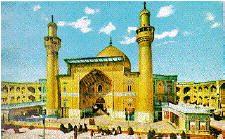
The holy shrine of Imam 'Ali ibn Abi Talib and Prophets Adam and Noah (peace be upon them all) which is presently desecrated by the US-led occupying forces

© 1998-2004 Shajaratun Muntazirah
Email: [email protected]
Address: http://www.geocities.com/smuntazirah
