
Culture of 'Awaiting' among Muslims in the Philippines
Introduced to Islam through the sufi-missionary-trader
Sharifs (or Sadat, descendants of Prophet Muhammad (s.a.w.) from
the Middle East, Muslims in the Philippines are concentrated in Mindanao,
the southern part of the country. They constitute about 5-10% of the total
national population. From the 13 Muslim ethno-linguistic groups, 3 are
major ones, viz., Maguindanaon, Tausug and Maranao. Balik-Islam (former
Christians who embraced Islam) may constitute another group.
Since Sadat who were probably Muntazirin or have
Muntazirin roots, had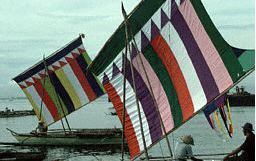 introduced Islam to the country, it is no wonder
that the religious beliefs and practices of local Muslims contain elements
of Intizar. This is especially true with that of the old folks who
are the least affected by the recent penetration of Wahhabi creed in the
country. The elderly ones, particularly the learned men of religion called
pandita, possess a hand-written Arabic-script manuscript named
kissa. As a collection of life accounts of religious figures such as
prophets, it is interestingly enough that it contains a remarkable section
of biographies of the Imams of the Ahl al-Bayt ('a) such as Imams 'Ali,
Hasan, Husayn, Zayn al-'Abidin, and Al-Mahdi ('a), though with slight
inaccuracies.[1] It has a lengthy
narration of the P'rang/P'dang Karbala (Karbala battle) and the
circumstances surrounding the occultation of Al-Mahdi ('a) as well as his
future advent. In the manuscript every time the name of Yazid ibn
Mu'awiyah is mentioned, it is followed by the phase, "The cruel who's
accursed by the Most High God." Similarly, it is common for a child who is
naughty, obstinate, or troublesome to be ridiculously labeled, 'Yazid'.
Nobody is either named 'Yazid' or 'Mu'awiyah'.
introduced Islam to the country, it is no wonder
that the religious beliefs and practices of local Muslims contain elements
of Intizar. This is especially true with that of the old folks who
are the least affected by the recent penetration of Wahhabi creed in the
country. The elderly ones, particularly the learned men of religion called
pandita, possess a hand-written Arabic-script manuscript named
kissa. As a collection of life accounts of religious figures such as
prophets, it is interestingly enough that it contains a remarkable section
of biographies of the Imams of the Ahl al-Bayt ('a) such as Imams 'Ali,
Hasan, Husayn, Zayn al-'Abidin, and Al-Mahdi ('a), though with slight
inaccuracies.[1] It has a lengthy
narration of the P'rang/P'dang Karbala (Karbala battle) and the
circumstances surrounding the occultation of Al-Mahdi ('a) as well as his
future advent. In the manuscript every time the name of Yazid ibn
Mu'awiyah is mentioned, it is followed by the phase, "The cruel who's
accursed by the Most High God." Similarly, it is common for a child who is
naughty, obstinate, or troublesome to be ridiculously labeled, 'Yazid'.
Nobody is either named 'Yazid' or 'Mu'awiyah'.
Muslims in Mindanao met American rule in the Philippines after the
departure of the Spaniards with fierce resistance. One such defiance to
the American authority was exemplified by the Maranao Sultan of Bayang,
which led to his martyrdom along with his entire family and all his
followers. In emulation of the shahadah of Imam Husayn at Karbala,
the sultan fought the American army to the last man inside his kuta
(fort) in what is now known to local Muslims as P'rang/P'dang Karbala.
 Like other important Islamic dates, 'Ashura has been remarkably reckoned
by the old folks. As the month of Muharram is deemed nakas
(ill-omened), holding of marriage rites and traveling to distant shores
are frowned upon. On the 9th of Muharram, which they also called Tasu'a,
all bolos (indigenous kind of spear) in every neighborhood of community
are gathered inside the mosque. After the congregational performance of
dhuhr prayer, every male worshipper would go outside the mosque while
carrying a bolo as a symbolic gesture of allegiance and support to
Amilusin/Amilkusen (Amir Husayn). From the 8th to the 10th of the
month, it has been the practice of every housewife to see to it that all
water vessels are filled with water, with the belief that in doing so,
water shortage is not likely to happen all the year round. Obviously, this
belief is rooted on the scarcity of water from which Al-Husayn's votaries
suffered in Karbala. Furthermore, with the belief that playing with balls
spells events of beheading, it was not rare for parents before to
discourage their sons to play any ballgame.
Like other important Islamic dates, 'Ashura has been remarkably reckoned
by the old folks. As the month of Muharram is deemed nakas
(ill-omened), holding of marriage rites and traveling to distant shores
are frowned upon. On the 9th of Muharram, which they also called Tasu'a,
all bolos (indigenous kind of spear) in every neighborhood of community
are gathered inside the mosque. After the congregational performance of
dhuhr prayer, every male worshipper would go outside the mosque while
carrying a bolo as a symbolic gesture of allegiance and support to
Amilusin/Amilkusen (Amir Husayn). From the 8th to the 10th of the
month, it has been the practice of every housewife to see to it that all
water vessels are filled with water, with the belief that in doing so,
water shortage is not likely to happen all the year round. Obviously, this
belief is rooted on the scarcity of water from which Al-Husayn's votaries
suffered in Karbala. Furthermore, with the belief that playing with balls
spells events of beheading, it was not rare for parents before to
discourage their sons to play any ballgame.
Undoubtedly, this custom can be
traced back to the event of 'Ubaydullah ibn Yizad's poking with stick the
head of Al-Husayn, which was then put in a plate:
"Narrated Muhammad: Anas bin Malik said, "The head of Al-Husain was
brought to 'Ubaydullah bin Ziyad and was put in a tray, and then Ibn Ziyad
started playing with a stick at the nose and mouth of Al-Husain's head..."
[2]

There's also a religious practice of local Muslims of annually giving an
amount called kumus, which is different from zakat. One half
of which is paid to the Sultan or Datu (prince) while the other half is
for the pandita (elders in religion). The first half is called
sakem-i datu and the other half, sakem-i pandita. Apparently,
kumus is referring to the Islamic religious tax, khums,
(literally means one-fifth). According to the Ja'fari jurisprudence, this
one fifth tax is obligatorily levied on every adult Muslim who is
financially secure and has surplus in his income out of annual savings,
net commercial profits, and all movable and immovable property which is
not commensurable with the needs and social standing of the person.
Khums is divided into
two equal parts: the share of the Imam (sahm al-Imam) and the share
of the sayyids (sahm as-sadat). Accordingly, the share of the Imam
is to be paid to the living Imam, and in the period of the Occultation, to
the most learned living mujtahid who is the giver's marja'i
taqlid (Source of Emulation). The other half of khums, the
share of the sayyids, is to be given to needy sayyids who
lack the resources for one year's respectable living in consonance with
their various statuses. The sahm al-Imam, handed nowadays to the
supreme jurists is perhaps represented by the sakem-i pandita.
Whereas, the sahm as-sadat, which is intended for the poor
descendants of the Prophet may have constituted the sakem-i datu or
share of the datu, who is believed to have descended from the Prophet. An
interesting point to notice is the close proximity between khums
and kumus, and between sahm and sakem.
 Taking these cultural practices into account, we can conclude that long
before they were introduced to the hook, line and sinker of Wahhabi
beliefs, Muslims in Mindanao have a remarkable culture of intizar.
Thus, for them acceptance of Wilayah of Aali Muhammad (s) is just a
return to their original roots.
Taking these cultural practices into account, we can conclude that long
before they were introduced to the hook, line and sinker of Wahhabi
beliefs, Muslims in Mindanao have a remarkable culture of intizar.
Thus, for them acceptance of Wilayah of Aali Muhammad (s) is just a
return to their original roots.
Notes:
[1] For instance,
Hind, the wife of Abu Sufyan, is mentioned in the kissa as Rajah
Hind. The epithet 'Rajah' (prince) gives the wrong impression that she is
a male.
[2] Muhammad Muhsin Khan, trans.,
Sahih al-Bukhari, vol. 5, hadith no. 57.

© 1998-2004 Shajaratun Muntazirah
Email: [email protected]
Address: http://www.geocities.com/smuntazirah
