| Home | Malay Version |
Click here for other language (:
|
1n 1940, Tunku was appointed Deputy Director of Civil Defence, Southern
Kedah. When the Japanese handed Kedah over to Thailand in 1941, Tunku was made
Supervisor of Education, a post he held till the British took over Kedah and the
rest of the country. |
|
Determined to complete his law studies, Tunku joined the Inns of Court in
England in 1947. He received his legal qualification in 1949 and returned to
Kedah. |
|
Soon after his return to Kedah, Tunku was made Chairman of the United
Malays National Organisation (UMNO), Kedah. When Dato' Onn bin Jaafar resigned
from his post of UMNO President, a delegation asked Tunku to accept the
leadership of the party. Tunku became President of UMNO on the 26th of August,
1951. |
|
In the next few years, Tunku worked towards unity, traveling all over the
country to speak to the people. His simplicity and warmth won the respect
and affection of people from all communities and all walks of life. |
|
His efforts and those of Chinese leaders, saw fruition in a political alliance of UMNO and the Malayan Chinese Association (MCA) in 1952; later was known as the Alliance Party. The Malayan Indian Congress (MIC) joined the Alliance in 1955. |
|
The people of Malaya, as the country was called then, were sufficiently
united to push for self-government in their progress towards independence. In
July 1955, the first general election was held. The Alliance won 51 out of the
52 seats contested. Tunku was appointed Chief Minister and Minister of Home
Affairs. |
|
As Chief Minister, Tunku made a big effort to end communist terrorism in
a peaceful way. On the 9th of September 1955, he declared an amnesty for
communist terrorists who surrendered. As a follow-up, the Baling Talks were held
on the 28th-29th December 1955 between the Malayan Communist Party, represented
by Chin Peng, Chen Tien and Rashid Maidin; and the Government represented by Too
Joo Hing, David Marshall, Tun Tan Cheng Lock and Tunku. The talks failed when
Chin Peng rejected Tunku's proposal that the communists lay down their arms
unconditionally. Tunku was more determined than ever to vanquish the terrorists.
Five years later, the concerted effort of Malayans succeeded in ending the
Emergency caused by communist terrorism. |
|
In 1956, Tunku led a delegation to London to hold talks with the British
Government concerning independence for Malaya. The Malayan delegation,
comprising of four representatives of the Malay Rulers and four Alliance
representatives, convinced the British Government to set a date for
independence: 31st August 1957. |
|
Achieving independence peacefully needed a great deal of wisdom and
give-and-take. Tunku Abdul Rahman and other leaders like Tun
Abdul Razak, Dato' Sulaiman Abdul Rahman, Tun Tan Cheng Lock, Tun H.S. Lee
and Tun Sambathan, made invaluable contributions to the Merdeka cause. |
|
On the 30th of August 1957, at the Selangor Club Padang (now known as
Dataran Merdeka or Independence Square), as the clock struck midnight the
Malayan flag was hoisted to take the place of the Union Jack. Early the next
morning, the 31st of August, at the Merdeka Stadium, Tunku read the Proclamation
of Independence. On both occasions, Tunku's shouts of 'Merdeka!' were joyously
echoed by thousands of Malayans who were there, and the millions who followed
the proceedings through the mass media. |
|
Three years later, Tunku mooted the idea of Malaysia, to comprise
Malaya, Singapore, North Borneo, Sarawak and Brunei. An inter-governmental
committee was formed. On the 6th of January 1962, the governments of British and
Malaysia set up the Cobbold Commission to find out how the people of Sabah
(North Borneo) and Sarawak felt about joining Malaysia. The Philippines and
Indonesia opposed the formation of Malaysia. Brunei made its decision not to join. On the
9th of July 1963, Malaysia was formed consisting of Malaya, Singapore, Sabah and
Sarawak. Unfortunately, Singapore left Malaysia on the 9th of August 1965. The
decision to let Singapore go was a sadness for Tunku. |
|
Just as Malaysia seemed securely set on a course of peace and prosperity,
the race riots of May 13, 1969 jolted everyone into realizing that there were
imbalances and rifts in Malaysian society, which must be corrected. Emergency
was declared, Parliament suspended, and the country governed by the National
Operations Council chaired by the Deputy Prime Minister, Tun Abdul Razak. On the
22nd of September 1970, Tunku, profoundly saddened by the May 13 Tragedy,
stepped down, and Tun
Abdul Razak became Malaysia's second Prime Minister. |
|
Tunku could not stop serving his beloved land. Through his newspaper
columns, books and occasional speeches, he continued to emphasize the importance
of national unity, religious tolerance and the eternal values of truth, justice,
freedom and compassion among men. |
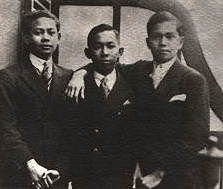
Tunku with his friends in England
Comments, questions about this web site? Send email to webmaster.
HOME TUNKU'S BIOGRAPHY AWARDS MEMORIAL