The Fibromyalgia Help Book
Introduction
''Fibromyalgia syndrome'' (FMS) is the medical term that describes a complex clinical disorder characterized by symptoms of chronic widespread soft tissue pain, stiffness, insomnia, and an altered pain threshold. It can mimic and even accompany the symptoms of joint injury, but it is not a form of arthritis.

Within the medical community, fibromyalgia has not received the attention that would place it high high on the list of diagnoses that would explain the presence of wdespread body pain. Persons who have just been given the diagnosis of fibromyalgia often experience elation and relief when they realize that there is a medical explanation for their terrible pain.
Prior to diagnosis, people with this condition tend to believe that they are alone with a terrible disorder that will ultimately rob them of their ability to function. With a firm diagnosis of fibromyalgia, many are able to cope more effectively. Education about this illness leads to understanding that provides a sense of personal empowerment.
Fibromyalgia syndrome is a relatively common disorder, affecting about five million individuals in the United States and about 1.5 percent of the general population in nearly every country where it has been studied. It can affect a person's ability to function as much as rheumatoid arthritis does, even though there is no recognizable injury to the joints in fibromyalgia. For many years, the medical community believed that fibromyalgia was a somatic consequence of psychiatric disease or a psychological affective disorder with no physical abnormalities and no abnormal laboratory tests to confirm its identity. Now the diagnosis can be made with confidence based on a simple physical examination. In addition, it is clear that laboratory abnormalities result from assays not routinely performed in most clinical laboratories. Also, fibromyalgia appears to be a disorder of the nuroendocrine system involving chemicals of the brain and blood which regulate how pain is perceived by the body. This realization has implications for understanding the disorder and for future approaches to treatment.
The treatment of fibromyalgia presently is multi-modal, involving education, rest, exercise, medication, and adaptation. Judicious use of these modalities in combination makes it possible for most individuals to meet the challenges of life. Alone, these modalities are not completely satisfactory, and even in combination they cannot cure the disorder. Thus, there is room for improvement in current treatment approaches, and most people with FMS are impatient for more knowledge, better understanding, and more effective treatment.
Beryl Markham [1902-1986] said in West with the Night, ''The present is a sluggish traveler which plods along the path that tomorrow wants to take.''
While the wheels of progress grind slowly forward, we want to provide a current and comprehensive synopsis of information about fibromyalgia in a single volume. The Fibromyalgia Help Book outlines the symptoms which characterize the disorder and how the diagnosis is made.
It provides a step-by-step explanation of how to relate to fibromyalgia and how to overcome the many hurdles of the syndrome. It provides insight into the biochemical mechanisms that are associated with the illness and focuses light on approaching being taken to studying them scientifically. It repeats some key information in more than one place to assist readers who have a particular concern, so they can find a reasonably complete explanation in a specific chapter. In addition, the book lists resources where empathetic medical help can be obtained, and includes information about how to start a support group.
We have observed the sufferings of our patients; we hope to provide them – and others with fibromyalgia – encouragement, practical help, and the courage to move forward. We also hope those readers who do not suffer from fibromyalgia will find information about the disorder that increases their empathy and understanding.
Jenny Fransen, R.N.
I. Jon Russell, M.D., Ph. D.
|
 Smith House Press is proud to present our signature book: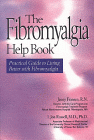


 viewer of this page.