






 |
 |
 |
 |
 |
 |
 |
 |
 |
Cool's Links:
 |
 |
 |
 |
 |

Comparison of General Research and Target CorporationBefore beginning the comparison between Target Corporation’s ethical and social responsibility with the general research, it would be helpful to understand an organization’s role and duty to society. As stated earlier, a company is part of a community or society. And as such, a company uses or takes from that society certain resources, namely land, capital, and human resources. Therefore, it is reasonable to expect a company to give back something in return for the use of those resources. Stated in the book, Ethical Issues in Business, “The Aristotelean approach and, I would argue, the leading question for business in the nineties begins with the idea that the corporation is first of all a community. We are all individuals to be sure, but we find our identities and our meanings only within communities, and for most of us that means—at work in a company or an institution.” (Donaldson, p. 51) This statement supports the idea that a company is not only a part of a community, but is a community unto itself. Furthermore, the people of a company, its human resources, are part of and responsible to that company and to society. This is an important point, because the ethical and social responsibility approaches that management supports, should be at least accommodating, but preferably proactive in order to set a high level of standards for employees to emulate.
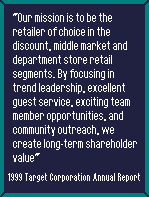
When comparing the definition of a proactive approach, which is a strong commitment and active involvement with community, with the Target Corporation’s community activism, it is easy to recognize that Target takes a proactive approach and clearly does more than expected to return benefits to its stakeholders. Target maintains local and national community involvement with schools, families, charities and foundations. One such foundation is the Target House, which offers a home-away-from-home for patients and families going through treatment at St. Jude’s Children’s Research Hospital. (1999 Target Corporation Annual Report)
Target encourages its customers to become partners with a community by using Target’s Take Charge of Education Program, which gave almost $14 million to local schools during the calendar year 1999. With this program, Target Corporation matches all purchases made using a Target Guest Card, with a donation of one percent of the total purchase is given to a selected school in the area. (Target Homepage, Oct. 15, 2000)
Target supports the environment through local and national programs. Employees gather together with people from the community to reviewuate past projects and to vote on which projects to work on during the summer. In September they reconvene to review their efforts and to celebrate their accomplishments. Target also supports conscientious efforts to care for our environment through waste management. Recycling is very important and saves the company money with respect to time and resources, besides helping the environment. During 1998, Target recycled 22 tons of food waste from
its cafés, and recycled 30,000 pounds of shopping-cart plastic into pet food dishes, to be resold in the market. Furthermore, Target provides leadership in environmental education through a partnership with the National Wildlife Federation. As a result, Target has been awarded both locally and nationally for its proactive environmental initiatives. (Target Homepage, October 15, 2000)With respect to ethical issues, Senior Vice-President, Paul Singer said, “Target starts with an absolute passion for doing what is right for its guests (customers). Target takes a very proactive approach regarding the community, ethics, policies, and procedures and treating people right. Without guests, Target wouldn’t survive; therefore it is imperative that Target give back to its stakeholders.” Mr. Singer stated that management is very conscious about promoting employee involvement by encouraging them to give personal time and funds. In turn, Target matches funds for social programs. (Singer, Interview,
October 31, 2000)It is no wonder that Mr. Singer speaks so highly about Target Corporation and concurs with its obligation to society. The Company’s social responsibility programs began with its founder, Mr. George Dayton. In 1946 the Dayton Company began the tradition of giving back 15% of pre-tax profits to the local communities. This tradition has been carried forward through years of changes, mergers and acquisitions. The significance of Mr. Dayton’s actions helped shape the values andattitudes of employees throughout the years. With the numerous community program s supported by Target Corporation and its team members, it is obvious that Target cares about people. Future plans reported by the current CEO, Bob Ulrich, include community contributions exceeding $80 million during the calendar year ending December 31, 2000. (Target Annual Report, 1999)
Eighty million dollars is a phenomenal sum of money and makes a huge statement about Target’s level of commitment to the community at large. The impact will be felt by millions of children, families, schools, charities and foundations. This world would be an incredible place if organizations and employees a


Last modified 10-31-2000. Terms in Use