






 |
 |
 |
 |
 |
 |
 |
 |
 |
Cool's Links:
 |
 |
 |
 |
 |

Target CorporationThe majority of research included in this section is based on an interview with one of Target’s senior vice presidents. The interview revealed the quality of management at Target, including the emphasis management places on goal achievement, how it defines its management style, and the structure of the organization.
Paul Singer, Senior Vice President and Chief Information Officer, generously provided an extensive look inside the Target Corporation. Mr. Singer has been with Target Corporation for the past 17 years, and during that time, he has experienced a multitude of changes and significant management issues. Mr. Singer was originally hired as a buyer for the Target Stores Division and worked in that capacity for approximately ten years. He stated that the most significant event occurred ten years ago, when the current CEO, Bob Ulrich, took the helm and introduced new ways for management to approach achieving goals, with changes in management style. (Singer, 2000)
Mr. Singer reports to the Vice-Chairman and has functional responsibility for the Development, Computer and Network Services, and the B2B (business to business) departments. When asked to characterize the working environment at Target, Mr. Singer stated that the environment is extremely high energy, with high expectations to meet goals and objectives. Although Target does not use the term, MBO (management by objective), effectively that is how Target manages behavior of its employees and goal achievement. Although accountability is high, the Company is extremely supportive
about helping employees achieve their goals. (Singer, 2000)With respect to strategy, Mr. Singer shared that the retail business is very complex and highly competitive. Target keeps a close watch on its competitors, Wal-Mart and Kmart. Management at Target uses a number of strategies to stay ahead of its competition and grow as an organization. Recently Target created an e-Commerce division to compete with other retail businesses using the Internet. Other ways to maintain a competitive edge are mentioned by the Chairman and CEO, Bob Ulrich in the annual report, which include new store growth, differentiated merchandising, better guest service, the expansion of the SuperTarget Stores, credit programs and community partnering. Each of
these areas has successfully contributed to the corporate goal to deliver an average annual return of 15% or more on earnings. (Target Annual Report, 1999)When asked about the type of management style practiced at Target, Mr. Singer stated that Target strives for a balance between theories X and Y, and therefore would more closely resemble Theory Z. He said that management has regular discussions about accountability and responsibility. Target is heavily process oriented, especially at the store level. He said, “Target puts a lot of emphasis on high accountability and high process. For example, all the Target stores look the same, which means whether a guest walks into a store in Colorado or California, the layout is the same.” However, he also
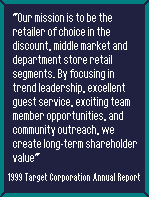
stated that when procedures change, it does not negate accountability. Employees are encouraged individually and collectively to participate toward being successful. This means taking responsibility for one’s actions and for the Company mission, in order to be the best discount retailer of choice. (Singer, 2000)The organizational structure of Target resembles a flat hierarchy. The company has three divisions: the discount, middle-market and department stores. Each division operates using a geographic structure, with functional managers overseeing specific departments and employees. With respect to output control, Mr. Singer stated that each division has specific goals and that divisional goals are based on revenues, which means sales targets and profits are watched closely. Five years ago, Target added EVA (Economic Value Added) measurements, used to monitor capital usage. Mr. Singer said each
employee is reviewed and held accountable for respective goals and objectives. In addition, he is personally responsible for creating, maintaining, and managing operational budgets for each of his departments. (Singer, 2000)Although Target was ranked 100 out of 100 for Quality of Management in Fortune Magazine, the over all ranking puts Target in the number two position, for the category General Merchandisers. Mr. Singer was genuinely surprised that Target did not rank higher in management. He believes management does a good job of establishing goals and implementing strategies to achieve them. He stated that revenues and profits are higher, expansion is progressing and shareholders are foremost in management's planning. In addition, he said he has been very satisfied working at Target, both as an
employee and as a senior executive. He feels his contributions are appreciated, and has been rewarded accordingly. Mr. Singer plans to remain with Target until his retirement in the next few years. (Singer, 2000)


Last modified 10-31-2000. Terms in Use