






 |
 |
 |
 |
 |
 |
 |
 |
 |
Cool's Links:
 |
 |
 |
 |
 |

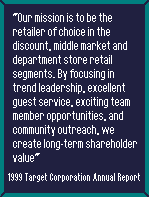
Comparison of General Research and Target CorporationComparing the general research to Target was easy, because the management of Target incorporates most of the principles included in the book, Contemporary Management. For instance, management styles, utilizing concepts in Theories X and Y are evident in the way Target Corporation strives to balance individuality, while maintaining organizational standards and goal achievement. Other comparisons include planning, and controlling resources, management's decision-making processes, measuring goals and objectives, and innovative strategies. (Jones, et al., 2000)
William Ouchi developed a management theory during the 1980’s, called Theory Z. Ouchi researched management differences, between Japan and the United States, and how cultural differences and worker attitudes affect a work setting. Ouchi’s theory incorporates the management's viewpoints and expectations of workers into an approach that combines both. Ouchi’s Theory Z is defined as “an approach to management that recognizes and rewards individual achievements within a group context.” (Jones, et al., 2000, p. 58)
The Theory Z type of management style was evident during the interview with Paul Singer, who stated that Target’s management style was to encourage individuality while maintaining corporate values and achieving organizational goals. For example, employees are encouraged to participate in and become part the community, and yet management decentralized the fund allocation process, which gave autonomy back to the stores to select which programs to be involved with and to determine how funds
should be allocated. (Singer, 2000)The planning and controlling of a company can greatly hinder or enhance its organizational goals. When evaluating Target’s history, structure, innovations, culture and financial success, it is obvious that Target totally understands the retail business. Financial soundness is one way to measure how successful a management team has been. Target has a solid track record of financial success and has consistently achieved or exceeded the goal of a 15% or greater return on earnings per share. Target’s success is no accident. Management carefully plans objectives and strategies to ensure its commitment to shareholders. Management is held accountable using a quasi (MBO) system, along with financial measures, and operational budgets. Strategy includes a total focus on differentiation strategy, and Target’s number one goal is to increase value to its guests. According to Mr. Singer, Target uses a differentiation strategy, which is aimed at increasing value to customers; and a low-cost strategy aimed at driving costs down to ensure higher gross margins. (Singer, 2000)
In addition, management at Target uses a programmed decision-making process at the divisional levels. All stores are managed tightly using guidelines to ensure uniformity. Mr. Singer said that Target encourages ideas for change, but that it goes through a process involving a lot of people before changes are made. He cited an example of the shift that took place when Target hired a new CEO, Bob Ulrich. Prior to Ulrich, the management team was too regimented, but now that team is gone. The new management team, reporting to Ulrich, was taken to Disneyland. The point was to show the new
management team how important an emphasis on process and effort, put together with accountability and responsibility for tasks, can make a huge difference. (Singer, 2000)Target keeps a watchful eye on its competitors, Wal-Mart and Kmart, and considers this activity paramount to achieving organizational goals. Management’s goal is to have customers recognize an immediate difference between Target and other discount stores. Target wants to be the first choice, when guests are deciding where to shop. In order to increase its customer base and gain a competitive edge, Target will only plan diversification as it relates directly to the retail industry. In fact, Target now owns the Rivertown Trading Company, which provides an additional channel for sales through direct
marketing. Target also owns The Associated Merchandising Corporation, an apparel company, to provide Target with some of its own inputs. These represent innovative management decisions to expand and improve Target’s position in the retail industry. (Singer, 2000)


Last modified 10-31-2000. Terms in Use