 |
 |
 |
| Fossil Fuels and Smog |
| Carbon is the stuff of life- its ability to bond in a variety of chains, rings, and crystals allows it to form more types of compounds than any other element except Hydrogen. These compounds are the building blocks of all organisms, alive or dead: carbon is present in every genetic blueprint (DNA), strand of hair, drop of blood, or any other living cell. Naturally, when an organism dies, there is still that mass of carbon remaining. After thousands of years, some of those remains become buried under the earth, protected from the elements, oxidation, and bacteria, all of which would otherwise eventually eradicate the remains. These deposits of plant and animal remains are exposed to high temperatures and chemical reactions that transform them, after |
| thousands of years, to become fossil fuels. There are several types of fossil fuels, but the most common in use are petroleum, natural gas, and coal. To refine separate and refine petroleum and natural gas, the raw substance is first distilled to remove impurities, then separated by weight: lighter molecules are processed to become gasoline, while heavier molecules are either used to become engine lubricants or asphalt, or they are further separated into even lighter molecules for more gasoline products. When these substances are burned, they release energy that is millions of years old- the energy from the sun that the original organism stored in its form when it was alive. |
| What makes the burning of fossil fuels harmful to the environment are the carbon dioxide, carbon monoxide, nitrogen oxides, sulfur dioxide, and particulates (tiny solid particles) released as products. Between 1900 and 1970, a consequence of the rapid rise in car ownership and automobile manufacturing was the 690% increase of Nitrogen oxides in the atmosphere. At high concentrations, these chemicals are dangerous to human health, as well as harmful to the ozone (to learn more about how certain chemicals can act as catalysts in ozone decomposition, click here). |
| What Are Fossil Fuels? |
| What Is Smog? |
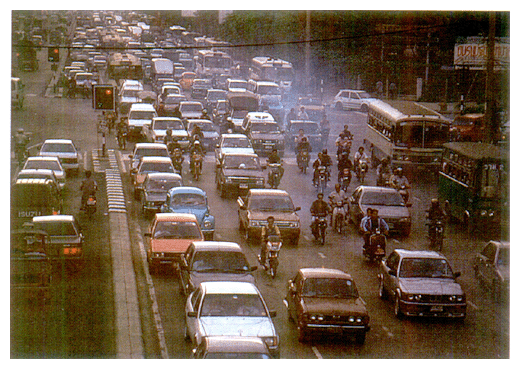
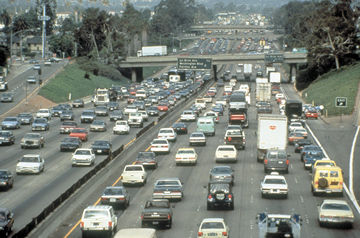
| Smog occurs when large concentrations of localized pollution is trapped in pockets of the troposphere. If all the air pollution in the troposphere was distrubuted equally around the earth, it would be unnoticeable and harmless. However, mostly due to heavy traffic exhaust and thermal inversion, most air pollution can be found over large metropolises. Thermal inversion is the process in which a layer of cool air is trapped under a layer of hot air. The effect is that the two layers of air, and all of their chemical components, do not mix. |
| What determines a cloud of smog's severity is the levels of ozone it contains (see ozone). If there is a large amount of ozone in the smog cloud, then it is more dangerous.When there are unusually high levels of ozone in a cloud, there are most likely other dangerous pollutants present as well. Volatile organic chemicals (VOCs), are chemicals that can form photochemical smog clouds, which are reactive to sunlight. |
| Quick-fix solutions will not work forever. In order to "escape" air pollution, many people decide to move to a less populated area, thinking that once they get to a place where there is less traffic and air conditioners, they can breathe easy. This is valid logic- to an extent. Although there are definitely much higher levels of smog in, say, Los Angeles than Brattleboro, we are by no means protected by some sort of invisible bubble that keeps the world's pollution out. What does this mean? Well, droplets of smog can come from thousands of miles away, carried by the wind, or just by being carried along through the water cycle. The result is that a pristine forest miles away from a city might be covered by a coat of acidic snow, or that a sparkling mountain spring might be contaminated by a downfall of acid rain. Pollution does not only affect wildlife, of course. High levels of smog can cause asthma, heart disease, respiratory illnesses, and other health problems, especially in young children and the elderly. |
| A Problem for Everyone |