 |
| Ozone is one of those things that everyone has heard of but hardly anyone knows exactly what it is. Many people know that it affects plants, human health, and agriculture, but how? Another question that might pop into the mind of some rather...*ahem* unenthusiastic reader is: Who really cares? Well, guess what's shielding you from deadly ultraviolet waves shooting straight at us from that flaming ball of gas we call the sun: you guessed it- it's OZONE of course. |
| Ozone |
| What and Where It Is |
 |
 |
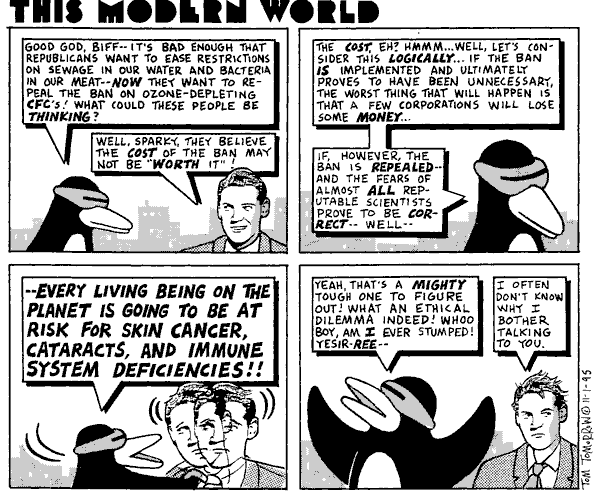
| Click one of these to read Thismodernworld.com's take on ozone |
| * * * * * * * |
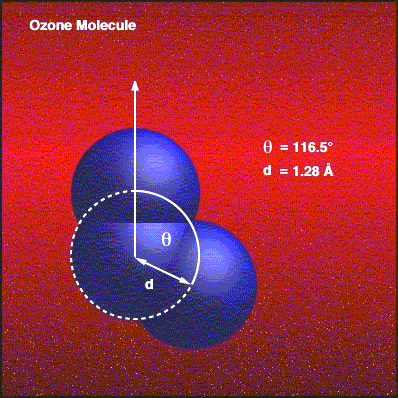
| The Molecule... Ozone is a triatomic form of oxygen, meaning it has three atoms of oxygen rather than two (its formula is O3). In the upper stratosphere, ozone is formed by the division of regular diatomic oxygen atoms. This process, known as photodissociation, is quite simple. Energy needed to break a molecular bond is unique to each type of bond; some molecules need more energy to be broken apart, some less. Diatomic oxygen can be split by UV rays coming from the sun. Although UV rays are not as frequent as the more common yellow light, (which has a wavelength of 500-600 nanometers), ultraviolet light is stronger, since it has a shorter wavelength 150-350 nanometers). Once this reaction is complete, the product left is two single oxygen atoms. Each of these atoms is then free to bond with a molecule of diatomic oxygen, which has not yet been affected by a UV ray. The resulting ozone molecule is not as strong as an oxygen molecule, so can be decomposed more easily by other elements and radiation. O2+UV yields O+O O+O2 yields O3 Note: in this second reaction, certain elements, such as nitrogen, can act as catalysts to the reaction. So the synethesis reaction might look like, O+O2+M=O3+M, where M is the catalyst element. Part of the reason for the stratosphere's relatively constant warmth is because of the energy given off by these chemical reactions. In normal circumstances, ozone does not heavily accumulate in the atmosphere, because of decomposition reactions with the sun's energy and other elements. |
| The Good Side... The greatest concentration of ozone is between 12-20 mi altitude, which means that this layer is the strongest atmospheric shield we have against UV-B rays. The radiation most harmful to humans has a wavelength beween 290-320, which is just the type that ozone reacts with. Without this protection against "biologically active ultraviolet rays," humans and other organisms would be exposed to this radiation, which can cause cataracts, sunburn, and malignant melanoma. The Environmental Protection Agency has caluculated that "for every 1% decrease in the concentration of ozone in the stratosphere there would be a 5% increase in the number of nonmalignant skin cancers each year in the US- an additional 10,000 to 20,000 victims over and above the present fugures." UV-B rays are not just dangerous to humans: crops and lifestock are affected as well. There have been 200 different species of plants tested for sensitivity to UV-B rays, and of those, 2/3 of them have been proven sensitive. In soybeans, which are a vital crop in many countries around the world, there was a 25% decrease in crop yield when UV-B exposure was increased by 25%. Photoplankton, a significant part of the ocean's food change, were also sensitive to an increase in radiation. Cattle were less healthy as well, with an increased amount of sickness, especially pinkeye, when exposed to UV-B rays. |
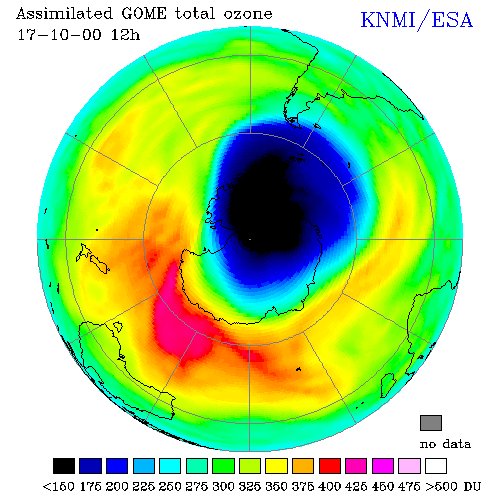
| NASA graph of hole |
| The Bad Side... There can be too much of a good thing. When clouds of smog form in the troposphere, they usually contain nitrogen oxides and volatile organic chemicals (see Smog and Pollution page). When VOCs and nitrogen oxides combine, ozone is formed. What makes this a bad thing is this type of ozone's location and amount. While a large amount of ozone is important to have in the upper levels of the atmosphere to act as a buffer against radiation, down in the lower levels of the troposphere ozone can cause bronchitis and asthma. This ozone does not even protect us from radiation, because it is too near to the Earth for powerful UV rays to be present. Ironically, those UV rays have already been absorbed by naturally formed ozone in the upper stratosphere. |
| The Hole... In the past two decades, scientists have discovered holes in the ozone layer over Antarctica, as well as one over northern Europe and North America. These holes are mainly due to the widespread use of CFCs in aerosols in the fifties and sixties. (See aerosols). CFCs contain chlorine, which breaks up molecules of ozone- one atom of chlorine can act as a catalyst to decompose as many as 100,000 molecules of ozone. Even the smallest hole in the ozone layer can cause increased cases of asthma and bronchitis in humans, and can also harm vegetation, including food crops. This results in faster global warming, as there are less plants to convert carbon dioxide into glucose. |
 |