|
S. M. MOHAMED LEBBAI'S WEB SITE
WELCOMES YOU |
The Quran on Human
Embryonic Development: |
|
In the Holy Quran, Allah speaks about the
stages of man’s embryonic development:
|
We created man from an extract of clay. Then We made
him as a drop in a place of settlement, firmly fixed. Then We made
the drop into an alaqah (leech, suspended thing, and blood clot),
then We made the alaqah into a mudghah (chewed
substance)... (Quran, 23:12-14)
Literally, the Arabic word alaqah has
three meanings: (1) Leech, (2) Suspended thing, and (3) Blood clot.
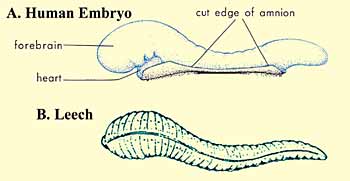
In comparing a leech to an embryo in the
alaqah stage, there will be a similarity between the two as we can see in figure 1.
Also, the embryo at this stage obtains nourishment from the blood
of the mother, similar to the leech, which feeds on the blood of
others.
|
|
|
Figure 1: Drawings illustrating the
similarities in appearance between a leech and a human embryo at the
alaqah stage. (Leech drawing from Human Development as
Described in the Quran and Sunnah, Moore and others, p. 37,
modified from Integrated Principles of Zoology, Hickman and
others. Embryo drawing from The Developing Human, Moore
and Persaud, 5th ed., p. 73.) |
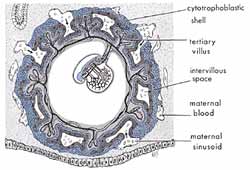
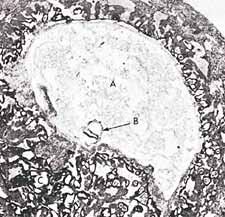
The second meaning of the word alaqah is
“suspended thing.” This is what we can see in figures 2 and 3, the
suspension of the embryo, during the alaqah stage, in the womb of
the mother.
|
Figure 2: We can see in this diagram
the suspension of an embryo during the alaqah stage in the
womb (uterus) of the mother. (The Developing Human, Moore and
Persaud, 5th ed., p. 66.) |
|
| |
|
|
Figure 3: In this photomicrograph,
we can see the suspension of an embryo (marked B) during the
alaqah stage (about 15 days old) in the womb of the
mother. The actual size of the embryo is about 0.6 mm. (The
Developing Human, Moore, 3rd ed., p. 66, from Histology,
Leeson and Leeson.) |
|
The third meaning of the word alaqah is
“blood clot.” We find that the external appearance of the embryo and
its sacs during the alaqah stage is similar to that of a blood
clot. This is due to the presence of relatively large amounts of
blood present in the embryo during this stage (see figure 4). Also during this stage, the
blood in the embryo does not circulate until the end of the third
week. Thus, the embryo at this stage is like a clot
of blood.
|
Figure 4: Diagram of the primitive
cardiovascular system in an embryo during the alaqah
stage. The external appearance of the embryo and its sacs is
similar to that of a blood clot, due to the presence of relatively
large amounts of blood present in the embryo. (The Developing
Human, Moore, 5th ed., p. 65.) |
 |
So the three meanings of the word alaqah
correspond accurately to the descriptions of the embryo at the
alaqah stage.
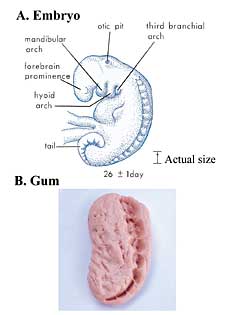
The next stage mentioned in the verse is the
mudghah stage. The Arabic word mudghah means “chewed
substance.” If one were to take a piece of gum and chew it in his or
her mouth and then compare it with an embryo at the mudghah stage,
we would conclude that the embryo at the mudghah stage acquires the
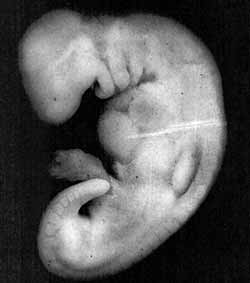
appearance of a chewed substance. This is because of the somites at
the back of the embryo that “somewhat resemble teethmarks in a chewed
substance.” (see figures 5 and 6).
|
Figure 5: Photograph of an embryo at
the mudghah stage (28 days old). The embryo at this
stage acquires the appearance of a chewed substance, because the
somites at the back of the embryo somewhat resemble teeth marks in a
chewed substance. The actual size of the embryo is 4 mm.
(The Developing Human, Moore and Persaud, 5th ed., p. 82,
from Professor Hideo Nishimura, Kyoto University, Kyoto,
Japan.) |
|
| |
|
|
Figure 6: When comparing the
appearance of an embryo at the mudghah stage with a piece of
gum that has been chewed, we find similarity between the
two.
A) Drawing of an embryo at the mudghah
stage. We can see here the somites at the back of the embryo
that look like teeth marks. (The Developing Human, Moore and
Persaud, 5th ed., p. 79.)
B) Photograph of a piece of gum
that has been chewed.
(Click on the image to enlarge
it.) |
|
|