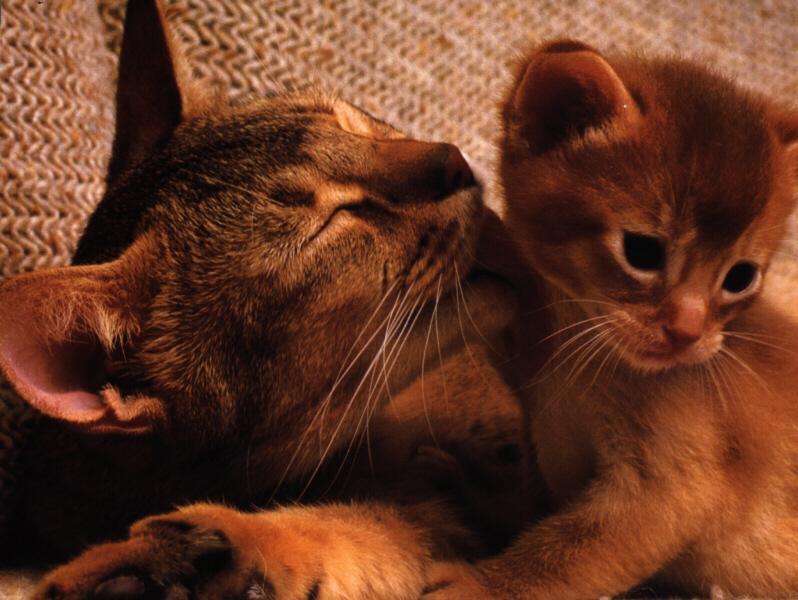
| Socialization Consider what personality you would like your cat to have. Probably you want a cat who is friendly, confident and joins in with family and other pets. Several factors influence a cat's character, such as genetic make-up, mom-cat behaviour and the young kitty's own experiences. There are different types of cats in terms of their friendliness and willingness to interact. Some cats enjoy being sociable while others seem to avoid contact with humans and/or other pets. The sociability of the mother-cat also has an important role on how her kittens view people. A kitten first learns social skills from his/her mother and littermates around the 8th week of life. It is during the 8th through 12th week that mothers and kittens will start 'playing' and therefore, learning the social skills they will carry through life. It is at this time that a kitten should stay with his/her mother and litter, and the kittens should have a good deal of human contact as well. A queen who is relaxed with her owners and lets them touch her babies is passing on the message that humans are not a threat. Young kittens learn a great deal by watching and copying their mom, including their attitude toward humans. The most important influence on kitten's ability to become a happy, interactive pet is his/her early experiences. Up to about 8 weeks of age a kitten can meet other species and accept them as friendly and part of normal life. During this short period of time kittens learn about everyday objects, noises and surroundings without fear. A varied and interesting environment during this time will help kittens to learn quickly and assure that the kitten will be inquisitive and confident in dealing with novelties that arise thereafter. If a kitten misses out on these early experiences he/she is likely to be fearful and nervous for the rest of his/her life. Many owners adopt kittens too early (between the 8th and 10th week) and many of these owners find that their new pet isn't as well socialized or behaved, as they would like. They also find that if they want a well-socialized animal they now have the responsibility of teaching the kitten what the mother didn't get a chance to finish. Be wary of any pet store or breeder that is willing to sell you a kitten before the 12th week. Many kittens at shelters are strays that are found abandoned by the mother or owner and may be under 12 weeks. Remember these kittens are adoptable and are in great need of your help, but be aware that you may need to do a little extra work with them by being their surrogate mom. As an adult your cat will need to keep those social skills well sharpened so even if you adopted a well socialized cat but ignore, pay no attention, don't play or don't spend enough time with your cat he/she may revert to anti-social behaviours. If you adopted an older cat or a stray that need to be socialized you must realize that socializing a cat takes a great deal of effort and patience and the results might not be what you wanted or expected them to be. I successfully socialized Spike but it took me 2 years and he never really became a calm and outgoing cat, he still feared and hated visitors, hands and feet and physical contact with humans, after 2 years of effort he only accepted me, so the results can be mixed and difficult to accept if you have kids and other pets. Dominance and Hierarchy in Cats Dominance is a key part to life in a multiple cat home. Cats in multiple cat homes will quickly establish a dominance hierarchy amongst themselves. This is a commonly accepted order status in the cat world and should not be interfered with by owners. In such a hierarchy one cat will take the top dominant position. This cat will then be known as the 'alpha-wolf' so to speak. The lowest cat on the totem pole is known as the pariah. This set up is normal and should not be interfered with. Such a system is usually set up through several encounters of 'play fights' between the various cats in the home, quickly the hierarchy will be set up. This hierarchy can be seen throughout your cat's daily lives. You will notice your dominant cat being the first to eat, first to play, the first to want and get your attention etc. The dominant cat will perch at the highest spot in a room (height equals respect in the cat world), while the other cats will then position themselves in descending heights. Many shelters now-a-days actually have plenty of cat towers and various objects of various heights such that the cats can display their dominance while in the shelter. Also remember that cats are creatures of habit. They like routines and low-stress environments. To them this established hierarchy is part of their routine and habit, and part of what makes their living situation acceptable. If they are not allowed to do such they will get stressed and anxious. You should not try to go against this system. Your dominant cat isn't being mean or bossy, just following his instinctual laws. Although it may be difficult at times, follow the hierarchy your cats have set up. Treat the dominant cat as the dominant cat, make sure to give treats or feed that cat first. When the dominant cat expresses his dominance try not to punish or yell at that cat, even though he may seem to be acting mean or unfair. This is a common mistake among owners. Although we might like our cats to live in a world where everyone is created equal, this is not the case in the feline social structure. Going against the system will generally cause the dominant cat to become more aggressive in an attempt to regain his role. Cats who feel their dominance or place in the hierarchy is threatened may also start to exhibit the following behaviors: Spraying Litterbox problems Biting, or Scratching Aggressive Behavior Hissing Dominance is one reason why getting a second cat 'to play with your first cat' may not always be the best idea. A dominant cat will not appreciate a new cat in his home and will let you and the new cat know it. Getting a dominant cat to accept the new cat can also be very tricky especially if the new cat isn't happy with being the pariah. This is why many owners find that their older, friendly, and problem-free cat suddenly starts urinating outside the box and spraying when they bring home a new little kitten! If your first cat is particularly aggressive, dominant, or likes to be alone then getting a second cat may only create a problem. The best time to adopt a second cat is when you are adopting a kitten, in which case both cats can grow up together. If you do choose to get a second cat it should be of the opposite sex of the first cat and you should be aware that you will need to take great care in introducing the two cats and helping them to learn to live together and get along. If introduced properly many cats can learn to live together; however, be aware of the possibility that the two cats may never get along and may only learn to tolerate each other or may need to be separated full time. Main Page Cats Home |
 |
 |
 |
 |