Other Behaviors Rolling on his/her back and exposing the belly - your cat is letting you know that he/she totally trusts you as he/she is exposing the most vulnerable part of the body. This doesn't necessarily mean that your cat wants a belly rub, although Joe for example loves tommy rubs and often falls asleep, just that he/she is totally comfortable with you and trusts you. Kneading - this stems from 'milk threading' that kittens do. Kittens knead their mother's belly to stimulate milk production. In doing this to you your cat is not only expressing his/her love for you as a mother-figure but also remembering the happy feelings that used to occur when the mother was kneaded. My cats are not declawed so the kneading reminds when it's time to trim their claws. Snoring - if your cat snores when he/she sleeps he/she is totally relaxed! Sniffing - cats sniff each other in the wild to say hello and get to know each other. If your cat sniffs your face consider it a greeting and a way of showing that your cat trusts and likes you. Many owners even get down on the floor (face level with their cats) and touch noses when they greet. I do that a lot with my cats not only for greeting but at any occasion that they're willing to. Remember you always have to ask permission from your cat to get physical contact. It is always a good idea to observe your cat and allow him/her to initiate contact with you. Every cat has a different personality: some like affection and are lap cats like Joe, some avoid getting too physical but will seek you out if they want some affection, like Seafore. . Main Page Cats Home |
 |
 |
| Cat Talk As we all know cats don't speak human languages, they speak cat languages, and we as humans can learn to understand and talk back to them. I find communicating with cats exteremely relaxing and lots of fun. Immitation of my cat's sounds and body language (as much as a human can!) is not that hard, it may not be the case that my cat actually understands me but we try to establish a conversation. It may sound crazy, but if you've never tried it do so. In no time you'll find your cat initiating a conversation with you that is unique to you. My cats conversations with my husband are completely different from mine. But before you start talking to your cat it is essential to learn cat's body language, as cats like any other animal (including humans) communicate through their bodies. Learn to understand what your cat is trying to tell you and then teach them to understand what you're trying to tell them. Learn what your cat's different signals mean so that you and your cat can communicate regularly. This will improve the bond between you and your cat and keep your cat happy, it will also allow you to better read your cat's signals so you know when your cat wants to play or just wants to be left alone! |
 |
| Tails Watch your cat's tail as it is probably one of the best communication indicators that cats have. You can read almost every cat feeling and thought by looking at his/her tail. Tail arched and puffed out or bristled - your cat is scared or fearful and is ready to attack or defend itself. The bristling is instinctual as it makes the cat look larger. Tail straight up in the air and fully puffed out or bristled - your cat is angered, aggressive and ready to attack. Seafore exibits more of that behavior as he is fearless and runs to Joe's rescues, also if there is a neighbour's cat in our backyard. As my cats are strictly indoor cats Seafore almost ripped the back door screen off trying to fight with a cat in the back yard. Just seeing his tail helped me intrvene and shut the door before he actually could break out and get hurt. Tail straight up in the air and quivering a bit - your cat's tail moves this way when spraying urine to mark territory; however, once your cat is spayed or neutered he/she will continue to move his/her tail this way (without any spray or urine being excreted) when you greet him/her. This is your cats way of saying, 'hi, it's your loving cat!' This is more typical of Joe, as he is more territorial than Seafore. When he was a kittten I thought he would spray, and took them to the vet, they both were neutered one month earlier (at 5 monthe instead of six) bacause of it. Tail straight up and unmoving - an unabashed greeting. This is what a mother cat does to her kitten to tell him/her to inspect her rear. Joe and Seafore both do it on a regular basis, Joe actually puts his rear as close to my nose as he can, good thing he is a very clean cat!!! Tail straight up but the tip tilted to one side - your cat is very interested and intrigued by something; your cat is happy and friendly. Tail straight up or just slightly raised and curved like a question mark - your cat is very excited and interested in something. Tail curved down and then back up again near the tip - your cat is very relaxed and content. Tail still but tip of tail quivering or twitching - your cat is mildly irritated. Your cat may attack if the twitching becomes violent enough. This is a 'leave me alone' signal. Tail swishing from side to side rapidly or violently - your cat is about to attack something, this is seen during fights and play time. This is not the same as tail wagging in dogs. Tail held to one side - your cat is giving a sexual invitation (generally only females in heat do this). Tail held low and puffed out or bristled - your cat is intensely afraid. I've never seen my cats doing it, may be beacause they're never afraid and that is a good thing. Tail held low and tucked between the hind legs - your cat is showing his submission or defeat. |
 |
| Ears Cats ears are another way that a cat expresses his/her emotions. Ears pointing forward and slightly outward - your cat is relaxed and happy. Ears very straight up and forward - your cat is listening to something that is intriguing. Ears twitching nervously - your cat is agitated and nervous. Joe exibits this behaviour more than Sefore as he is a much more nervous cat. Ears flat against the head - your cat is frightened and may attack (this is instinctual as to protect the ears during a fight). I've seen that a lot when they play-fight each other. Ears back or in between alert and defensive position - your cat is aggressive and may attack. Also seen a lot during play-fight. |
 |
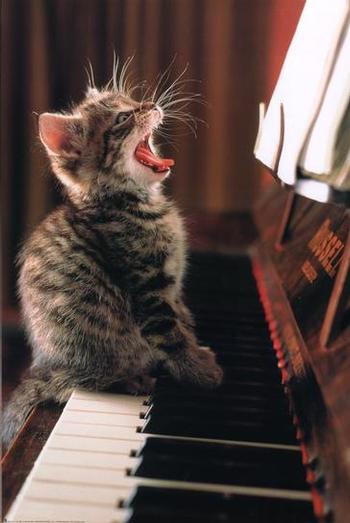
| Meowing Cats can make over 100 different vocal sounds (dogs can only make 10). These sounds encompasses a variety of meows, purrs, gurgles, and eeps which occur in a variety of tones and octaves and can mean a plethora of things. The more you talk to your cat, the more your cat will talk back and extend his/her 'vocabulary'. And a good owner will learn over time what his/her cat means by each of his/her vocal sounds. By listening to your cat and talking back, eventually you and your cat can start to 'talk' back and forth to each other with understanding. This will help streangthen the bond between you and your cat grow and entice your cat to become even more expressive. Seafore talks more, he has whole speaches sometimes. With Joe is a little bit different, he doesn't talk unless it is a demand-he is VERY demanding. In human terms he yells and gives orders!!! I guess it is his way of making sure you're listening to what he has to say. |
| Growling and Hissing Growling and or hissing means only one thing - your cat means business and wants you to back off. If your cat growls or hisses at you don't push the issue or you will be attacked. The only time Joe hisses is when he is visiting the vet. Never heard Sefore do that. Back and Fur In general a cat's body fur remains fairly consistent; however, if you notice your cat arching his or her back and bristling you can rest assured that your cat is frightened and on the defensive. Your cat may attack at this point. As kitties, my cats did that a lot, now is not as often but it still happens and mostly with Seafore. He becomes double his size!!! |
 |
| Purring It is still not known why cats purr. Some theories on the origin of purring include 1) the possession of false vocal cords 2) the contraction of laryngeal muscles 3) blood flow that is amplified by the diaphragm. Whatever the cause of purring a cat purrs when he or she is generally happy; although, some cats are known to only purr when they are ill. However, most cat owners will attest to the fact that their cats only purr when they are content or happy. When my cats were little in addition to purring they would lick my nose and ears and face, etc, etc. Coupled with love bites I was ready to scream from pain but I didn't. This type of behaviour is related to bonding, to them I was mom-cat and it is crucial for the kitties. But I am glad they don't need to that anymore, now aside from loud purrs I get a nose to nose rub or a whole face rub, it's better than love bites on the nose!!! |
 |
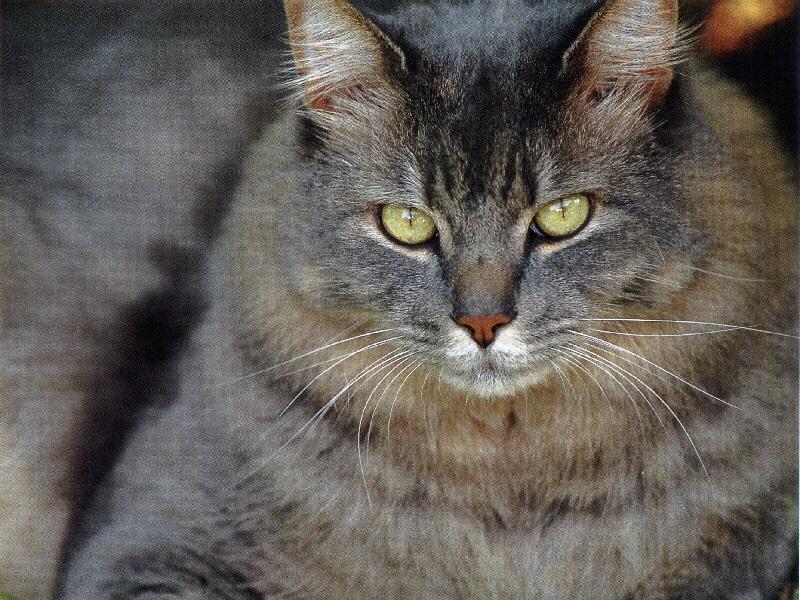
| Pupils Cat's pupils for the most part change with the amount of the light in the room. However, if your cat becomes very aroused, excited or angered his/her pupils will become greatly enlarged regardless of the amount of light in the room. Eyes Your cats eyes can also tell you a lot about what kitty is thinking: Wide open eyes - your cat is awake and ready to go Wide open eyes with a little sparkle - your cat is feeling a little mischievous Half closed eyes - your kitty is relaxed and ready for a cat nap! This can also mean your cat is ill if the eyes are like this on a consistent basis, even when awake. Closed eyes - your cat is napping, obviously. Winking/Blinking - A long slow blink means that your cat is content and relaxed. One of the greatest discoveries for me was the fact that if I blink while one of the cats is looking at me he will usually respond. It is a communication of mutual trust and love.. |
 |
 |