|
By Daniel Fischer Every page present in Europe & the U.S.!
| Ahead | Awards 
The latest issue!
| A German companion - only available here! Current mission news: MGS (latest pictures!) + Cassini + Stardust |
Space action all over Germany on the weekend Sep. 17...19!According to initial statistics, hundreds of widely publicized space events all over Germany have drawn way over 100,000 visitors: DLR, STERN, WAA and Stw. Hannover PMn. The events were running under the labels Astronomietag, Lange Nacht der Sterne and Tag der Raumfahrt. | |
|
Posted in part from the Marina de Portisco, Sardinia, Italy (kind of) |
Genesis recovery: more good newsAs more of the Genesis capsule's contents are revealed, the team's level of enthusiasm for the amount of science obtainable continues to rise. As of Sep. 16, the science canister that holds the majority of the mission's scientific samples is lying upside down - on its lid. Scientists are very methodically working their way "up" from the bottom portion of the canister by trimming away small portions of the canister's wall. The team continues to extract, from the interior of the science canister, small but potentially analyzable fragments of collector array material. One-half of a sapphire wafer was collected on Sep. 14 - the biggest piece of collector array so far. The mission's main priority is to measure oxygen isotopes: The condition of the crucial collector segments will be better known over the next few days, after the canister's solar wind concentrator is extricated. At this time, it is believed that three of these segments are relatively intact and that the fourth may have sustained one or more fractures.
Most Genesis science can be salvaged!Scientists, who conducted the preliminary assessment of the Genesis canister, are encouraged by what they see: They believe it may be possible to achieve the most important portions of their science objectives. Based on initial inspection, it is possible a repository of solar wind materials may have survived that will keep the science community busy for some time. The mission's main priority is to measure oxygen isotopes to determine which of several theories is correct regarding the role of oxygen in the formation of the solar system. Scientists hope to determine this with isotopes collected in the four target segments of the solar wind concentrator carried by the Genesis spacecraft. From the initial look, one can see that two of the four concentrator segments are in place, and all four may be intact.The mission's second priority is to analyze nitrogen isotopes that will help understand how the atmospheres of the planets in our solar system evolved. These isotopes will be analyzed using gold foil, which have also been found intact. Other samples of solar winds are contained on hexagonal wafers. It appears these are all or nearly all broken, but sizable pieces will be recovered, and some are still mounted in their holders. One won't really know how many can be recovered for some time, but Genesis scientists already are far more hopeful important science can be conducted than they were on "landing" day. Another type of collector material, foils contained on the canister's lid, were designed to collect other isotopes in the solar wind. It appears approximately three-fourths of these are recoverable, too. |
Genesis sample capsule crashes, science rescue attempts ongoingAttempts are under way to save any science return possible from the solar wind sample return capsule from the Genesis mission that crashed into the Utah desert on September 8. Genesis' science canister loaded with the solar wind samples has been transported by helicopter from the impact site to a holding area next to a specially constructed cleanroom on the Utah base. Foil wrapping was removed from the canister and dirt brushed off before the canister was moved into the cleanroom for analysis of the contents. The Genesis team was to begin examining the canister today; according to early reports, some of the plates designed to collect solar wind particles appear to be more or less intact, although others have crumbled to dust. "Scientists are hopeful that the recovered Genesis samples will be sufficient to achieve the mission's science goals," reads a NASA statement of Sep. 9.The capsule had plunged into Earth's atmosphere at 15:52:47 UTC and entered the preplanned entry ellipse in the Utah Test & Training Range as predicted. However, the drogue chute and parafoil failed to deploy, causing the craft to smack the ground at a speed of 311 km/h. By the time the capsule entered Earth's atmosphere, the flight crews tasked to capture Genesis were already in the air. Once it was confirmed the capsule touched down out on the range, the flight crews were guided toward the site to initiate a previously developed contingency plan. They landed close to the capsule and, per the plan, began to document the capsule and the area. NASA is convening a Mishap Investigation Board to determine why the Genesis drogue parachute failed to deploy. A faulty battery has already emerged as one of the likeliest causes for the crash: It may have overheated early in the mission and thus failed to detonate the pyrotechnic charge of the parachute. |
| |||||||
Fred Whipple, planetary science giant, dead at 97Dr. Fred Lawrence Whipple, the oldest living American astronomer and one of the last giants of 20th century astronomy, passed away on Aug. 30 at the age of 97 following a prolonged illness. He was Phillips Professor of Astronomy Emeritus at Harvard University and a Senior Physicist at SAO. A discoverer of six comets, Whipple may be best known for his comet research. Five decades ago, he first suggested that comets were "icy conglomerates," what the press called "dirty snowballs." His dirty snowball theory caught the imagination of the public even as it revolutionized comet science. Whipple's change of concept from the generally accepted "flying sandbank" model was "one of the most important contributions to solar system studies in the 20th century," says Dr. Brian Marsden, director of the Minor Planet Center located at SAO. A 2003 survey by The Astrophysical Journal showed that Whipple's 1950 and 1951 scientific papers on the "icy conglomerate" model were the most cited papers in past 50 years. |
| |||||||
Two more "Exo-Neptunes" announcedShortly after the European announcement of the lowest-mass exoplanet detected via the radial velocity method (see below), U.S. scientists have revealed two more examples of similar mass - thus a new (sub-)class of low-mass extrasolar planets has been established. (The main difference between the U.S. and the European announcements, by the way, is that the 'American' planets were slighty ahead in the formal publication process, but there is some controversy over who really made the first clear discovery; see Science of Sep. 3, 2004, p. 1382 ...) In all three cases of exo-Neptunes it is not clear yet how they formed, so close to their stars: Either they were growing but something stopped the process, or they migrated inwards and were stripped of much of their gas mantle.The new planets, though approaching the Earth in size, are still far from Earth-like. Both whip around their stars in a few days and are so close as to be roasting on the side facing the star. Because each planet is so close to its star, its rotation is no doubt locked into its orbital period, so that it always presents the same face to the star. The newly discovered Neptunes may well be the harbingers of many more (and smaller) things to come. Although lower-mass planets like these tend to be harder to detect than their higher-mass cousins, the statistics to date suggest they occur more frequently. And if that's the case then an obvious extrapolation suggests that we may soon be seeing many more Neptunes - and that Earth-sized planets, if we can ever detect them, may be downright abundant.
|
|
Saturn UpdateCassini has performed a major trajectory correction on August 23, with a 51-min burn of its main engine - and discovered a new ring and more little moons: Press Releases and Status Reports of Sep. 9 and Aug. 23 and ESA Releases of Sep. 17 [alt.] and Aug. 25. | Pictures 67... 09, 64... 78, 77, 76, 75, 70, 66, 65, 64, 63, 62, 61, 60, 26, 25, 21, 20, 19, 18, 17, 15, 06, 04, 03, 02, 01, 00, 63... 51, 48, 47, 46, 45, 61... 14, 06, 05, 60... 92, 90, 89, 87, 84, 83, 82, 73, 54... 39, 38, 37, 36, 34, 33, 32, 31, 30, 28, 27, 26, 13, 12, 11, 10, 07, 06, 50... 76, 75 and coverage of Sep. 14: AB. Sep. 13: ST. Sep. 10: AFP. Sep. 9: BBC, New Sci., AFP, SC, NZ. Aug. 25: AB. Aug. 23: AB. Aug. 22: CENAP - and what's that? |
Mars UpdateMars Express - the internal Beagle disaster report has been released, but it can't explain the loss either: the report, a PPARC Release, ESA Press Releases of Sep. 2, Aug. 30 and Aug. 23 and coverage of Aug. 30: S&T (scroll down). Aug. 26: BBC. Aug. 25: AB, Scotsm., Guard. Aug. 24: Plan. Soc., Nat., BBC, AFP (other story), New Sci. (other story), AP, SC, ST. Aug. 23: USA T. Aug. 22: Guard. |
Mars Odyssey can continue until at least the end of 2006:
NASA Press Release
[JPL],
New Sci.,
AP,
ST.
Large sea near Opportunity landing site inferred from Odyssey data:
CU Press Release
[SR],
SF Gate,
SC,
Welt.
More watery news from Mars meteorite Lafayette:
AB.
No rain involved in Mars valleys?
Dsc.
Mars methan detection stressed:
Guard.
Dotted dunes seen by MGS: APOD.
MER at sleep while Mars in conjunction: the status on Sep. 1 and coverage of Sep. 7: MWC. Aug. 23: ExtremeTech. Mars laser communications in 2009: New Sci. |
ISS etc. UpdateO'Keefe testimony on the STS RTF costs, the VA/HUD Subcommittee's report on HR 5041, an MSFC Release on the ET, ESA Press Releases of Sep. 9 and Aug. 30 on the ISS Cupola and coverage of Sep. 19: FT. Sep. 18: ST. Sep. 17: AD, FT (other story), ST. Sep. 16: HC, FT, UPI, AP, SC (other story). | Sep. 15: BBC (scroll down to "MANNED SPACE"), FT, AFP, ST. Sep. 14: BBC. Sep. 13: SpaceRev. Sep. 11: ST. Sep. 10: AD, FT, HC, ST. Sep. 9: FT, AP. Sep. 8: AP, UPI, SC. Sep. 7: SpaceRev. Sep. 4: ST. Sep. 3: SN, SC. Aug. 30: SpaceRev. Aug. 28: FT, HC, ST. Aug. 27: FT, BBC, AFP, SC, ST. Aug. 26: AD, FT (other and another story, OpEd), New Sci., SC. Aug. 25: UPI. Aug. 24: APOD, SC (other story). Aug. 23: AB, SpaceRev. Aug. 21: ST. The HST crisis - coverage of Sep. 6: HC. |
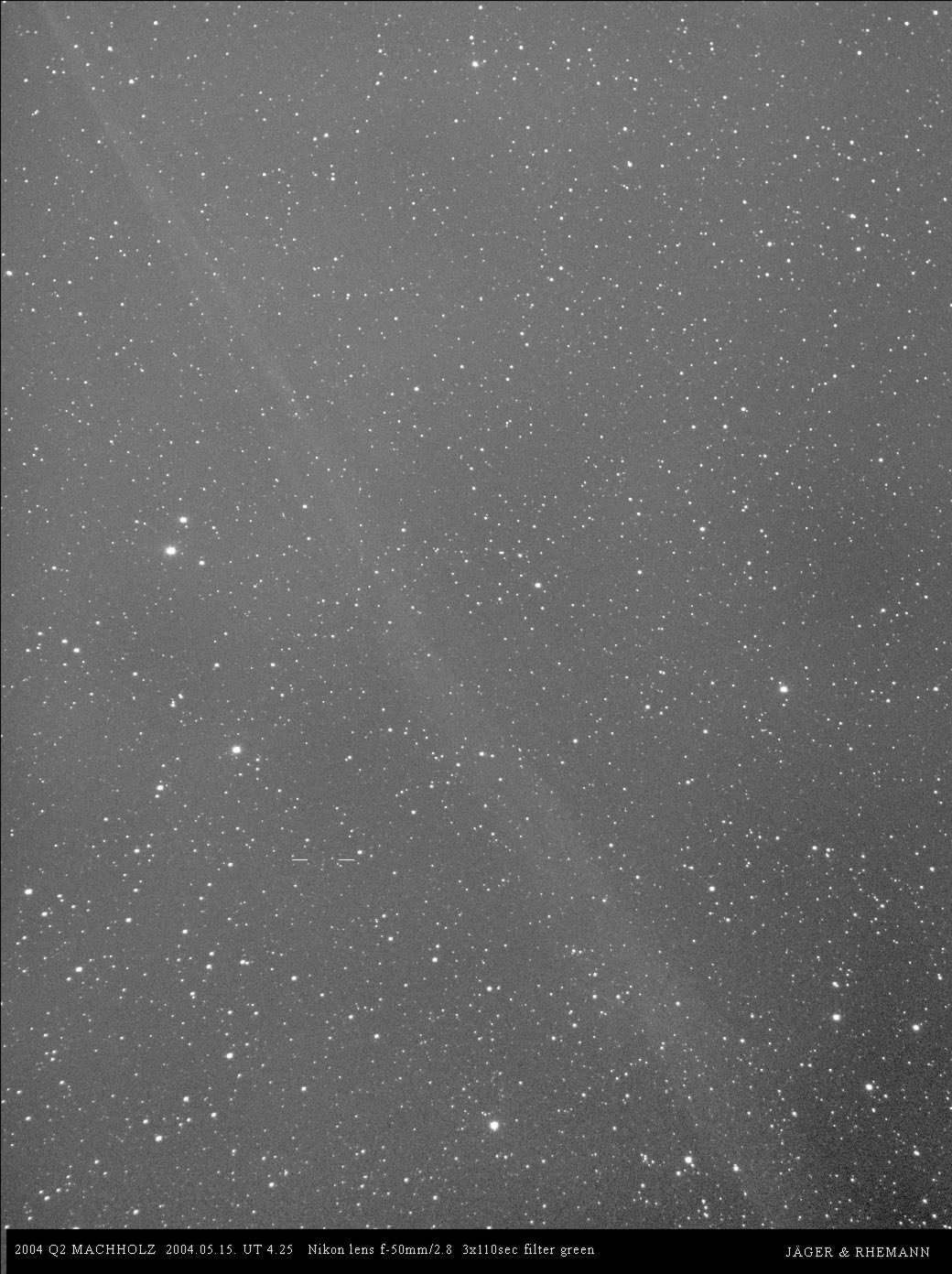
Another comet Machholz!It could be well-positioned for Northern observers by year's end, with perhaps marginal naked-eye brightness, like 4th magnitude in early January 2005: an ephemeris, an alternate calculation (with different positions), more info and S&T (more) and SC stories. Machholz was close to the long tail comet C/2002 T7 (LINEAR) in mid-May and thus there is at least one accidental pre-discovery image (detail) from that time! For more current pictures check the TA files. New comet C/2004 R2 (ASAS) heads south: S&T. Comet C/2003 K4 (LINEAR) on Aug. 17: APOD.Asteroid shaved past Earth's atmosphere2004 FU162 streaked across the sky just 6500 km above the ground on 31 March: NEO News, Wired, New Sci., AFP, ACC, Ast., ST. Sedna's moon, origin speculations: Nat., S&T.Toutatis to come close to Earth on Sep. 29 Asteroid 4179 will approach to within 1.5 million km, offering a chance for close-up inspection: S&T, Wired, "Homepage". Deflecting an asteroid? NEO News. Well-preserved layer of material ejected from Chesapeake Bay meteor-strike discovered: U GA PR. Traces of post-impact flooding 200 Myr ago in Germany? NZ. Ignition threshold for impact-generated fires: SwRI Press Release. Meteorites supplied Earth life with phosphorus, perhaps crucial for life on Earth: U of A PR, BdW. Bacteria can survive impact: Nature, BdW. Impacts also good for life? New Sci. The Park forest meteorites in detail: PSRD. Altitude of Perseid calculated: G�hrken. Gravity Probe B: the science has begun!Gravity Probe B, a NASA spacecraft to test two predictions of Albert Einstein's general theory of relativity, achieved a major milestone in early September with the completion of the first phase of its mission and the transition into the science phase: MSFC Press Release, Science@NASA. Will observations of a neutron star beat the mission? New Sci.Spitzer one year in orbit, numerous results obtained: FT. A Spitzer view of The Antennae: Caltech, CfA Press Releases, UPI. Canada to build FGS for JWST: CSA PR. China launches several science satelliteson Aug. 29 and Sep. 9 - the last two are part of the Shijian series of experimental satellites, and are designed to spend two years in orbit: Xinhua (earlier), PD, AFP (earlier), ST (earlier). China's 'Cape': AFP (earlier), AP.Israeli spysat launch fails - the third and final stage of the Shavit booster malfunctioned, sending the satellite into the Mediterranean Sea: BBC, Tor.Star, AFP, ST. Iran talks of satellite launch: AFP. DARPA to take over X-37 program - NASA is turning over control of the X-37 RLV technology demonstrator program to the defense research organization: Arnold AFB NR, Desert News, SC, ST. X-43A record recognized: BBC. SS1 engine upgrade: SC, New Sci. (earlier). Da Vinci tests balloon: X Prize PR. It's very risky: Wired, UPI. X Prize long-shots still around: Wired. |
Little LOFAR delivers the first imagesRight now, the LOFAR Initial Test Station consists of 60 inconspicuous antennas in a grassy field near the Dutch village of Exloo: S&T.SOFIA sees the first stars, but the flying observatory is still on the ground: Ames Release [SN]. Giant gas vortices at the edge of Earth's magnetic bubblehave been observed clearly for the 1st time by the Cluster quartet - the superheated gases trapped in these structures are probably tunnelling their way into the magnetosphere: ESA Press Release, SC, BdW.The 2nd Solar Eclipse Conference was recently held in the U.K. - a report from S&T, the meeting page and audio recordings of all talks. Mercury stars in the morning: S&T. A cool picture of the Crescent Nebula NGC 6888 with a small telescope and 4 hours CCD exposure time: Haupt. M33 with a Deltagraph: Sch�ffner. Stephen's Quinted as seen by Gemini [PPARC]. The Milky Way over La Silla: ESO. Milky Way born quickly after Big BangVLT beryllium data show that the Milky Way is about 200 million years older than a globular cluster aged 13.4 billion years - the Milky Way is therefore about 13.6 Gyr old, very close to the age of the universe itself: ESO Press Release, BBC, SC, ST, Welt, NZ, BdW.Hurricanes damage NASA facilities, delay launchesHurricanes Frances and Ivan are disrupting NASA work in several locations, delaying e.g. the launch of Swift by several weeks - and causing lots of damage at the KSC: NASA Releases of Sep. 16, Sep. 14 and Sep. 7, NASA Hurricane Updates, KSC damage photos, APOD (earlier), FT (earlier, earlier, other, other, earlier, earlier and other story), AP (earlier, still earlier, even earlier, still earlier), SN (other, earlier and still earlier stories), HC (earlier), AB, CNN, New Sci. (earlier), SR (earlier), ST (earlier, still earlier, even earlier, still earlier), NZ (fr�her), Welt. Science from those hurricanes: JPL Release.
|
All other historical issues can be found in the Archive.
The U.S. site of this Cosmic Mirror has been visited
since it was issued (the German site has no counter).
Compiled and written by Daniel Fischer
