|
By Daniel Fischer Every page present in Europe & the U.S.!
| Ahead | Awards 
The latest issue!
| A German companion! (SuW version) Current mission news: MGS (latest pictures!) + Cassini + Stardust |
A nice special page from Armagh, an ephemeris and another one, the MPECs # 2002-E22 and 2002-D36, visual observations, image galleries from AstroStudio (one of the pics is an APOD), FG Kometen and SpaceWeather, special sites by FGK and Aerith, an S&T Press Release and stories by AST, S&T ( more), BBC, SD, DSC, CNN, Guardian, SC. Another amateur comet discovery! This time by an American and a Japanese: AP story, ephemeris.
| |
Pair of satellites launched to measure Earth's gravity fieldInformally they are known as "Tom" and "Jerry" and together they form the mission GRACE = Gravity Recovery and Climate Experiment, a joint American-German project to measure the gravity field of the Earth with the highest spatial as well as temporal resolution ever. The two satellites fly about 220 km apart and measure the distance between them by radio ranging to within a few microns while they determine their absolute position in space with GPS receivers. The idea: Mass concentrations will accelerate the first satellite and increase the spacing.Every 30 days a new complete gravity map of the Earth will be produced, some 60 times during the 5-year mission. Temporal changes of the gravity field due to moving water, ice and magma masses will become detectable for the first time, and a wide range of research areas will benefit from the data that should be readily available on the web. After a 1-day delay because of high winds, the satellite pair was launched on March 17 from the Russian Plesetsk cosmodrome on a Rockot, a modified SS-19 ICBM. |
| |||||||||
Best Hubble ever after another perfect SMColumbia returned to Earth on the morning of March 12, after another 100% successful Hubble Servicing Mission: When the satellite was released on March 9 after 5 EVAs (setting a new total duration record for one single shuttle flight of 35h 55m) and a modest 6-km orbit raise, it was in a better shape than ever before, with
Hubble snatched, solar arrays retractedSoon after Columbia's launch it had looked as if the mission would have to be aborted due to a malfunctioning cooling system of the orbiter, but eventually green light was given to proceed with the mission as planned. And that the astronauts did: On March 3 at 9:31 UTC astronaut Nancy Currie snatched the HST with the robot arm, an hour later the precious payload was safely fixed in the payload bay, and at 14:46 UTC both solar arrays had retracted. That cleared the way for the series of 5 daily EVAs from March 4 to 8. All start at about 6:27 UTC, except for the most complicated 3rd one that will begin an hour earlier.The most dangerous Hubble Servicing Mission yetis about to begin on March 1 at 11:22 UTC after the first opportunity on Feb. 28 was missed due to cold weather in Florida. Those involved in "Servicing Mission 3B" (3A was flown in late 1999; see Update # 165) as well as Hubble fans around the world are more nervous now than usual - as for the first time since its launch 12 years ago the HST will have to be powered down completely for one of the operations necessary this time. And when it doesn't come back alive within a few hours, it could turn into a piece of space garbage instead of looking forward to another 8 years as a better than ever space observatory.The risky operation involves the Power Control Unit (PCU) which is no longer reliable enough - and which has to be replaced although it is not one of the HST components expressly designed for that! The astronauts will have to unplug and reconnect 36 tiny power lines during the same EVA, the 3rd of 5. The other tasks during HST SM-3B aka STS-109 are comparably simple: exchange the two solar arrays against smaller and better ones, replace some reaction wheels, replace the old Faint Object Camera with the new Advanced Camera for Surveys (ACS) and install an experimental cryocooler for NICMOS. |
| |||||||||
"One big day for Europe": Envisat in perfect orbit"This is one big day for Europe," ESA Director General Antonio Rodotà declared when an Ariane 5 had deployed the 8.2-ton 2.5-billion-Euro environmental satellite Envisat on the morning of March 1. During a major launch party at the European Space Operations Center in Darmstadt, Germany, he now felt that "Europe is demonstrating that it is leading in space, it is not following, it is leading most of the fields." With 10 instruments (a combined mass of 2.2 tons), some of them highly complex, Envisat will monitor the atmosphere, oceans, ice fields and land mass of the Earth for at least the next five years.Given its sheer size, Envisat has involved almost all of Europe's space industries in the development of numerous advanced technologies, particularly for the payload. Envisat is expected to be declared operational after just a few weeks, once its payload has been checked out and the various data-recovery links set up. Then the satellite's six-month long commissioning phase will begin, ensuring that the ten instruments are operating as specified and that validated products can be delivered to the users. So far about 700 groups of scientists have been granted access, there will also be a commercial distribution system, and data from some of the instruments will be freely available. |
|
First Mars Odyssey science: water ice near the South pole, fine THEMIS picturesThe first results from Mars Odyssey's instruments are in - the Gamma Ray Spectrometer has found evidence for a lot of water ice near the South Pole, and the IR images by THEMIS look fine: JPL and LANL Press Releases, details about the GRS findings and the THEMIS pictures. Coverage by SN, NYT, NSU, Astronomy, LAT, New Sci., FT, APOD, ABC, AFP, SC ( earlier), CNN, ST, StarTrek, SP ( früher), WELT, RP, ZEIT. Earlier: SC.MARIE instrument on Odyssey working! The Martian Radiation Environment Experiment started returning data on March 13: Status, Plan. Soc., S&T, AP, DSC, ST. More Odyssey science: AST, SC ( earlier). Meet Odyssey's lead navigator: JPL. Mars Global Surveyor Spacecraft has entered contingency mode and as of 5 March 2002 had not been sufficiently recovered to resume normal daily global monitoring: SpaceRef. Mars' features not eroded by running water?Scientists have provided new evidence that liquid carbon dioxide, not running water, may have been the primary cause of erosional features such as gullies, valley networks, and channels that cover the surface of Mars: AGU Press Release, S&T, NZ. Watery arguments: Science@NASA, DSC.Last ALH84001 evidence for fossil life fades as magnetite crystals turn out to be not unique: U Dayton PR, S&T. Bizarre bacteria speculations: ESA Science News. When Cassini flew by Jupiterin late 2000, not only were joint observations performed with Galileo, but orbiting telescopes like the HST and Chandra as well as groundbased ones contributed to the campaign as well: MPG, Chandra, JPL, UMD and PPARC Press Releases, Science@NASA, NSU, APOD, New Sci., LAT, SC, AP, SP, NZ.Cassini observed a vortex on Jupiter: picture [ JPL], movie [ JPL], JPL Press Release, SC, SPIEGEL. Galileo's last Io visit - the latest findings: Astronomy. Stunning amateur Jupiter pictures by Ed Grafton with a C14, e.g. of Feb. 25. A Jupiter occultation by the Moon was observed in parts of Europe: an animated GIF and a gallery. Europe's largest solar telescopehas now opened on La Palma, with a main lens diameter of almost 1 meter and Adaptive Optics soon: First Sunlight Page.A new multi-object spectrograph at the VLT may be the most powerful in the world: ESO Press Release. German minister visits Paranal, is allowed to 'operate' VLT: ESO Press Release. Six optical telescopes linked interferometricallyfor the first time in the NPOI - now the first images of stellar surfaces may be on the horizon: NPOI Press Release.Subaru images Uranus, together with rings and moons: Press Release [SR], BBC. Stars with "sunscreen"The large amplitude of the brightness in Mira stars has been explained by the formation of light-absorbing chemicals in the star's gaseous atmosphere - the same chemicals found in sunscreen: CfA Press Release, SP.A bowshock around a hot star has been imaged by Hubble: STScI Release, SP. Massive stars form quickly, new calculations show: Berkeley Press Release. Skeptical lawmakers quiz NASA chief about budgetThey are concerned that his penchant for pinching pennies may hamper his ability to manage a rigorous space program: SN, ST, HC.What the COROT mission will bringAstronomers from ESA's Member States are preparing to take part in a French-led mission to be the first to search for rocky planets around other stars - COROT is an important stepping stone in the European effort to find habitable, Earth-like planets around other stars, even before Kepler (see Update # 231) flies: ESA Science News.A similar project on the ground - with simple optics (a telephoto lens!) but a good CCD camera, aiming at finding many transiting 'hot Jupiters': JPL Release. Solar sail won't fly before SeptemberHardware is being manufactured, delivered and tested, but the schedule has slipped and the first orbital attempt with Cosmos 1 (see Updates # 219 story 2 and 226 story 2) will not launch before September of this year: Updates.Gravity Probe B Relativity mission achieves two major milestones - it successfully mated its science payload to its spacecraft, and after successful systems testing, the GP-B space vehicle was shipped to Sunnyvale, Calif., to prepare for upcoming rigorous environmental tests: Stanford Press Release. China delays 3rd Shenzhou launch - only a simulated launch using a computer had been carried out in February, indicating technical issues are still being worked out: AFP. |
Pioneer 10 responds on 30th launch anniversary!Pioneer 10 was successfully contacted on March 2nd - a 200 kW uplink transmission from the Goldstone 70 meter DSN antenna had been sent to the old spacecraft, and 22 hours later in Madrid another 70 meter antenna got a reply: Ames Press Release [SR] (earlier), New Sci., ST, SC, SP, RP, WELT. Previews: Ames Press Release, ST, SP.The fastest binary star everdiscovered consists of two white dwarfs that orbit each other every five minutes, optical observations of this well-known X-ray source have shown: ESO Press Release.A pair of quasars is for real and not a gravitational lens product - while the optical spectra are practically identical, the X-ray spectra are different and there is also no galaxy cluster around for a lensing effect: Chandra Press Release, NZ. Gas around a very distant galaxy has been detected with the VLT - the excess of material near MS 1512-cB58 is possible evidence of a young supercluster of galaxies: ESO Press Release. Sgr Dwarf a piece of the LMC?There are remarkable similarities between a famous dwarf galaxy just being absorbed by the Milky Way and the Large Magellanic Cloud: Obs Paris Press Release, Astronomy, SC.Another pulsar with a 'wrong' age casts further doubts on the traditional "characteristic age" calculations: NRAO Press Release. "Color of the Universe" correctedBecause of an erroneous white point the claim that all galaxies mixed together would shine in a turqoise light (see Update # 233 story 6) had to be retracted - it would be rather a beige color, very close to pure white: JHU Press Release, details, BBC, AFP, WP, AP, RP, SP, NZ.New redshift record - a galaxy with z=6.56 has been found, and the cosmic "Dark ages" apparently ended even earlier: IfA Press Package, BBC, New Sci., CNN, SC, NZ, SP. Russia unveils tourists' spaceshipA Russian company has unveiled the prototype of the world's first reusable spaceship, aimed at space tourists - and the company says it already has financial backing from investors: Space Adventures Press Release [SR], data sheet, X Prize entry, AN, BBC, CNN, Space & Tech, New Sci., HC, AP, AFP, ST, SC, RP, SP, NZ. Earlier: SD.You can stabilize a space telescope using the solar wind when you design big sails accordingly, astronomers believe: UA Press Release. NEO discovery by German amateurA German amateur astronomer has discovered a new Near Earth Asteroid, 2006 EL6: discovery details, MPEC, impact risk, stories by RP, SPIEGEL.Asteroid approached Earth from "blind spot", was discovered only after C/A: New Sci. A new Web-based asteroid monitoring system, Sentry, to monitor and assess the threat of space rocks: Homepage, CCNet, SC. Rosetta target Wirtanen imaged with the VLTin preparation of the first landing on a comet nucleus: ESA Science News, ESO Press Release, New Sci., NZ, SPIEGEL.A new family of SOHO comets that come close to the Sun but do not belong to the Kreutz group has been discovered by the German amateur M. Meyer. New Borrelly insights ½ year after the encounter: Astronomy.
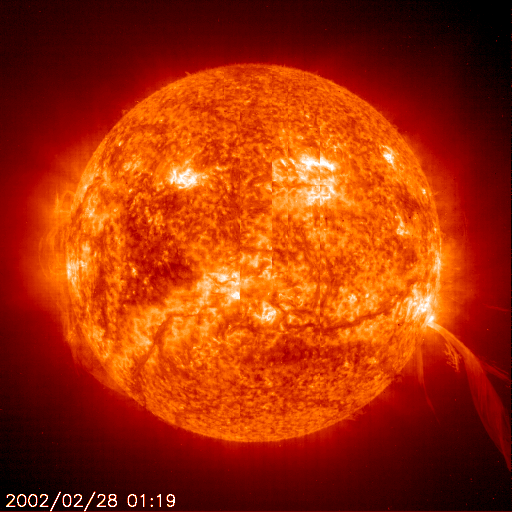
Radar reveals big crater on MercuryIt has a diameter of 85 km and is very young: S&T. Terra views Meteor Crater (3D view): PhotoJournal. Big Canadian meteorite: Calgary Press Release.The full Moon of Feb. 27 was the closest of the year: Science@NASA, RP. Another impressive solar prominence was seen by SOHO on Feb. 28. A filament lifts off on March 2 (plus the related CME). New aurora pics from Finland. Plus a sunspot with birds ...
|




All other historical issues can be found in the Archive.
The U.S. site of this Cosmic Mirror has been visited
since it was issued (the German site has no counter).
Compiled and written by Daniel Fischer
(send me a mail to [email protected]!), Skyweek
