Most discs are designed to create lift when thrown with the flat side up.
Without spin, a disc will wobble and fall. Without velocity, the disc will not go anywhere. Using these two guidelines, any number of throws are possible. Regardless of delivery, however, if the disc makes it from the thrower to the receiver, then the throw was successful.
This is a guide to learning how to throw a disc successfully, and become a better ultimate player:
- Useful Tips/Learning to Throw:
Being able to throw well is an extremely important part of the Sport. You must be able to throw clean, catchable throws that make it successfully to the receiver. But at the same time you must overcome wind, your defender, distance and other factors.
Concentrate first on learning to throw a good, level pass. It's more important to be able to throw level than to throw hard or far, and it's easier to catch. Once you've mastered a level throw, experiment with adding 'bend' or curve to your throws.
Spin is critical to keep a disc flying. Speed is a secondary concern. A disc thrown level with a lot of spin and a little bit of power will fly very far, although very slowly. Many beginners make the mistake of overpowering their throws in order to make them go farther - this often results in poorly aimed throws or throws which angle quickly into the ground.
As you throw the disc, step sideways or forward with the foot on the same side as your throwing arm. This means that one foot stays planted as your piviot foot, the other moves freely.
If your RIGHT-HANDED your LEFT FOOT should stay planted as your piviot foot. If left-handed then your right foot will be the piviot foot. It is important that your piviot foot doesnt move all you are travelling!
Lastly, ultimate can be successfully played with ONLY three main throws. They are the Backhand, Forehand (Sidearm) and a Hammer. Therefore these throws should be mastered first before the other fancy "trick" throws.
Oh...and don't give up! Learning to throw takes time!
- Backhands
This is probably the most commonly learned throw, and also one of the most powerful. There is a long windup for the throw, both in terms of path length and time.
Grip: Fingers are curled under the disc's rim, and the thumb is placed on top of the Frisbee to hold it in place. The index finger may either be on the edge of the Frisbee (to help aim), or four fingers may be tucked underneath the rim (to aid power).

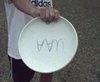
Throw: The thrower draws their arm across their body to build velocity for the Frisbee. During this movement, the arm straightens out. As the arm becomes straight, the wrist is flicked, to impart spin. After release, the arm usually points towards the target.
- Curved Backhands
A simple backhand can be thrown on a slight angle, giving the throw curve. This can be used to get around objects (eg, defenders!). A huck (long throw) can be thrown with a light curve allowing time for the receiver to 'read' the disc and get in a position to catch.
Remember: A Disc thrown right-side up will accelerate in the direction of the low end of the Disc.
- Air Bouncers (Backhand)
By putting downward pressure on the trailing edge (back side) of the disc as it is released, this throw will sail a short distance at a low height, then "bounce" up into the air. This is done by pressing down with the thumb, which is on the trailing edge at the point of release. Skilled throwers can execute this throw such that the disc travels under a parked car.
An Air bounce is a valuable throw to have in indoors, but against the wind in outdoors rendors it useless. It can take a while to learn how to execute the throw perfectly.
- High Release Backhands
Used to get around an object (or a person), the High Release is thrown above the thrower's shoulder, mostly powered by the flick of the wrist instead of the arm and shoulder.
A lot of spin may be needed if thrown outdoors.
- Backhand Push Passes ("Biscuit"):
This little-known version of the backhand is similar to a Push Pass (see Forehand variations, below) in that little spin is imparted onto the throw, making it hard to execute and of limited utility. The disc is gripped against the palm, with four fingers on top of the disc and the thumb underneath for stability. Using a backhand throwing motion, spin is imparted by snapping the wrist forwards as the disc is released.
- Forehands (Sidearms):
This throw is the bread-and-butter throw of Ultimate players. Focused in the wrist, this throw takes little time to execute.
Grip: The index finger is extended and laid against the bottom of the disc to provide stability for the throw, the middle finger is pressed against the rim of the disc, and the edge of the disc is tucked under the thumb. The Frisbee is cocked back at the wrist, and the arm is extended out from the body.
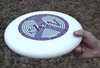
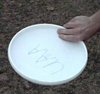
Throw: A flick of the wrist imparts spin off the middle finger as well as some forward velocity. Some snap of the lower arm can provide additional power. After release, your index finger should point to your target.
Note that 90% of this throw is below the elbow, and most of that at the wrist. A common mistake is to attempt to use the upper arm and shoulder to add power to the throw. Usually, this results in little or no spin being imparted on the disc, which causes it to fall quickly. It's also common for the flick of the wrist to pull the outside edge of the Frisbee up; to compensate, hold the disc somewhat loosely, so that the outer edge hangs down slightly. Experiment with the cocking and flicking motions to determine how best to produce a level throw.
As you learn how to throw a flick, it may help to tuck your elbow in towards your body; this is a bad habit to get into if you play Ultimate, but may assist with preventing you from using too much shoulder and arm. As you improve, work on extending your arm out away from your body. Advanced throwers will note that the arm and wrist action is much like a bullwhip cracking sideways; the addition of whip-like motion in your upper arm, shoulder, and even upper body (by rotating the hips) can impart more power onto your throw, but is difficult to control.
- Push Passes:
The forehand is an extraordinarily versatile throw, and can be adapted to many different situations. The Push pass (or "the Pansy Push Pass") is a variation of the forehand and is often used in Indoors.
It is thrown with a grip similar to a backhand (index finger on the outer rim of the disc, thumb on top, fingers curled underneath) but is released on the forehand side. The wrist "pushes" the disc forward while spin is imparted "backwards" by rolling the disc off the index finger. A final flick of the index finger finishes the release. Frequently, very little spin is actually imparted, which makes this throw tend to flutter and fall more often than not. However, with use one can learn to add much more spin to this throw and it may become useful over short distances.
Often during social indoor games, we have what we call a PPP ("Push Pass Point"), where all throws must be a push pass, until a point is scored.
- High Release Forehands:
Used to get around an object (or a person), the High Release is thrown above the thrower's shoulder, and is completely powered by the flick of the wrist. In order to be thrown flat so that it will travel without curving, the index finger is pulled in to the edge of the disc with the middle finger and the outer edge of the disc is rotated down, so that the disc lies at a slight angle to the line of the knuckles.
- Thumbers:
The Thumber is not popular in ultimate Frisbee circles due to its predictable flight path and proximity of release to the thrower's body. Its very UNPOPULAR with me :-).
Its primary advantage (and ONLY, if you ask me!!) is that it can be a very hard, very accurate throw, and therefore useful for those uncomfortable with the staple throws of the game, the forehand and backhand.
Grip: The thumber derives its name from the grip: it is thrown on the forehand side with the thumb under the rim and the rest of the hand against the outside of the disc. The arm should also be tucked against the side, and the elbow bent. Keeping the disc parallel to the ground, (any tilt and it will fall) cock your wrist back so your thumb is pointing as far back as you can.
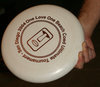
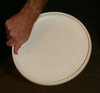
Throw: To release, simply flick your wrist forward. Spin is imparted off the flat part of the thumb; power can be gained by rotating the body at the hips. A flat release is critical to a successful thumber. After release, the flat part of the thumb should point towards the target.
- Upside-down Throws:
A Frisbee thrown upside-down has a very different flight path than one thrown right-side up. Lift is applied towards the rounded side of the disc; if the disc is completely upside-down, the lift is now propelling the disc straight into the ground. Thus, these throws typically have a stronger arc to them, tend to bank or roll as they fly, and are much harder to catch. Where a right-side up throw tends to spend a considerable portion of its flight path at a catchable height, an upside-down throw tends to land abruptly at a certain point.
Upside-down throws can be difficult and/or painful to catch!
- Hammers:
The Hammer is one of the more difficult throws to master, despite being gripped just like a normal forehand throw, and the throwing motion being relatively natural. Hammers are difficult to aim well due to their high, arcing flight path, and their tendency to catch any amount of wind.
Hammers dont always fly how you want them to, and should be practised before being used in a game. As a rule, remember: Don't throw a throw that your *really* bad at! Also - often it seems like the only throw in a situation is a hammer, but often a curved backhand or sidearm can be used instead.
Grip: Identical to the forehand, when throwing a hammer one grips the disc under the thumb, with the index finger extended against the underside of the disc for stability and the middle finger pressed against the inside rim to impart spin.
Throw:Swing the throwing arm over the head, turning the disc upside-down (somewhere between 90 and 180 Deg.) and throwing it up at an angle. The wrist flicks to impart spin off the middle finger, just like when throwing a forehand. Throw like your serving in tennis.
A hammer, when thrown properly (and in no wind) by a right-handed thrower, will arc up and to the left as it moves away from the thrower. As it flies, the disc will roll over until it is completely upside-down (180 Deg.), falling down and to the right again. Ideally, it should reach its target at between 135 and 180 Deg. to make catching it as easy as possible.
However, hammers are notoriously difficult to throw "properly". Common failure modes include:
The Blade, in which the disc does not turn over at all, but instead keeps its original orientation towards the ground. Blades tend to fall very sharply and quickly and are difficult (and often painful) to catch.
NB: A Blade can also be thrown intentionally in indoors, usually into the zone for an easy, but 'cheap' point.
The Double Helix, when the disc over-rotates past 180 DRtG. These throws tend to float as they fall, drifting right and then left again (for a right-handed thrower) before landing flat.
This Hammer is difficult to block in Ultimate but tends to arrive very fast and at an unpredictable angle. They are often a last ditch effort in a game of Ultimate when the thrower has reached a stall count of 8 or 9 (5 or 6 in indoors) and needs to get rid of the disc quickly.
- Scoobers:
Another upside-down variant of the forehand, The scoober looks like a hammer thrown flat to the backhand side. It has an unpredictable flight path due to the almost inevitable double helix that results from the release, is difficult to catch in windy conditions, and is frequently mocked by unexperienced Ultimate players. However, it is quite useful for short (5 - 10m) throws.
Grip: Identical to a forehand or hammer.
Throw: Stepping towards the backhand side, hold the disc upside down and bring the throwing arm across the body. Leading with the elbow, swing the throwing arm forward and flick the disc off the middle finger (as in a forehand), releasing the disc somewhere between 160 and 180 Deg. The steeper the angle of release, the more similar the path of the scoober will be to that of a hammer, and thus may the double helix pattern be avoided.
- Gripper:
The Gripper (not to be confused with the Thumber) is an advanced throw that is rarely used in competitive play, compared to the Hammer or standard forehand. It has a flight path that is the mirror-image of the Hammer (arcing high and to the right for a right-handed thrower). It can be useful when the disc needs to drop quickly and fly with an opposite helix to the Hammer.
Grip: The thumber derives its name from the grip: the disc is held upside-down with the thumb tightly against the rim and the rest of the hand against the outside of the disc.
Throw: Cock the arm backwards, then bring it forward and snap the wrist to impart spin. The disc should be approximately 135 DRtG at the point of release.
- Other Throws:
There are MANY throws that can be used in ultimate. Many are "trick throws" that you pick up as you watch others play.
More throws to come soon....but remember: PRACTICE MAKES PERFECT!